A copper ball of radius $'r'$ travels with a uniform speed $'v'$ in a viscous fluid. If the ball is changed with another ball of radius $'2r'$ , then new uniform speed will be
Easy


Download our appand get started for free
Experience the future of education. Simply download our apps or reach out to us for more information. Let's shape the future of learning together!No signup needed.*
Similar Questions
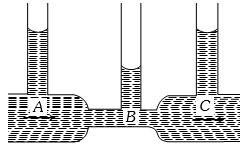
- 1In the following fig. is shown the flow of liquid through a horizontal pipe. Three tubes $A, B$ and $ C$ are connected to the pipe. The radii of the tubes $A, B $ and $C$ at the junction are respectively $ 2 cm, 1 cm$ and $2 cm.$ It can be said that theView Solution
- 2A piston of cross-section area $100\, cm^2$ is used in a hydraulic press to exert a force of $107\, dynes$ on the water. The cross-sectional area of the other piston which supports an object having a mass $2000 \,kg$. isView Solution
- 3The pressure acting on a submarine is $3 \times 10^{5}\;Pa$ at a certain depth. If the depth is doubled, the percentage increase in the pressure acting on the submarine would be: (Assume that atmospheric pressure is $1 \times 10^{5} \;Pa$ density of water is $10^{3}\, kg \,m ^{-3}, g =10 \,ms ^{-2}$ )View Solution
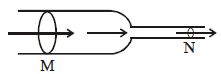
- 4Horizontal tube of non-uniform cross-section has radii of $0.1\,m$ and $0.05\,m$ respectively at $M$ and $N.$ For a stream-line flow of liquid the rate of liquid flow isView Solution
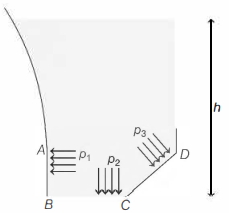
- 5A tall tank filled with water has an irregular shape as shown. The wall $C D$ makes an angle of $45^{\circ}$ with the horizontal, the wall $A B$ is normal to the base $B C$. The lengths $A B$ and $C D$ are much smaller than the height $h$ of water (figure not to scale). Let $p_1, p_2$ and $p_3$ be the pressures exerted by the water on the wall $A B$, base $B C$ and the wall $C D$ respectively. Density of water is $\rho$ and $g$ is acceleration due to gravity. Then, approximatelyView Solution
- 6A liquid is kept in a cylindrical vessel which rotated along its axis. The liquid rises at the sides. If the radius of the vessel is $0.05\,m$ and the speed of rotation is $2\,rev/s$ , The difference in the height of the liquid at the centre of the vessel and its sides will be .............. $\mathrm{cm}$ $(\pi ^2 = 10)$View Solution
- 7View SolutionA large ship can float but a steel needle sinks because of
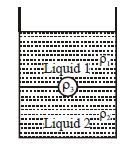
- 8Diagram shows a jar filled with two non mixing liquids $1$ and $2$ having densities ${\rho _1}$ and ${\rho _2}$ respectively. A solid ball, made of a material of density ${\rho _3}$ , is dropped in the jar. It comes to equilibrium in the position shown in the figure. Which of the following is true for ${\rho _1}$ , ${\rho _2}$ and ${\rho _3}$ ?View Solution
- 9View SolutionThe pressure at the bottom of a tank containing a liquid does not depend on
- 10A wide vessel with a small hole at the bottom is filled with two liquids. The density and heightof one liquid are $\rho_1$ and $h_1$ and that of the otherare $\rho_2$ and $h_2 \ (\rho_1 >\rho_2)$. The velocity of liquid coming out of the hole is :View Solution