MCQ
Assertion: To convert a galvanometer into an ammeter a small resistance is connected in parallel with it.

Reason: The small resistance increases the combined resistance of the combination.

  • A
    If both Assertion and Reason are correct and Reason is the correct explanation of Assertion.
  • B
    If both Assertion and Reason are correct, but Reason is not the correct explanation of Assertion.
  • C
    If Assertion is correct but Reason is incorrect.
  • D
    If both the Assertion and Reason are incorrect.
Answer

An ammeter should have a low resistance which we get when we connect low resistance in parallel with galvanometer.

Need a full question paper?

Generate a complete, print-ready paper with questions like this in minutes — across 16+ boards, with answer keys.

Start Generating Free

Similar questions

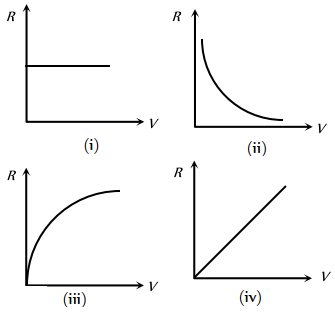
The graph which represents the relation between the total resistance $R$ of a multi range moving coil voltmeter and its full scale deflection $V$ is

Image

A car, starting from rest, accelerates at the rate $f$ through a distance $S$, then continues at constant speed for time $t$ and then decelerates at the rate $\frac{f}{2}$ to come to rest. If the total distance traversed is $15 S$, then
In a surface tension experiment with a capillary tube water rises upto $0.1 \mathrm{~m}$. If the same experiment is repeated on an artificial satellite, which is revolving around the earth, water will rise in the capillary tube upto a height of
Magnetic lines of force
A drop of oil is placed on the surface of water. Which of the following statement is correct
A particle moves with constant speed $v$ along a circular path of radius $r$ and completes the circle in time $T$. The acceleration of the particle is
A small disc is on the top of a hemisphere of radius $R$. What is the smallest horizontal velocity $v$ that should be given to the disc for it to leave the hemisphere and not slide down it ? $[$There is no friction$]$
Two rods of different materials having coefficients of linear expansion $\alpha_1, \alpha_2$ and Young's moduli $Y_1$ and $Y_2$ respectively are fixed between two rigid massive walls. The rods are heated such that they undergo the same increase in temperature. There is no bending of rods. If $\alpha_1: \alpha_2=2: 3$, the thermal stresses developed in the two rods are equally provided $Y_1: Y_2$ is equal to
If orbital velocity of planet is given by $v=G^a M^b R^c$, then
Which of the following statements is correct in respect of a geostationary satellite