MCQ
Assertion: To convert a galvanometer into an ammeter a small resistance is connected in parallel with it.

Reason: The small resistance increases the combined resistance of the combination.

  • A
    If both Assertion and Reason are correct and Reason is the correct explanation of Assertion.
  • B
    If both Assertion and Reason are correct, but Reason is not the correct explanation of Assertion.
  • If Assertion is correct but Reason is incorrect.
  • D
    If both the Assertion and Reason are incorrect.
Answer

Correct option: C.
If Assertion is correct but Reason is incorrect.
c
An ammeter should have a low resistance which we get when we connect low resistance in parallel with galvanometer.

Need a full question paper?

Generate a complete, print-ready paper with questions like this in minutes — across 16+ boards, with answer keys.

Start Generating Free

Similar questions

Two small spheres each having the charge +Q are suspended by insulating threads of length L from a hook. This arrangement is taken in space where there is no gravitational effect, then the angle between the two suspensions and the tension in each will be
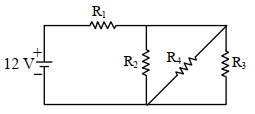
In the given figure $R_1=10 \Omega, R_2=8 \Omega, R_3=4 \Omega$ and $R_4=8 \Omega$. Battery is ideal with emf $12 \mathrm{~V}$. Equivalent resistant of the circuit and current supplied by battery are respectively.
A disk of radius $a / 4$ having a uniformly distributed charge $6 \mathrm{C}$ is placed in the $x-y$ plane with its centre at $(-a / 2,0,0)$. A rod of length $a$ carrying a uniformly distributed charge $8 \mathrm{C}$ is placed on the $x$-axis from $x=a / 4$ to $x=5 a / 4$. Two point charges $-7 \mathrm{C}$ and $3 \mathrm{C}$ are placed at $(a / 4,-a / 4,0)$ and $(-3 a / 4,3 a / 4,0)$, respectively. Consider a cubical surface formed by six surfaces $x= \pm a / 2, y= \pm a / 2$, $z= \pm a / 2$. The electric flux through this cubical surface is
Which of the following effects could not be explained by Maxwell's electromagnetic wave theory?
In extrinsic P and N-type, semiconductor materials, the ratio of the impurity atoms to the pure semiconductor atoms is about
$A$ ray of light is incident at an angle of $75^o$ into a medium having refractive index $\mu$ . The reflected and the refracted rays are found to suffer equal deviations in opposite direction $\mu $ equals
Three concentric spherical metallic shells $X , Y$ and $Z$ of radius $a , b$ and c respectively $[ a < b < c ]$ have surface charge densities $\sigma,-\sigma$ and $\sigma$, respectively. The shells $X$ and $Z$ are at same potential. If the radii of $X$ and $Y$ are $2\,cm$ and $3\,cm$, respectively.The radius of shell $Z$ is $......cm$.
1 tesla is equal to:
An electric dipole is placed along the $x - $ axis at the origin $O$. A point $P$ is at a distance of $20\,cm$ from this origin such that $OP$ makes an angle $\frac{\pi }{3}$ with the $x-$axis. If the electric field at $P$ makes an angle $\theta $ with the $x$-axis, the value of $\theta $ would be
Two moving coil meters $M_1$ and $M_2$ having the following particulars :-
$R_1 = 10\,\Omega , N_1 = 30, A_1 = 3.6\times10^{-3}\, m^2, B_1 = 0.25\, T$
$R_2 = 14\,\Omega , N_2 = 42, A_2 = 1.8\times10^{-3}\, m^2, B_2 = 0.50\, T$
(The spring constants are identical for the two meters). Determine the ratio of voltage sensitivity of $M_2$ and $M_1$