MCQ
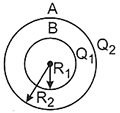
Assertion: Two concentric charged inner and outer shell are given. The potential difference between the shells depends on charge of inner shell.
Reason: Potential due to charge of outer shell remains same at every point inside the sphere.
  • Assertion and reason both are correct statements and reason is correct explanation for assertion.
  • B
    Assertion and reason both are correct statements but reason is not correct explanation for assertion.
  • C
    Assertion is correct statement but reason is wrong statement.
  • D
    Assertion is wrong statement but reason is correct statement.
Answer

Correct option: A.
Assertion and reason both are correct statements and reason is correct explanation for assertion.
Image
$ V _{ A }=\frac{1}{4 \pi \varepsilon_0} \frac{Q_1+Q_2}{R_2}$
$V_{ B }=\frac{1}{4 \pi \varepsilon_0}\left(\frac{Q_1}{R_1}+\frac{Q_2}{R_2}\right)$
$V _{ B }- V _{ A }=\frac{1}{4 \pi \varepsilon_0} Q_1\left(\frac{1}{R_1}-\frac{1}{R_2}\right)$

Need a full question paper?

Generate a complete, print-ready paper with questions like this in minutes — across 16+ boards, with answer keys.

Start Generating Free

Similar questions

Assertion : For a charged particle moving from point P to point Q, the net work done by an electrostatic field on the particle is independent of the path connecting point P to point Q.
Reason : The net work done by a conservative force on an object moving along a closed loop is zero.
Two statements are given-one labelled Assertion (A) and the other labelled Reason (R). Select the correct answer to these questions from the codes (a), (b), (c) and (d) as given below.
  1. Both A and R are true and R is the correct explanation of A.
  2. Both A and R are true but R is NOT the correct explanation of A.
  3. A is true but R is false.
  4. A is false and R is also false.
Assertion (A): When a charged particle moves perpendicular to magnetic field then its kinetic energy and momentum gets affected.
Reason (R): Force changes velocity of charged particle.
For question two statements are given-one labelled Assertion (A) and the other labelled Reason (R). Select the correct answer to these questions front the codes (a), (b), (c) and (d) as given below.
  1. Both A and R are true and R is the correct explanation of A.
  2. Both A and R are true but R is NOT the correct explanation of A.
  3. A is true but R is false.
  4. A is false and R is also false.
Assertion (A): Photosensitivity of a metal is high if its work function is small.
Reason (R): Work function $=\text{h}\upsilon_0,$ where $\upsilon_0$ is the threshold frequency.
For question two statements are given-one labelled Assertion $(A)$ and the other labelled Reason $(R).$ Select the correct answer to these questions from the codes $(a), (b), (c)$ and $(d)$ as given below.
Assertion $(A):$ The positively charged nucleus of an atom has a radius of almost $10^{-15}m.$
Reason $(R):$ In $\alpha$-particle scattering experiment, the distance of closest approach for $\alpha-$particles is $10^{-15}m.$
Two statements are given-one labelled Assertion (A) and the other labelled Reason (R). Select the correct answer to these questions from the codes (a), (b), (c) and (d) as given below.
  1. Both A and R are true and R is the correct explanation of A.
  2. Both A and R are true but R is not the correct explanation of A.
  3. A is true but R is false.
  4. A is false and R is also false.
Assertion: X-rays in vacuum travel faster than light waves in vacuum
Reason: The energy of X-rays photon is less than that of light photon.
Assertion (A): The photoelectrons produced by a monochromatic light beam incident on a metal surface, have a spread in their kinetic energies.
Reason (R): The work function of the metal varies as a function of depth from the surface
Two statements are given-one labelled Assertion (A) and the other labelled Reason (R). Select the correct answer to these questions from the codes (a), (b), (c) and (d) as given below.
  1. Both A and R are true and R is the correct explanation of A.
  2. Both A and R are true but R is not the correct explanation of A.
  3. A is true but R is false.
  4. A is false and R is also false.
Assertion: Electromagnetic waves exert pressure called radiation pressure.
Reason: Electromagnetic waves carries energy.
For question two statements are given-one labelled Assertion (A) and the other labelled Reason (R). Select the correct answer to these questions from the codes (a), (b), (c) and (d) as given below.
  1. Both A and R are true and R is the correct explanation of A.
  2. Both A and R are true but R is NOT the correct explanation of A.
  3. A is true but R is false.
  4. A is false and R is also false.
Assertion (A): For best contrast between maxima and minima in the interference pattern of Young's double slit experiment, the intensity of light emerging out of the two slits should be equal.
Reason (R): The intensity of interference pattern is proportional to square of amplitude.
Two statements are given-one labelled Assertion $(A)$ and the other labelled Reason $(R).$ Select the correct answer to these questions from the codes $(a), (b), (c)$ and $(d)$ as given below.
Assertion: If objective and eye lenses of a microscope are interchanged then it can work as telescope.
Reason: The objective lens of telescope has small focal length.
Two statements are given-one labelled Assertion (A) and the other labelled Reason (R). Select the correct answer to these questions from the codes (a), (b), (c) and (d) as given below.
  1. Both A and R are true and R is the correct explanation of A.
  2. Both A and R are true but R is NOT the correct explanation of A.
  3. A is true but R is false.
  4. A is false and R is also false.
Assertion (A): Voltmeter is connected in parallel with the circuit.
Reason (R): Resistance of a voltmeter is very large.