Question

Assertion  :   When the speed of an electron increases its specific charge decreases.

Reason      : Specific charge is the ratio of the charge to mass.

(a) If both assertion and reason are true and the reason is the correct explanation of the assertion.

(b) If both assertion and reason are true but reason is not the correct explanation of the assertion.

(c) If assertion is true but reason is false.

(d) If the assertion and reason both are false.

Answer

(b) If both assertion and reason are true but reason is not the correct explanation of the assertion.

Need a full question paper?

Generate a complete, print-ready paper with questions like this in minutes — across 16+ boards, with answer keys.

Start Generating Free

Similar questions

A point source of light is placed in front of a plane mirror:

An electromognetic wave travels in vacuum along z direction: $\text{E}=\big(\text{E}_1\hat{\text{i}}+\text{E}_2\hat{\text{j}}\big)\cos(\text{kz}-\omega\text{t})$. Choose the correct options from the following:
The work function of a metal depends on:

The wiring of a house has resistance 6 A 100 W bulb is glowing. If a geyser of 1000 W is switched on, the change in potential drop across the bulb is nearly

(a) Nil

(b) 23 V

(c) 32 V   

(d) 12 V

The unit of magnetic moment is

(a) Wb/m

(b)  

(c) A.m

(d)  

The thinnest bubble film in air that can possibly strongly reflect red light because of constructive interference makes up a certain bubble. How could we create the thinnest bubble film that will strongly reflect purple light?

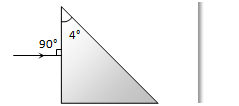
A prism having an apex angle 4o and refraction index 1.5 is located in front of a vertical plane mirror as shown in figure. Through what total angle is the ray deviated after reflection from the mirror

(a) 176o

(b) 4o

(c) 178o

(d) 2o  

The fusion of light elements take place at about the temperatures of about:

Two parallel plates separated by a distance of 5mm are kept at a potential difference of 50 V. A particle  of mass   and charge   enters in it with a velocity .  The acceleration of the particle will be

(a)  

(b)  

(c)

(d) 2 

The radius of the first (lowest) orbit of the hydrogen atom is  The radius of the second (next higher) orbit will be

(a) 4 

(b) 6 

(c) 8 

(d) 10