Questions · Page 1 of 10

M.C.Q (1 Marks)

🎯

Test yourself on this topic

50 questions · timed · auto-graded

Question 11 Mark

A proton, a deutron and an a-particle having the same momentum, enters a region of uniform electric field between the parallel plates of a capacitor. The electric field is perpendicular to the initial path of the particles. Then the ratio of deflections suffered by them is
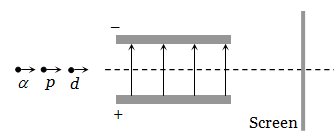
(a) 1 : 2 : 8

(b) 1 : 2 : 4

(c) 1 : 1 : 2

(d) None of these

Answer

(a) 1 : 2 : 8

View full question & answer
Question 21 Mark

The work function of a metal is 1.6  J. When the metal surface is illuminated by the light of wavelength  6400 Å, then the maximum kinetic energy of emitted photo-electrons will be (Planck's constant h = 6.4 )

(a) 14  

(b) 2.8  

(c) 1.4  

(d) 1.4  

Answer

(c) 1.4  

View full question & answer
Question 31 Mark

The ratio of de-Broglie wavelength of a a-particle to that of a proton being subjected to the same magnetic field so that the radii of their path are equal to each other assuming the field induction vector   is perpendicular to the velocity vectors of the a-particle and the proton is

(a) 1 

(b)  

(c)   

(d) 2

Answer

(c)   

View full question & answer
Question 41 Mark

The energy of a photon of wavelength  is given by

(a) h      

(b) ch 

(c)   

(d)  

Answer

(d)  

View full question & answer
Question 51 Mark

In a dark room of photography, generally red light is used. The reason is

(a) Most of the photographic films are not sensitive to red light

(b) The frequency for red light is low and hence the energy hv of photons is less

(c) (a) and (b) both

(d) None of the above

Answer

(c) (a) and (b) both

View full question & answer
Question 61 Mark

The electrons are emitted in the photoelectric effect from a metal surface         

(a) Only if the frequency of the incident radiation is above a certain threshold value

(b) Only if the temperature of the surface is high

(c) At a rate that is independent of the nature of the metal

(d) With a maximum velocity proportional to the frequency of the incident radiation

Answer

(a) Only if the frequency of the incident radiation is above a certain threshold value

View full question & answer
Question 71 Mark

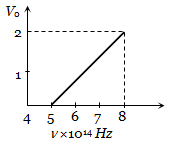
The stopping potential (  versus frequency (n) plot of a substance is shown in figure the threshold wave length is

(a) 5

(b) 6000Å

(c) 5000 Å

(d) Can not be estimated from given data

Answer

(b) 6000Å

View full question & answer
Question 81 Mark

Assertion :   The threshold frequency of photoelectric effect supports the particle nature of sunlight.

Reason      : If frequency of incident light is less than the threshold frequency, electrons are not emitted from metal surface.

(a) If both assertion and reason are true and the reason is the correct explanation of the assertion.

(b) If both assertion and reason are true but reason is not the correct explanation of the assertion.

(c) If assertion is true but reason is false.

(d) If the assertion and reason both are false.

Answer

(b) If both assertion and reason are true but reason is not the correct explanation of the assertion.

View full question & answer
Question 91 Mark

Assertion   :   Photoelectric effect demonstrates the wave nature of light.

Reason       : The number of photoelectrons is proportional to the frequency of light.

(a) If both assertion and reason are true and the reason is the correct explanation of the assertion.

(b) If both assertion and reason are true but reason is not the correct explanation of the assertion.

(c) If assertion is true but reason is false.

(d) If the assertion and reason both are false.

Answer

(d) If the assertion and reason both are false.

View full question & answer
Question 101 Mark

The wavelength of de-Broglie wave is 2mm, then its momentum is (h = 6.63 × 10⁻³⁴ J-s)

(a) 3.315 × 10⁻²⁸ kg-m/s

(b) 1.66 × 10⁻²⁸ kg-m/s

(c) 4.97 × 10⁻²⁸ kg-m/s

(d) 9.9 × 10⁻²⁸ kg-m/s

Answer

(a) 3.315 × 10⁻²⁸ kg-m/s

View full question & answer
Question 111 Mark

Which of the following statements is correct

(a) The current in a photocell increases with increasing frequency of light

(b) The photocurrent is proportional to applied voltage

(c) The photocurrent increases with increasing intensity of  light

(d) The stopping potential increases with increasing intensity of incident light

Answer

(c) The photocurrent increases with increasing intensity of  light

View full question & answer
Question 121 Mark

When a point source of monochromatic light is at a distance of 0.2 m from a photoelectric cell, the cut-off voltage and the saturation current are 0.6 volt and 18 mA respectively. If the same source is placed 0.6 m away from the photoelectric cell, then

(a) The stopping potential will be 0.2 V

(b) The stopping potential will be 0.6 V

(c) The saturation current will be 6 mA

(d) The saturation current will be 18 mA

Answer

(b) The stopping potential will be 0.6 V

View full question & answer
Question 131 Mark

If a photon has velocity c and frequency n, then which of following represents its wavelength

(a)        

(b)

(c)

(d) hv

Answer

(a)        

View full question & answer
Question 141 Mark

Stopping potential for photoelectrons

(a) Does not depend on the frequency of the incident light

(b) Does not depend upon the nature of the cathode material

(c) Depends on both the frequency of the incident light and nature of the cathode material

(d) Depends upon the intensity of the incident light

Answer

(c) Depends on both the frequency of the incident light and nature of the cathode material

View full question & answer
Question 151 Mark

The minimum wavelength of the X-rays produced by electrons accelerated through a potential difference of V volts is directly proportional to

(a)  

(b)  

(c) 1/ 

(d) 1/V

Answer

(d) 1/V

View full question & answer
Question 161 Mark

An electron beam in an X-ray tube is accelerated through a potential difference of 50000 volts. These are then made to fall on a tungsten target. The shortest wavelength of the X-ray emitted by the tube is

(a) 2.5 Å 

(b) 0.25 nm

(c) 0.25 cm

(d) 0.025 nm

Answer

(d) 0.025 nm

View full question & answer
Question 171 Mark

The largest distance between the interatomic planes of a crystal is 10-7cm. The upper limit for the wavelength of X-rays which can be usefully studied with this crystal is

(a) 1 Å

(b) 2 Å

(c) 10 Å

(d) 20 Å

Answer

(d) 20 Å

View full question & answer
Question 181 Mark

The energy of a photon of characteristic X-rays from  a Coolidge tube comes from

(a) The kinetic energy of the striking electron

(b) The kinetic energy of the free electrons of the target

(c) The kinetic energy of the ions of the target

(d) An electronic transition of the target atom

Answer

(d) An electronic transition of the target atom

View full question & answer
Question 191 Mark

The wavelength of  X-rays produced by an X-ray tube is 0.76 Å. The atomic number of the anode material of the tube is

(a) 20

(b) 60

(c) 40       

(d) 80

Answer

(c) 40       

View full question & answer
Question 201 Mark

In an X-rays tube, the intensity of the emitted X-rays beam is increased by

(a) Increasing the filament current

(b) Decreasing the filament current

(c) Increasing the target potential

(d) Decreasing the target potential

Answer

(a) Increasing the filament current

View full question & answer
Question 211 Mark

The structure of solid crystals is investigated by using

(a) Cosmic rays

(b) X-rays

(c) Infrared radiations

(d) γ -  rays

Answer

(b) X-rays

View full question & answer
Question 221 Mark

X-rays region lies between

(a) Short radiowave and visible region

(b) Visible and ultraviolet region

(c) Gamma rays and ultraviolet region

(d) Short radiowave and long radiowave

Answer

(c) Gamma rays and ultraviolet region

View full question & answer
Question 231 Mark

X-rays are produced due to

(a) Break up of molecules          

(b) Changing in atomic energy level

(c) Changing in nuclear energy level

(d) Radioactive disintegration

Answer

(b) Changing in atomic energy level

View full question & answer
Question 241 Mark

X-rays of which of the following wavelengths are hardest

(a) 4 Å

(b) 1 Å

(c) 0.1 Å  

(d) 2 Å

Answer

(c) 0.1 Å  

View full question & answer
Question 251 Mark

X-rays are known to be electromagnetic radiations. Therefore the X-ray photon has

(a) Electric charge

(b) Magnetic moment

(c) Both electric charge and magnetic moment

(d) Neither electric charge nor magnetic moment

Answer

(d) Neither electric charge nor magnetic moment

View full question & answer
Question 261 Mark

Which of the following is accompanied by the characteristic X-ray emission         

(a) α -  particle emission

(b) Electron emission

(c) Positron emission

(d) K–electron capture

Answer

(d) K–electron capture

View full question & answer
Question 271 Mark

 characteristic X-ray refers to the transition

(a) n = 2to n = 1

(b) n = 3 to n = 2

(c) n = 3  to n = 1

(d) n = 4 to n = 2

Answer

(a) n = 2to n = 1

View full question & answer
Question 281 Mark

The continuous X-rays spectrum produced by an X-ray machine at constant voltage has

(a) A maximum wavelength

(b) A minimum wavelength

(c) A single wavelength

(d) A minimum frequency

Answer

(b) A minimum wavelength

View full question & answer
Question 291 Mark

The X-ray beam coming from an X-ray tube will be

(a) Monochromatic

(b) Having all wavelengths smaller than a certain maximum wavelength

(c) Having all wavelengths larger than a certain minimum wavelength

(d) Having all wavelengths lying between a minimum and a maximum wavelength

Answer

(c) Having all wavelengths larger than a certain minimum wavelength

View full question & answer
Question 301 Mark

X-rays are not used for radar purpose because

(a) They are not reflected by the target

(b) They are not electromagnetic waves

(c) They are completely absorbed by the air

(d) They sometimes damage the target

Answer

(a) They are not reflected by the target

View full question & answer
Question 311 Mark

When a beam of accelerated electrons hits a target, a continuous X-ray spectrum is emitted from the target. Which of the following wavelength is absent in the X-ray spectrum, if the X-ray tube is operating at 40,000 volts

(a) 0.25 Å

(b) 0.5 Å

(c) 1.5 Å  

(d) 1.0 Å

Answer

(a) 0.25 Å

View full question & answer
Question 321 Mark

X-rays are in nature similar to

(a) Beta rays

(b) Gamma rays

(c) de-Broglie waves

(d) Cathode rays

Answer

(b) Gamma rays

View full question & answer
Question 331 Mark

Compton effect is associated with

(a) α -  rays

(b) β -  rays

(c) X-rays

(d) Positive rays

Answer

(c) X-rays

View full question & answer
Question 341 Mark

Molybdenum is used as a target element for production of X-rays because it is

(a) A heavy element and can easily absorb high velocity electrons

(b) A heavy element with a high melting point

(c) An element having high thermal conductivity

(d) Heavy and can easily deflect electrons

Answer

(b) A heavy element with a high melting point

View full question & answer
Question 351 Mark

The voltage applied across an X-rays tube is nearly

(a) 10 V

(b) 100 V

(c) 10000 V

(d) 106 V

Answer

(c) 10000 V

View full question & answer
Question 361 Mark

X-rays are

(a) Stream of electrons

(b) Stream of positively charged particles

(c) Electromagnetic radiations of high frequency

(d) Stream of uncharged particles

Answer

(c) Electromagnetic radiations of high frequency

View full question & answer
Question 371 Mark

X-rays were discovered by

(a) Becquerel

(b) Roentgen

(c) Marie Curie

(d) Von Laue

Answer

(b) Roentgen

View full question & answer
Question 381 Mark

The minimum wavelength of X-rays produced by electrons accelerated by a potential difference of volts is equal to

(a)  

(b)

(c)        

(d)

Answer
(c)        
View full question & answer
Question 391 Mark

Hydrogen atom does not emit X-rays because

(a) Its energy levels are too close to each other

(b) Its energy levels are too apart

(c) It is too small in size

(d) It has a single electron

Answer

(a) Its energy levels are too close to each other

View full question & answer
Question 401 Mark

In  radio theraphy, X-rays are used to

(a) Detect bone fractures

(b) Treat cancer by controlled exposure

(c) Detect heart diseases

(d) Detect fault in radio receiving circuits

Answer

(b) Treat cancer by controlled exposure

View full question & answer
Question 411 Mark

When the accelerating voltage applied on the electrons increased beyond a critical value

(a) Only the intensity of the various wavelengths is increased

(b) Only the wavelength of characteristic relation is affected

(c) The spectrum of white radiation is unaffected

(d) The intensities of characteristic lines relative to the white spectrum are increased but there is no change in their wavelength

Answer

(d) The intensities of characteristic lines relative to the white spectrum are increased but there is no change in their wavelength

View full question & answer
Question 421 Mark

The wavelength   of the   line of characteristic X-ray spectra varies with atomic number approximately

(a) 

(b)  

(c)  

(d)    

Answer
(c)  
View full question & answer
Question 431 Mark

An X-ray tube is operated at 50 kV. The minimum wavelength produced is

(a) 0.5 Å

(b) 0.75 Å

(c) 0.25 Å  

(d) 1 Å

Answer

(c) 0.25 Å  

View full question & answer
Question 441 Mark

The characteristic X-ray radiation is emitted, when

(a) The electrons are accelerated to a fixed energy

(b) The source of electrons emits a monoenergetic beam

(c) The bombarding electrons knock out electrons from  the inner shell of the target atoms and one of the outer electrons falls into this vacancy

(d) The valence electrons in the target atoms are removed as a result of the collision

Answer

(c) The bombarding electrons knock out electrons from  the inner shell of the target atoms and one of the outer electrons falls into this vacancy

View full question & answer
Question 451 Mark

Einstein got Nobel prize on which of the following works

(a) Mass-energy relation

(b) Special theory of relativity

(c) Photoelectric equation

(d)  (a) and (b) both

Answer

(c) Photoelectric equation

View full question & answer
Question 461 Mark

The mass of the electron varies with

(a) The size of the cathode ray tube

(b) The variation of ‘g’

(c) Velocity

(d) Size of the electron

Answer

(c) Velocity

View full question & answer
Question 471 Mark

X-rays of wavelength 0.1 Å allowed to fall on a metal get scattered. The wavelength of scattered radiation is 0.111 Å. If h = 6.624 × 10⁻³⁴ J-s and m0 = 9 × 10–31 kg, then the direction of the scattered photons will be

(a) cos–1 (0.547)

(b) cos–1 (0.4484)

(c) cos–1 (0.5)

(d) cos–1 (0.3)

Answer

(a) cos–1 (0.547)

View full question & answer
Question 481 Mark

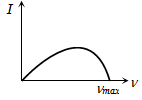
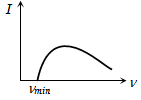
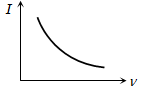
The continuous x-ray spectrum obtained from a Coolidge tube is of the form

(a)

(b)

(b)

(d)

Answer

(a)

View full question & answer
Question 491 Mark

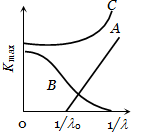
The correct graph between the maximum energy of a photoelectron and the inverse of wavelength of the incident radiation is given by the curve

(a) A

(b) B

(c) C

(d) None of the above

Answer

(a) A

View full question & answer
Question 501 Mark

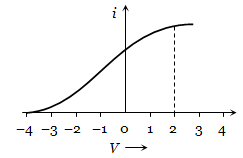
Figure represents the graph of photo current I versus applied voltage (V). The maximum energy of the emitted photoelectrons is

(a) 2eV

(b) 4 eV

(c) 0 eV

(d) 4 J

Answer

(b) 4 eV

View full question & answer