Question
How the electrons was discovered? Explain

Answer

SELF

Need a full question paper?

Generate a complete, print-ready paper with questions like this in minutes — across 16+ boards, with answer keys.
Start Generating Free

Similar questions

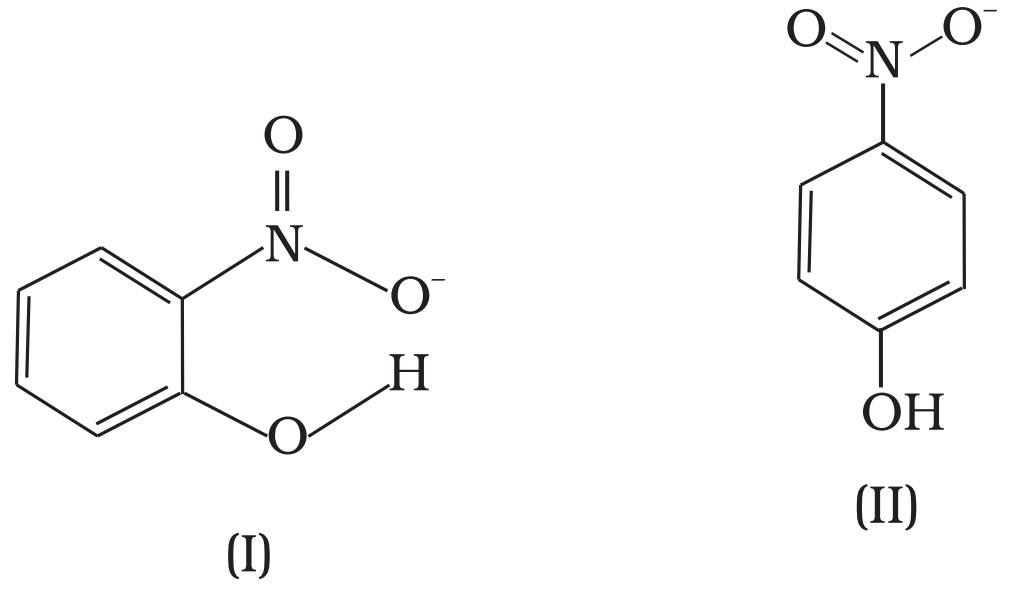
Structures of molecules of two compounds are given below:

  1. Which of the two compounds will have intermolccular hydrogen bonding and which compound is expected to show intramolecular hydrogen bonding?
  2. The melting point of a compound depends on. among other things, the extent of hydrogen bonding. On this basis explain which of the above two compounds will show higher melting point.
  3. Solubility of compounds in water depends on power to form hydrogen bonds with water. Which of the above compounds will form hydrogen bond with water easily and be more soluble in it?
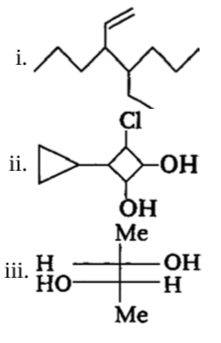
1. Give IUPAC names of the following structures.
Image
2. Benzoic acid is an organic compound. Its crude sample can be purified by crystallization from hot water. What characteristic differences in the properties of benzoic acid and the impurity make this process of purification suitable?
Write down the products of ozonolysis of 1,2-dimethylbenzene (o-xylene). How does the result support Kekulé structure for benzene?
Consider the following equilibrium at 2773K
$\text{H}_2(\text{g})+\text{Cl}_2(\text{g})\rightleftharpoons2\text{HCl}(\text{g})$
Initially 0.25M H2 and 0.25MCl2 are introduced into a reaction vessel and the system in allowed to attain equilibrium. At equilibrium the concentrations of H2(g) and Cl2(g) became 0.0314M. Calculate Kc and Kp.
Dihydrogen gas used in Haber’s process is produced by reacting methane from natural gas with high temperature steam. The first stage of two stage reaction involves the formation of CO and H2. In second stage, CO formed in first stage is reacted with more steam in water gas shift reaction,
$\text{CO (g) + H}_2\text{O (g)}\rightleftharpoons\text{CO}_2\text{ (g) + H}_2\text{ (g)}$
If a reaction vessel at 400°C is charged with an equimolar mixture of CO and steam such that $\text{p}_\text{co}=\text{p}_{\text{H}_2\text{O}}=4.0$bar, what will be the partial pressure of H2 at equilibrium?$\text{K}_\text{p}=10.1\text{ at }400^\circ\text{C}$
  1. Define solubility product. Write solubility product expression for Zr3(PO4)4.
  2. Calculate the pH of 0.01 M CH3COOH solution. [Ka(CH2COOH) = 1.74 × 10-51
  3. Explain why NaCl is precipitated when HCl(g) is passed through the saturated solution of NaCl.
Explain the following:
(a) Aufbau's principle
(b) Hund's law of maximum multiplicity
(c) Stability of half filled and full orbitals.
The pH of milk, black coffee, tomato juice, lemon juice and egg white are 6.8, 5.0, 4.2, 2.2 and 7.8 respectively. Calculate corresponding hydrogen ion concentration in each.
What volume of 0.1 M NaOH solution is required to neutralise 100ml of concentrated aqueous sulphuric acid which contains 98% H2SO4 by mass. The density of concentrated sulphuric acid solution is 1.84g ml-1 NaOH reacts with H2SO4 according to the following reaction:
2NaOH + H2SO4 → Na2SO4 + 2H2O
(Atomic mass/ g mol-1 H = 1, S = 32, O = 16).
How is molecular orbital different from atomic orbital? Give electronic configuration of:
  1. $\text{H}^+_2,$
  2. $\text{Li}_2$
  3. $\text{B}_2,$
  4. $\text{C}_2.$
Calculate their bond orders and predict their paramagnetic behaviour.