MCQ
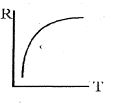
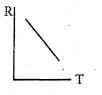
Assume a hypothetical wire in which free electron density changes with temperature in proportionality $n\ \alpha \ T$ assuming $\tau $(Relaxation time of collision) and dimensions of wire remain unchanged with increasing temperature. Which one of the resistance $v/s$ temperature graph is true

  • B

  • C

  • D

Answer

Correct option: A.

a
$R = \left( {\frac{{2lm}}{{{e^2}\tau A}}} \right)\frac{1}{n}$

Need a full question paper?

Generate a complete, print-ready paper with questions like this in minutes — across 16+ boards, with answer keys.

Start Generating Free

Similar questions

A lens of focal power $0.5 D$ is
A glass convex lens $({\mu _g} = 1.5)$ has a focal length of $8\,cm$ when placed in air. What would be the focal length of the lens when it is immersed in water ( ${\mu _w} = 1.33$)
Electric charge is measured in:
An alternating emf is applied across a parallel combination of a resistance $R$, capacitance $C$ and an inductance $L$. If $I_R$, $I_L$, $I_C$ are the currents through $R,\, L$ and $C$ respectively, then the diagram which correctly represents, the phase relationship among $I_R$, $I_L$, $I_C$ and source emf $E$, is given by
Glass has refractive index $\mu $ with respect to air and the critical angle for a ray of light going from glass to air is $\theta$. If a ray of light is incident from air on the glass with angle of incidence $\theta$, the corresponding angle of refraction is
A beam of light of wavelength $400\,nm$ and power $1.55\,mW$ is directed at the cathode of a photoelectric cell. If only $10 \%$ of the incident photons effectively produce photoelectron, then find current due to these electrons $...........\mu A$

[given, $hc =1240\,eV - nm , e =1.6 \times 10^{-{ }^{19}\,C }$ )

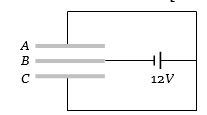
Three plates $A,\;B,\;C$each of area $50\,c{m^2}$ have separation $3\,mm$ between $A$ and $B$ and $3\,mm$ between $B$ and $C$. The energy stored when the plates are fully charged is
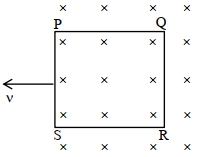
A square loop $\mathrm{PQRS}$ having $10$ turns, area $3.6 \times$ $10^{-3} \mathrm{~m}^2$ and resistance $100 \Omega$ is slowly and uniformly being pulled out of a uniform magnetic field of magnitude $\mathrm{B}=0.5 \mathrm{~T}$ as shown. Work done in pulling the loop out of the field in $1.0 \mathrm{~s}$ is. . . . . $\times 10^{-6} \mathrm{~J}$.
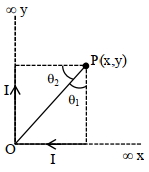
There are two infinitely long straight current carrying conductors and they are held at right angles to each other so that their common ends meet at the origin as shown in the figure given below. The ratio of current in both conductor is $1: 1$. The magnetic field at point $P$ is ...... .
Fraunhofer lines are produced by