Assume that a tunnel is dug along a chord of the earth, at a perpendicular distance $( R / 2)$ from the earth's centre, where $'R'$ is the radius of the Earth. The wall of the tunnel is frictionless. If a particle is released in this tunnel, it will execute a simple harmonic motion with a time period
JEE MAIN 2021, Diffcult
Download our app for free and get started
Force along the tunnel
$F =-\left(\frac{ GMmr }{ R ^{3}}\right) \cos \theta$
$F =-\frac{ gm }{ R } x \left(\frac{ GM }{ R ^{2}}= g , r \cos \theta= x \right)$
$a=-\frac{g}{R} x$
$\omega^{2}=\frac{g}{R} \quad T=2 \pi \sqrt{\frac{R}{g}}$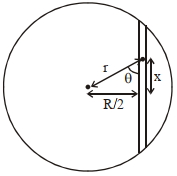

Download our appand get started for free
Experience the future of education. Simply download our apps or reach out to us for more information. Let's shape the future of learning together!No signup needed.*
Similar Questions
- 1$Assertion :$ The time-period of pendulum, on a satellite orbiting the earth is infinity.View Solution
$Reason :$ Time-period of a pendulum is inversely proportional to $\sqrt g$ - 2View SolutionWhat is constant in S.H.M.
- 3A loaded vertical spring executes $S.H.M.$ with a time period of $4\; sec$. The difference between the kinetic energy and potential energy of this system varies with a period of ........$sec$View Solution
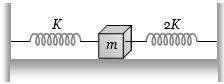
- 4Two springs of force constants $K$ and $2K$ are connected to a mass as shown below. The frequency of oscillation of the mass isView Solution
- 5View SolutionResonance is an example of
- 6The maximum acceleration of a particle in $SHM$ is made two times keeping the maximum speed to be constant. It is possible whenView Solution
- 7Vertical displacement of a plank with a body of mass $'m'$ on it is varying according to law $y = \sin \omega t + \cos \omega t.$ The minimum value of $\omega $ for which the mass just breaks off the plank and the moment it occurs first after $t = 0$ are given by : ( $y$ is positive vertically upwards)View Solution
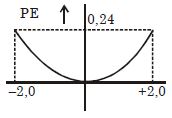
- 8A particle executing $S.H.M.$ its potential energy $V/S$ displacement graph is given by The value of restoring force constant is ..... $N/m$View Solution
- 9If $x=5 \sin \left(\pi t+\frac{\pi}{3}\right) \mathrm{m}$ represents the motion of a particle executing simple harmonic motion, the amplitude and time period of motion, respectively, areView Solution
- 10Two particles execute $SHM$ of same amplitude of $20\, cm$ with same period along the same line about the same equilibrium position. The maximum distance between the two is $20\, cm.$ Their phase difference in radians isView Solution