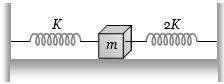
Two springs of force constants $K$ and $2K$ are connected to a mass as shown below. The frequency of oscillation of the mass is
AIIMS 2003, Medium
Download our app for free and get started
(c) $n = \frac{1}{{2\pi }}\sqrt {\frac{{{K_{effective}}}}{m}} = \frac{1}{{2\pi }}\sqrt {\frac{{(K + 2K)}}{m}} $=$\frac{1}{{2\pi }}\sqrt {\frac{{3K}}{m}} $

Download our appand get started for free
Experience the future of education. Simply download our apps or reach out to us for more information. Let's shape the future of learning together!No signup needed.*
Similar Questions
- 1A stationary tuning fork is in resonance with an air column in a pipe. If the tuning fork is moved with a speed of $2 ms ^{-1}$ in front of the open end of the pipe and parallel to it, the length of the pipe should be changed for the resonance to occur with the moving tuning fork. If the speed of sound in air is $320 ms ^{-1}$, the smallest value of the percentage change required in the length of the pipe is. . . . . .View Solution
- 2The position, velocity and acceleration of a particle executing simple harmonic motion are found to have magnitudes of $4 \mathrm{~m}, 2 \mathrm{~ms}^{-1}$ and $16 \mathrm{~ms}^{-2}$ at a certain instant. The amplitude of the motion is $\sqrt{\mathrm{x}} \mathrm{m}$ where $\mathrm{x}$ is. . . . . . .View Solution
- 3A particle executing simple harmonic motion of amplitude $5\, cm$ has maximum speed of $31.4\, cm/s$. The frequency of its oscillation is ..... $Hz$View Solution
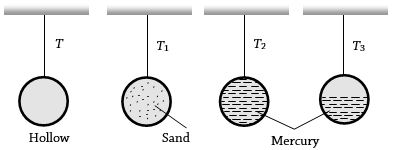
- 4The period of a simple pendulum, whose bob is a hollow metallic sphere, is $T$.The period is $T_1$ when the bob is filled with sand, $T_2$ when it is filled with mercury and $T_3$ when it is half filled with mercury. Which of the following is trueView Solution
- 5A particle executes linear simple harmonic motion with an amplitude of $2\, cm$. When the particle is at $1\, cm$ from the mean position the magnitude of its velocity is equal to that of its acceleration. Then its time period in seconds isView Solution
- 6If the maximum velocity and maximum acceleration of a particle executing $SHM$ are equal in magnitude, the time period will be .... $\sec$View Solution
- 7The total energy of a particle executing $S.H.M.$ is $80 \,J$. What is the potential energy when the particle is at a distance of $\frac{3}{4}$ of amplitude from the mean position..... $J$View Solution
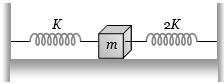
- 8Two springs of force constants $K$ and $2K$ are connected to a mass as shown below. The frequency of oscillation of the mass isView Solution
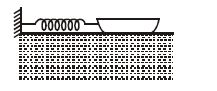
- 9A steady force of $120\ N$ is required to push a boat of mass $700\ kg$ through water at a constant speed of $1\ m/s$ . If the boat is fastened by a spring and held at $2\ m$ from the equilibrium position by a force of $450\ N$ , find the angular frequency of damped $SHM$ ..... $rad/s$View Solution
- 10A $5\, kg$ collar is attached to a spring of spring constant $500\, Nm^{-1}$. It slides without friction over a horizontal rod. The collar is displaced from its equillibrium position by $10\, cm$ and released. The time period of oscillation isView Solution