Question
Assume that an electric field $\vec E = 30{x^2}\hat i$ exists in space. Then the potential difference $V_A-V_O$ where $V_O$ is the potential at the origin and $V_A$ the potential at $x = 2\ m$ is....$V$

Answer

Potential difference between any two points in an electric field is given by,

${\mathrm{d} \mathrm{V}=-\vec{E} \cdot \overrightarrow{d x}}$

${\int_{V_{O}}^{V_{A}} d V=-\int_{0}^{2} 30 x^{2} d x}$

${V_{A}-V_{O}=-\left[10 x^{3}\right]_{0}^{2}=-80\, \mathrm{J} / \mathrm{C}}$

Need a full question paper?

Generate a complete, print-ready paper with questions like this in minutes — across 16+ boards, with answer keys.
Start Generating Free

Similar questions

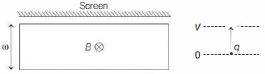
A particle of mass $m$ carrying charge $q$ is accelerated by a potential difference $V$. It enters perpendicularly in a region of uniform magnetic field $B$ and executes circular arc of radius $R$, then $\frac{q}{m}$ equals
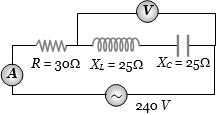
In the circuit shown in figure neglecting source resistance the voltmeter and ammeter reading will respectively, will be
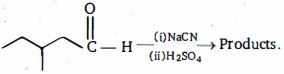
Products of the reaction are
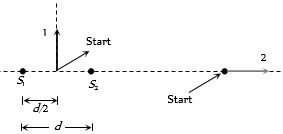
Following figure shows sources ${S_1}$ and ${S_2}$ that emits light of wavelength $\lambda $ in all directions. The sources are exactly in phase and are separated by a distance equal to $1.5\lambda .$ If we start at the indicated start point and travel along path $1$ and $2$, the interference produce a maxima all along
A block of $1\, kg$ is stopped against a wall by applying a force $F$ perpendicular to the wall. If $\mu = 0.2$ then minimum value of $F$ will be ....... $N.$
A weightless thread can bear a tension upto $3.7\,kg-wt$ . A stone of mass $500\,g$ is tied to it and revolved in a circular path of radius $4\,m$ in a vertical plane. If $g = 10\,ms^{-2}$, then the maximum angular velocity of the stone will be ......... $rad\,s^{-1}$
A car when passes through a convex bridge exerts a force on it which is equal to
The total energy of a black body radiation source is collected for five minutes and used to heat water. The temperature of the water increases from $10.0^{\circ} C$ to $11.0^{\circ} C$. The absolute temperature of the black body is doubled and its surface area halved and the experiment repeated for the same time. Which of the following statements would be most nearly correct?
A rectangular region of dimensions ( $\omega \times l(\omega) \ll l$ ) has a constant magnetic field into the plane of the paper as shown in the figure below. On one side, the region is bounded by a screen. On the other side, positive ions of mass $m$ and charge $q$ are accelerated from rest and towards the screen by a parallel plate capacitor at constant potential difference $V < 0$ and come out through a small hole in the upper plate. Which one of the following statements is correct regarding the charge on the ions that hit the screen?
A cylindrical tank of height $1$ $m$ and cross section area $A$ $=$ $4000$ $cm^2$ is initially empty when it is kept under a tap of cross sectional area $1$ $cm^2$. Water starts flowing from the tap at $t$ $=$ $0$, with a speed $= $ $2$ $m/s$. There is a small hole in the base of the tank of cross-sectional area $0.5$ $cm^2$. The variation of height of water in tank (in meters) with time $t$ is best depicted by