A car when passes through a convex bridge exerts a force on it which is equal to
Easy
Download our app for free and get started
(d)$F = mg - \frac{{m{v^2}}}{r}$

Download our appand get started for free
Experience the future of education. Simply download our apps or reach out to us for more information. Let's shape the future of learning together!No signup needed.*
Similar Questions
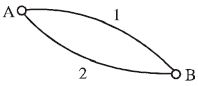
- 1A small body slips, subject to the force of friction, from point $A$ to point $B$ along two curved surfaces of equal radius, first along route $1,$ then along route $2$. Friction does not depend on the speed and the coefficient of friction on both routes is the same. In which case will the body’s speed at $B$ be greater?View Solution
- 2A $500 \,kg$ car takes a round turn of radius $50 \,m$ with a velocity of $36 \,km/hr$. The centripetal force is .......... $N$View Solution
- 3View SolutionA metal block is resting on a rough wooden surface. A horizontal force applied to the block is increased uniformly. Which of the following curves correctly represents velocity of the block ?
- 4A body of mass $10$ kg slides along a rough horizontal surface. The coefficient of friction is $1/\sqrt 3 $. Taking $g = 10\,m/{s^2}$, the least force which acts at an angle of $30^o $ to the horizontal is ...... $N$View Solution
- 5A block of mass $0.1 \,kg$ is held against a wall by applying a horizontal force of $5\, N$ on the block. If the coefficient of friction between the block and the wall is $0.5$, the magnitude of the frictional force acting on the block is ........ $N$View Solution
- 6A body of mass $m$ is tied to one end of a spring and whirled round in a horizontal plane with a constant angular velocity. The elongation in the spring is one centimetre. If the angular velocity is doubled, the elongation in the spring is $5\, cm$ . The original length of the spring is ............ $cm$View Solution
- 7A $500 \,kg$ car takes a round turn of radius $50 \,m$ with a velocity of $36 \,km/hr$. The centripetal force is .......... $N$View Solution
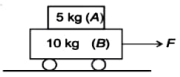
- 8If acceleration of $A$ is $2 \,m / s ^2$ which is smaller than acceleration of $B$ then the value of frictional force applied by $B$ on $A$ is ......... $N$View Solution
- 9A stone of mass of $16\, kg$ is attached to a string $144 \,m$ long and is whirled in a horizontal circle. The maximum tension the string can withstand is $16$ Newton. The maximum velocity of revolution that can be given to the stone without breaking it, will be ....... $ms^{-1}$View Solution
- 10View SolutionA car is moving with uniform velocity on a rough horizontal road. Therefore, according to Newton's first law of motion