Assume that the displacement$(s)$ of air is proportional to the pressure difference $(\Delta p)$ created by a sound wave. Displacement$(s)$ further depends on the speed of sound $(v),$ density of air $(\rho)$ and the frequency $(f)$ If $\Delta p \approx 10\, Pa , v \approx 300\, m / s , p \approx 1\, kg / m ^{3}$ and $f \approx 1000 \,Hz$, then $s$ will be the order of
(take multiplicative constant to be $1$ )
JEE MAIN 2020, Diffcult


Download our appand get started for free
Experience the future of education. Simply download our apps or reach out to us for more information. Let's shape the future of learning together!No signup needed.*
Similar Questions
- 1$Assertion :$ Sound waves cannot travel in vacuum but light can travel in vacuum.View Solution
$Reason :$ Sound waves are longitudinal waves and they cannot be polarised but electromagentic waves are transverse and they can be polarised. - 2The fundamental frequency of a sonometer wire is increases by $6\, Hz$ if its tension is increased by $44\%$, keeping the length constant. The frequency of the wire is ...... $Hz$View Solution
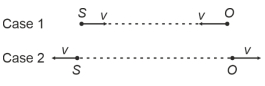
- 3A source $(S)$ of sound has frequency $240 \ Hz$. When the observer $(O)$ and the source move towards each other at a speed $v$ with respect to the ground (as shown in Case $1$ in the figure), the observer measures the frequency of the sound to be $288 \ Hz$. However, when the observer and the source move away from each other at the same speed $v$ with respect to the ground (as shown in Case $2$ in the figure), the observer measures the frequency of sound to be $n Hz$. The value of $n$ is. . . . . .View Solution
- 4A source producing sound of frequency $170 Hz$ is approaching a stationary observer with a velocity $17 \,ms^{-1}$. The apparent change in the wavelength of sound heard by the observer is (speed of sound in air $= 340 \,ms^{-1}$) ..... $m$View Solution
- 5View SolutionThe harmonics which are present in a pipe open at one end are
- 6If separation between screen and source is increased by $2\%$ what would be the effect on the intensityView Solution
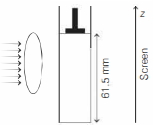
- 7A parallel beam of light is incident on a tank filled with water up to a height of $61.5 \,mm$ as shown in the figure below. Ultrasonic waves of frequency $0.5 \,MHz$ are sent along the length of the water column using a transducer placed at the top and they form longitudinal standing waves in the water. Which of the schematic plots below best describes the intensity distribution of the light as seen on the screen? (Take, the speed of sound in water to be $1500 \,m / s$ )View Solution
- 8Sound waves of frequency $660 \,\,Hz$ fall normally on a perfectly reflecting wall. The shortest distance from the wall at which the air particle has maximum amplitude of vibration is .... $m$ (velocity of sound in air is $330 \,\,m/s$)View Solution
- 9The frequency of a stretched uniform wire under tension is in resonance with the fundamental frequency of a closed tube. If the tension in the wire is increased by $8 N,$ it is in resonance with the first overtone of the closed tube. The initial tension in the wire is .... $N$View Solution
- 10View SolutionThe intensity of sound increases at night due to