Question
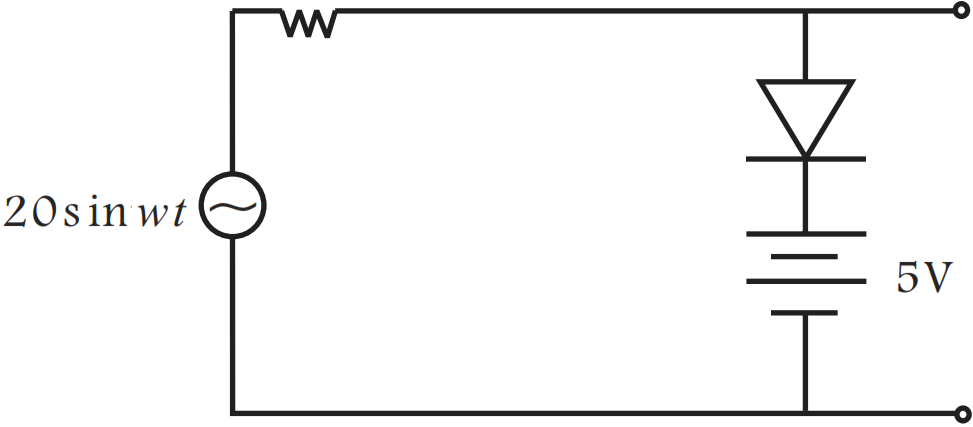
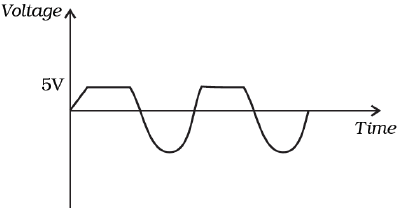
Assuming the ideal diode, draw the output waveform for the circuit given in Fig. Explain the waveform.

Answer

An ideal diode behaves like a perfect conductor when voltage is applied forward biased and like a perfect insulator when voltage is applied reverse biased.
When input voltage is greater than 5V, diode is conducting
When input is less than 5V, diode is open
The correct diagram is shown below:

Need a full question paper?

Generate a complete, print-ready paper with questions like this in minutes — across 16+ boards, with answer keys.
Start Generating Free

Similar questions

In an experiment to measure the speed of light by Fizeau's apparatus, following data are used:
Distance between the mirrors = 12.0km,
Number of teeth in the wheel = 180.
Find the minimum angular speed of the wheel for which the image is not seen.
Show that for a material with refractive index $\mu\geq\sqrt{2}$, light incident at any angle shall be guided along a length perpendicular to the incident face.
Prove that energy remains conserved in electromagnetic induction.
Find the expression for the energy stored in the capacitor. Also find the energy lost when the charged capacitor is disconnected from the source and connected in parallel with the uncharged capacitor. Where does this loss of energy appear?
The current in a conductor and the potential difference across its ends are measured by an ammeter and a voltmeter. The meters draw negligible currents. The ammeter is accurate but the voltmeter has a zero error (that is, it does not read zero when no potential difference is applied). Calculate the zero error if the readings for two different conditions are 1.75A, 14.4V and 2.75A, 22.4V.
A particle is fired vertically upward from earth's surface and it goes up to a maximum height of 6400km. Find the initial speed of the particle.
Assume that a tunnel is dug along a chord of the earth, at a perpendicular distance $\frac{\text{R}}{2}$ from the earth's centre where R is the radius of the earth. The wall of the tunnel is frictionless.
  1. Find the gravitational force exerted by the earth on a particle of mass m placed in the tunnel at a distance x from the centre of the tunnel.
  2. Find the component of this force along the tunnel and perpendicular to the tunnel.
  3. Find the normal force exerted by the wall on the particle.
  4. Find the resultant force on the particle.
  5. Show that the motion of the particle in the tunnel is simple harmonic and find the time period.
$i.$ Describe, with the help of a suitable diagram, the working principle of a step$-$up transformer. Obtain the relation between input and output voltages in terms of the number of turns of primary and secondary windings and the currents in the input and output circuits.
$ii.$ Given the input current $15 A$ and the input voltage of $100 V$ for a step$-$up transformer having $90\%$ efficiency, find the output power and the voltage in the secondary if the output current is $3 A.$
Apply Gauss’s Theorem to find the electric field near a charged conductor.
OR
Show that the electric field at the surface of a charged conductor is $\vec{\text{E}}=\frac{\text{p}}{\in_0}\hat{\text{n}}$ where $\sigma$ is surface charge density and $\hat{\text{n}}$ is a unit vector normal to the surface in the outward direction.
Two charged conducting spheres of radii $a$ and $b$ are connected to each other by a wire. What is the ratio of electric fields at the surfaces of the two spheres? Use the result obtained to explain why charge density on the sharp and pointed ends of a conductor is higher than on its flatter portions.