Show that for a material with refractive index $\mu\geq\sqrt{2}$, light incident at any angle shall be guided along a length perpendicular to the incident face.
Download our app for free and get started
Let the ray incident on face AB at angle i, after refraction, it travels along PQ and then interact with face AC which is perpendicular to the incident face.
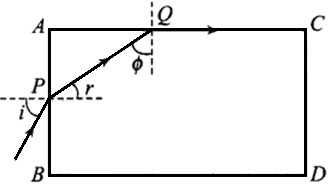
Any ray is guided along AC if the angle ray makes with the face AC $(\phi)$ is greater than the critical angle. From figure
$\phi+\text{r}=90^\circ,\ \therefore\ \sin\phi=\cos\text{r}\ .....(\text{i})$
If $\phi$ is the critical angle it means, $\sin\phi\geq\frac{1}{\mu}\ .....(\text{ii})$
From (i) and (ii), $\cos\text{r}\geq\frac{1}{\mu_2}\text{ or }1-\cos^2\text{r}\leq1-\frac{1}{\mu^2}$
i.e., $\sin^3\text{r}\leq\frac{1}{\mu^2}\Rightarrow\ \sin^2\text{r}\leq1-\frac{1}{\mu^2}\ .....(\text{iii})$
Applying Snell's law on face AB,
$1.\sin\text{i}=\mu\sin\text{r}$
or $\sin^2\text{i}=\mu^2\sin^2\text{r}\Rightarrow\ \sin^2\text{r}=\frac{1}{\mu^2}\sin^2\text{i}\ .....(\text{iv})$
From (i) and (ii), $\frac{1}{\mu_2}\sin^2\text{i}\leq1-\frac{1}{\mu^2}$
of $\sin^2\text{i}\leq\mu^2-1\ .....(\text{v})$
When $\text{i}=\frac{\pi}{2}$, then we have smallest angle $\phi$.
If it is greater than the critical angle, then all other angles of incidebce shall be more than the critical angle.
Thus, $1\geq\mu^2-1\text{ or }\mu^2\geq2$
$\Rightarrow\ \mu\geq\sqrt{2}$. This is the requires result.
Any ray is guided along AC if the angle ray makes with the face AC $(\phi)$ is greater than the critical angle. From figure
$\phi+\text{r}=90^\circ,\ \therefore\ \sin\phi=\cos\text{r}\ .....(\text{i})$
If $\phi$ is the critical angle it means, $\sin\phi\geq\frac{1}{\mu}\ .....(\text{ii})$
From (i) and (ii), $\cos\text{r}\geq\frac{1}{\mu_2}\text{ or }1-\cos^2\text{r}\leq1-\frac{1}{\mu^2}$
i.e., $\sin^3\text{r}\leq\frac{1}{\mu^2}\Rightarrow\ \sin^2\text{r}\leq1-\frac{1}{\mu^2}\ .....(\text{iii})$
Applying Snell's law on face AB,
$1.\sin\text{i}=\mu\sin\text{r}$
or $\sin^2\text{i}=\mu^2\sin^2\text{r}\Rightarrow\ \sin^2\text{r}=\frac{1}{\mu^2}\sin^2\text{i}\ .....(\text{iv})$
From (i) and (ii), $\frac{1}{\mu_2}\sin^2\text{i}\leq1-\frac{1}{\mu^2}$
of $\sin^2\text{i}\leq\mu^2-1\ .....(\text{v})$
When $\text{i}=\frac{\pi}{2}$, then we have smallest angle $\phi$.
If it is greater than the critical angle, then all other angles of incidebce shall be more than the critical angle.
Thus, $1\geq\mu^2-1\text{ or }\mu^2\geq2$
$\Rightarrow\ \mu\geq\sqrt{2}$. This is the requires result.

Download our appand get started for free
Experience the future of education. Simply download our apps or reach out to us for more information. Let's shape the future of learning together!No signup needed.*
Similar Questions
- 1The radii of curvature of a lens are +20cm and +30cm. The material of the lens has a refracting index 1.6. Find the focal length of the lens.View Solution
- If it is placed in air.
- If it is placed in water $(\mu=1.33).$
- 2A short object of length L is placed along the principal axis of a concave mirror away from focus. The object distance is u. If the mirror has a focal length f, what will be the length of the image? You may take $L < < |v - f|.$View Solution
- 3Trace the rays of light showing the formation of an image due to a point object placed on the axis of a spherical surface separating the two media of refractive indices $n_1$ and $n_2$. Establish the relation between the distances of the object, the image and the radius of curvature from the central point of the spherical surface. Hence derive the expression of the lens maker’s formula.View Solution
- 4A right angled prism of refractive index n has a plane of refractive index $n_1$ so that $n_1 < n$, cemented to its diagonal face. The assembly is in air. A ray is incident on AB.View Solution
- Calculate the angle of incidence at AB for which the ray strikes the diagonal face at the critical angle.
- Assuming n = 1.352, calculate the angle of incidence at AB for which the refracted ray passes through the diagonal face undeviated.
- 5View SolutionAt what angle should a ray of light be incident on the face of a prism of refracting angle 60° so that it just suffers total internal reflection at the other face? The refractive index of the material of the prism is 1.524.
- 6View SolutionThe mixture a pure liquid and a solution in a long vertical column (i.e, horizontal dimensions < < vertical dimensions) produces diffusion of solute particles and hence a refractive index gradient along the vertical dimension. A ray of light entering the column at right angles to the vertical is deviated from its original path. Find the deviation in travelling a horizontal distance d < < h, the height of the column.
- 7View SolutionWhat is the focal length of a convex lens of focal length 30cm in contact with a concave lens of focal length 20 cm? Is the system a converging or a diverging lens? Ignore thickness of the lenses.
- 8View Solution
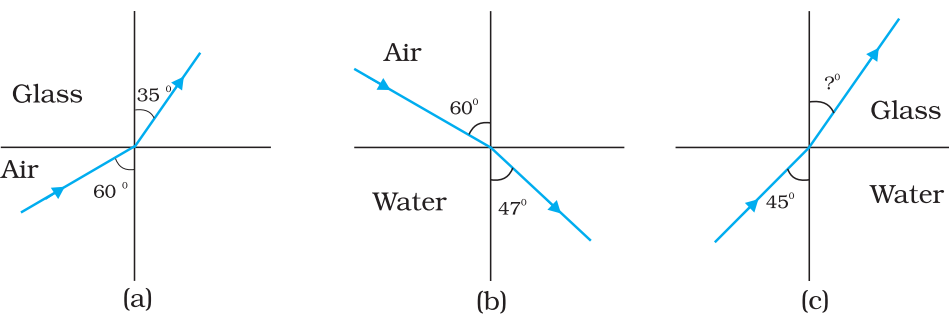
(a) and (b) show refraction of a ray in air incident at 60° with the normal to a glass-air and water-air interface, respectively. Predict the angle of refraction in glass when the angle of incidence in water is 45º with the normal to a water - glass interface.
- 9View SolutionA pin of length 2.0cm lies along the principal axis of a converging lens, the centre being at a distance of 11cm from the lens. The focal length of the lens is 6cm. Find the size of the image.
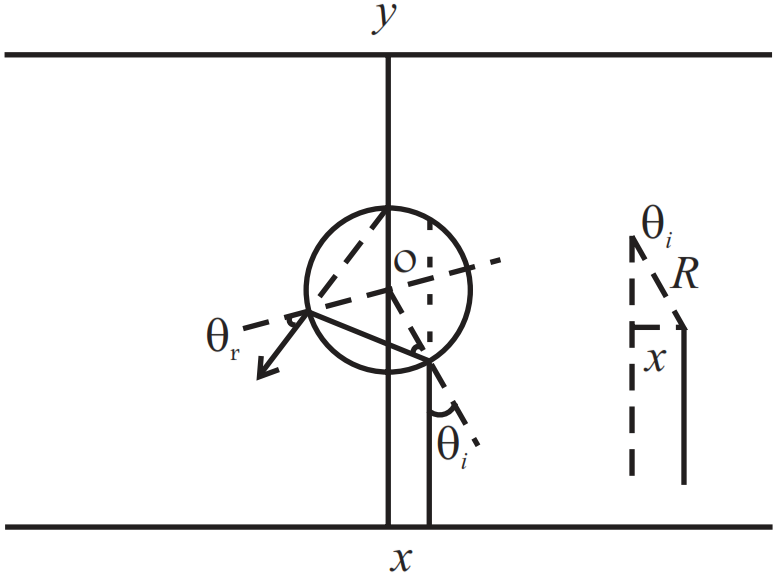
- 10View SolutionAn infinitely long cylinder of radius R is made of an unusual exotic material with refractive index -1 (Fig). The cylinder is placed between two planes whose normals are along the y direction. The center of the cylinder O lies along the y-axis. A narrow laser beam is directed along the y direction from the lower plate. The laser source is at a horizontal distance x from the diameter in the y direction. Find the range of x such that light emitted from the lower plane does not reach the upper plane.