MCQ
At $444\,^oC$ , the equilibrium constant $K$ for the reaction $2A{B_{(g)}} \rightleftharpoons {A_{2(g)}} + {B_{2(g)}}$ is $\frac {1}{64}$ . The degree of dissociation of $AB$ will be .....$\%$
  • A
    $10$
  • $20$
  • C
    $30$
  • D
    $50$

Answer

Correct option: B.
$20$
b
$\mathop {\mathop {2AB}\limits_1 }\limits_{1 - \alpha }  \rightleftharpoons \mathop {\mathop {{A_2}(g)}\limits_0 }\limits_{\frac{\alpha }{2}}  + \mathop {\mathop {{B_2}(g)\,\,}\limits_0 }\limits_{\frac{\alpha }{2}} \,\,\,\,\,\,\,{K_p} = \frac{1}{{64}}$

$\mathrm{K}_{\mathrm{p}}=\frac{\left(\frac{\alpha}{2}\right)^{2}}{(\mathrm{p}-\alpha)^{2}}$

$\sqrt{\frac{1}{64}}=\frac{\alpha}{2(1-\alpha)}$

$\alpha=\frac{1}{5}=0.2$

$\alpha=20 \%$

Need a full question paper?

Generate a complete, print-ready paper with questions like this in minutes — across 16+ boards, with answer keys.
Start Generating Free

Similar questions

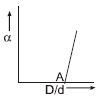
Before equilibrium is set-up for the chemical reaction ${N_2}{O_4}(g) \rightleftharpoons 2N{O_2}(g)$ , vapour density $d$ of the gaseous mixture was measured. If $D$ is the theoretical value of vapour density, variation of $\alpha $ with $D/d$ is given by the graph. What is value $D/d$ at point $A$ ?
In which of the following reactions $1,3$ butadiene will be obtained as a major product?
What is the work done when $1\, mole$ of a gas expands isothermally and reversibly from $25\, L$ to $250\, L$ at a temperature of $300\, K$?....$J$
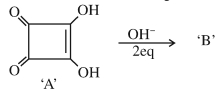
Correct statements for the given reaction are :

$A$. Compound ' $B$ ' is aromatic

$B$. The completion of above reaction is very slow

$C$. '$A$' shows tautomerism

$D$. The bond lengths $C - C$ in compound $B$ are found to be same

Choose the correct answer from the options given below :
Which statement is correct with respect to the property of the elements with increase in atomic number in the carbon family?
Which of the following has $ds{p^2}$ hybridization
Which of the following compounds has the lowest boiling point?
The electronic configuration of four elements are given in brackets$L\,\left( {1{s^2},\,\,2{s^2}2{p^1}} \right);\,\,M\,\left( {1{s^2},\,\,2{s^2}\,2{p^5}} \right)$

$Q\,\left( {1{s^2},\,\,2{s^2}\,2{p^6},\,\,3{s^1}} \right);\,\,R\,\left( {1{s^2},\,\,2{s^2}\,2{p^2}} \right)$The element that would most readily form a diatomic molecule is

Choose the correct sequence for the geometry of the given molecules Borazone, Borazole, $B_3O_6^{-3}$ , $Fe_2Cl_6$, trimer of $FCN$. [$'P'$ stands for planar and $'NP'$ stands for non-planar]
If in Bohr's model, for unielectronic atom, time period of revolution is represented as $T_{n,Z}$ where $n$ represents shell no. and $Z$ represents atomic number then the value of $T_{1,2} : T_{2,1}$ will be