MCQ
At absolute zero, $Si$ acts as:
  • A
    Non$-$metal.
  • B
    Metal.
  • Insulator.
  • D
    None of these.

Answer

Correct option: C.
Insulator.

Need a full question paper?

Generate a complete, print-ready paper with questions like this in minutes — across 16+ boards, with answer keys.

Start Generating Free

Similar questions

Assertion : In Young’s double slit experiment if wavelength of incident monochromatic light is just doubled, number of bright fringe on the screen will increase.

Reason : Maximum number of bright fringe on the screen is directly proportional to the wavelength of light used.
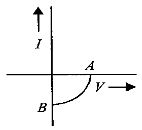
The given graph represents $V-I$ characteristic for a semiconductor device. Which of the following statement is correct? 
Cathode rays enter into a uniform magnetic field perpendicular to the direction of the field. In the magnetic field their path will be
For measurement of potential difference, potentiometer is preferred in comparison to voltmeter because
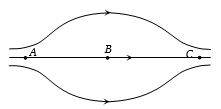
The figure shows some of the electric field lines corresponding to an electric field. The figure suggests
Assertion : When charges are shared between any two bodies, no charge is really lost, but some loss of energy does occur.
Reason : Some energy disappears in the form of heat, sparking etc.
A thin film of water $(\mu=4 / 3)$ is $3100 \,\mathring A$ thick. If it is illuminated by white light at normal incidence. The colour of film in the reflected light will be
A wire has a resistance of $6  \,\Omega$. It is cut into two parts and both half values are connected in parallel. The new resistance is ................ $\Omega$
A particle of charge $q$ and velocity $v$ passes undeflected through a space with non-zero electric field $E$ and magnetic field $B$. The undeflecting conditions will hold if.
A current of $5\; {A}$ is passing through a non-linear magnesium wire of cross-section $0.04\; {m}^{2}$. At every point the direction of current density is at an angle of $60^{\circ}$ with the unit vector of area of cross-section. The magnitude of electric field at every point of the conductor is ....${V} / {m}$ (Resistivity of magnesium is $\rho=44 \times 10^{-8}\, \Omega m$)