Question
At absolute zero temperature, pressure of a gas will be

Answer

$PV = \mu RT,$ $T = 0,$ 

$\therefore \,\,P = 0$ Because $V \ne 0$

Need a full question paper?

Generate a complete, print-ready paper with questions like this in minutes — across 16+ boards, with answer keys.
Start Generating Free

Similar questions

The threshold frequency of metal is $f_0$. When the light of frequency $2 f_0$ is incident on the metal plate, the maximum velocity of photoelectron is $v_1$. When the frequency of incident radiation is increased to $5 f _0$. the maximum velocity of photoelectrons emitted is $v_2$. The ratio of $v_1$ to $v_2$ is:
A resistance of $2 \Omega$ is comnected across one gap of a metre-bridge (the length of the wire is $100 \mathrm{~cm}$ ) and an unknown resistance, greater than $2 \Omega$, is connected across the other gap. When these resistance are interchanged, the balance point shifts by $20 \mathrm{~cm}$. Neglecting any corrections, the unknown resistance is
The work functions of Caesium $(Cs)$,Potassium $(K)$ and Sodium $(Na)$ are $2.14\,eV,2.30\,eV$ and $2.75\,eV$ respectively. If incident electromagnetic radiation has an incident energy of $2.20\, eV$, which of these photosensitive surfaces may emit photoelectrons?
A man standing in front of a mountain beats a drum at regular intervals. The rate of drumming is generally increased and he finds that the echo is not heard distinctly when the rate becomes $40$ per minute. He then moves nearer to the mountain by $90 m$ and finds that echo is again not heard when the drumming rate becomes $60$ per minute. The distance between the mountain and the initial position of the man is .... $m$
Two wire $A$ and $B$ are stretched by same force. If, for $A$ and $B, Y_A: Y_B=1: 2, r_A: r_B=3: 1$ and $L_A: L_B=4: 1$, then ratio of their extension $\left(\frac{\Delta L_A}{\Delta L_B}\right)$ will be .............
There are two spherical balls $A$ and $B$ of the same material with same surface, but the diameter of $A$ is half that of $B$. If $A$ and $B$ are heated to the same temperature and then allowed to cool, then
An $AC$ current is given by $I = I _{1} \sin \omega t + I _{2} \cos \omega t$. A hot wire ammeter will give a reading
Imagine a world where free magnetic charges exist. In this world, a circuit is made with a $U$-shape wire and a rod free to slide on it. A current carried by free magnetic charges can flow in the circuit. When the circuit is placed in a uniform electric field $E$ perpendicular to the plane of the circuit and the rod is pulled to the right with a constant speed $v$, the magnetic emf in the current and the direction of the corresponding current, arising because of changing electric flux will be ( $l$ is the length of the rod and $c$ is speed of light)
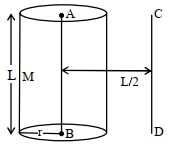
The solid cylinder of length $80\, {cm}$ and mass ${M}$ has a radius of $20\, {cm}$. Calculate the density of the material used if the moment of inertia of the cylinder about an axis $CD$ parallel to ${AB}$ as shown in figure is $2.7\, {kg} {m}^{2}$
A solid horizontal surface is covered with a thin layer of oil. A rectangular block of mass $m =0.4 kg$ is at rest on this surface. An impulse of $1.0 N s$ is applied to the block at time $t =0$ so that it starts moving along the $x$-axis with a velocity $v ( t )= v _0^{ e ^{-1 / \tau}}$, where $v_0$ is a constant and $\tau=4 s$. The displacement of the block, in metres, at $t=\tau$ is. . . . . . . Take $e ^{-1}=0.37$