MCQ
At absolute zero temperature, pressure of a gas will be
  • Zero
  • B
    One atmospheric pressure
  • C
    ${P_0} \times 273$
  • D
    ${P_0} \times 76$

Answer

Correct option: A.
Zero
a
$PV = \mu RT,$ $T = 0,$ 

$\therefore \,\,P = 0$ Because $V \ne 0$

Need a full question paper?

Generate a complete, print-ready paper with questions like this in minutes — across 16+ boards, with answer keys.

Start Generating Free

Similar questions

Gravitational mass is proportional to gravitational
If the velocity varies parabolically, how does the acceleration vary?
The position vector of a particle is given as $\vec r\, = \,({t^2}\, - \,8t\, + \,12)\,\hat i\,\, + \,\,{t^2}\hat j$ The time after which velocity vector and acceleration vector becomes perpendicular to each other is equal to........$sec$
At room temperature, the $r.m.s.$ speed of the molecules of certain diatomic gas is found to be $1920\, m/s$. The gas is
On applying a stress of $20 \times {10^8}N/{m^2}$ the length of a perfectly elastic wire is doubled. Its Young’s modulus will be
A shell is fired from a cannon, it explodes in mid air, its total:
A liquid in a beaker has temperature $\theta (t)$ at time $t$ and $\theta_0$ is temperature of surroundings, then according to Newton's law of cooling the correct graph between loge $log_e(\theta - \theta_0) $ and $t$ is
Consider a body of mass $1.0 \mathrm{~kg}$ at rest at the origin at time $\mathrm{t}=0$. A force $\overrightarrow{\mathrm{F}}=(\alpha \mathrm{t} \hat{\mathrm{i}}+\beta \hat{\mathrm{j}})$ is applied on the body, where $\alpha=1.0 \mathrm{Ns}^{-1}$ and $\beta=1.0 \mathrm{~N}$. The torque acting on the body about the origin at time $\mathrm{t}=1.0 \mathrm{~S}$ is $\vec{\tau}$. Which of the following statements is (are) true?

$(A)$ $|\vec{\tau}|=\frac{1}{3} \mathrm{Nm}$

$(B)$ The torque $\vec{\tau}$ is in the direction of the unit vector $+\hat{\mathrm{k}}$

$(C)$ The velocity of the body at $\mathrm{t}=1$ is $\overrightarrow{\mathrm{v}}=\frac{1}{2}(\hat{\mathrm{i}}+2 \hat{\mathrm{j}}) \mathrm{m} \mathrm{s}^{-1}$

$(D)$ The magnitude of displacement of the body at $\mathrm{t}=1 \mathrm{~s}$ is $\frac{1}{6} \mathrm{~m}$
$A$ current of $(2.5 \pm 0.05)$ $A$ flows through a wire and develops a potential difference of $(10 \pm 0.1)$ $\mathrm{volt}.$ Resistance of the wire in $\mathrm{ohm},$ is
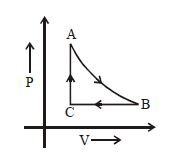
The adjoining figure shows the $P-V$ diagram for a fixed mass of an ideal gas undergoing cyclic process. $AB$ represents isothermal process and $CA$ represents isochoric process.Which of the graph shown in the following figures represents the $P-T$ diagram of the cyclic process ?