MCQ
If the velocity varies parabolically, how does the acceleration vary?
  • A
    Linearly
  • B
    Hyperbolically
  • C
    Parabolically
  • D
    Elliptically

Answer

  1. Linearly

Explanation:

Velocity varies parabolically implies that velocity is of the form at + bt2. On differentiating the velocity, we get the equation for acceleration.

Therefore, $\text{a}=\frac{\text{dv}}{\text{dt}}=\text{a}+2\text{bt},$ which is a linear equation. Hence the acceleration varies linearly.

Need a full question paper?

Generate a complete, print-ready paper with questions like this in minutes — across 16+ boards, with answer keys.

Start Generating Free

Similar questions

The equation of a wave on a string of linear mass density $0.04\, kgm^{-1}$ is given by : $y = 0.02\,\left( m \right)\,\sin \,\left[ {2\pi \left( {\frac{t}{{0.04\left( s \right)}} - \frac{x}{{0.50\left( m \right)}}} \right)} \right]$. The tension in the string is ..... $N$
The thermal capacity of a body is $80\, cal$, then its water equivalent is
The bulk modulus of copper is $1.4 × 10^{11}$ $Pa$ and the coefficient of linear expansion is $1.7 × 10^{-5} (C^o )^{-1}$. What hydrostatic pressure is necessary to prevent a copper block from expanding when its temperature is increased from $20^o C$ to $30^o C$
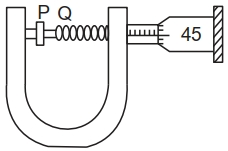
In an experiment to find out the diameter of wire using screw gauge, the following observation were noted.

$(a)$ Screw moves $0.5\,mm$ on main scale in one complete rotation

$(b)$ Total divisions on circular scale $=50$

$(c)$ Main scale reading is $2.5\,mm$

$(d)$ $45^{\text {th }}$ division of circular scale is in the pitch line

$(e)$ Instrument has $0.03 \;mm$ negative error

Then the diameter of wire is $...........\,mm$
To determine Young's modulus of a wire, the formula is $Y = \frac{F}{A}.\frac{L}{{\Delta L}}$ where $F/A$ is the stress and $L/\Delta L$ is the strain. The conversion factor to change $Y$ from $CGS$ to $MKS$ system is
The displacement of a particle is given by $\overrightarrow{\text{r}}=\text{A}\big(\overrightarrow{\text{i}}\cos\omega\text{t}+\overrightarrow{\text{j}}\sin\omega\text{t}\big)$ The motion of the particle is:
  1. Simple harmonic.
  2. On a straight line.
  3. On a circle.
  4. With constant acceleration.
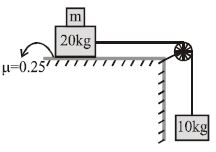
Find the minimum value of $m$ that should placed on $20\, kg$, so that system remain at rest ........ $kg$
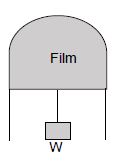
A thin liquid film formed between a $U-$ shaped wire and a light slider supports a weight of $1.5 \times 10^{-2}\ N$ (see figure). The length of the slider is $30\ cm$ and its weight are negligible. The surface tension of the liquid film is
A moving particle of mass $m,$ makes a head on elastic collision with another particle of mass $2\,m,$ which is initially at rest. The percentage loss in energy of the colliding particle on collision, is close to .................. $\%$
A particle moving with a uniform acceleration travels $24\, m$ and $64\, m$ in the first  two consecutive intervals of $4\, sec$ each. Its initial velocity is......$m / \sec $