MCQ
At constant temperature on increasing the pressure of a gas by $5\%$ will decrease its volume by ..... $\%$
  • A
    $5$
  • B
    $5.26$
  • C
    $4.26$
  • $4.76$

Answer

Correct option: D.
$4.76$
d
Given: $T=$ constant, $P \hat{i} \; 5 \%$, find change in Volume $\%$

Initial state $P_{0},V_{0},T_{0}\longrightarrow$ Fianl state $1.05 P_{0},V,T_{0}$

Using Boyles law

$P_{1} V_{1}=P_{2} v_{2}$

$P_{0} V_{0}=1.05 P_{0} V$

$V=0.9524 V_{0}$

$\Delta V \%$

$=\frac{V_{f}-V_{i}}{V_{i}} \times 100$

$=\left(\frac{V_{0}-0.9524 V_{0}}{V_{0}}\right) \times 100$

$=4.76 \%$

Need a full question paper?

Generate a complete, print-ready paper with questions like this in minutes — across 16+ boards, with answer keys.
Start Generating Free

Similar questions

Surface tension of a soap solution is $1.9 \times {10^{ - 2}}N/m$. Work done in blowing a bubble of $2.0\, cm$ diameter will be
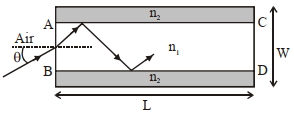
A planar structure of length $L$ and width $W$ is made of two different optical media of refractive indices $n _1=1.5$ and $n _2=1.44$ as shown in figure. If $L \gg W$, a ray entering from end $AB$ will emerge from end $CD$ only if the total internal reflection condition is met inside the structure. For $L =9.6 m$, if the incident angle $\theta$ is varied, the maximum time taken by a ray to exit the plane $CD$ is $t \times 10^{-9} s$, where $t$ is. . . . . . . [Speed of light $c =3 \times 10^8 m / s$ ]
A ray of light passes through equilateral prism $(\mu  = 1.5)$ such that angle of incidence is equal to angle of emergence and the later is equal to $3/4^{th}$ of prism angle. The angle of deviation is....$^o$
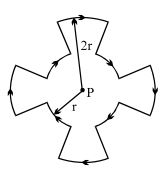
A current $I$ flows around a closed path in the horizontal plane of the circle as shown in the figure. The path consists of eight arcs with alternating radii $r$ and $2r$. Each segment of arc subtends equal angle at the common centre $P.$ The magnetic field produced by current path at point $P$ is
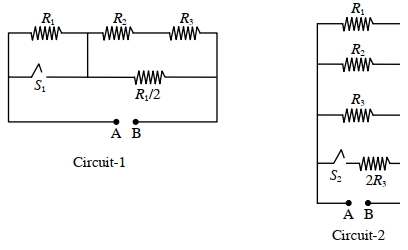
In Circuit-$1$ and Circuit- $2$ shown in the figures, $R_1=1 \Omega, R_2=2 \Omega$ and $R_3=3 \Omega$. $P_1$ and $P_2$ are the power dissipations in Circuit-$1$ and Circuit-$2$ when the switches $S_1$ and $S_2$ are in open conditions, respectively. $Q_1$ and $Q_2$ are the power dissipations in Circuit-$1$ and Circuit-$2$ when the switches $S_1$ and $S_2$ are in closed conditions, respectively.

Which of the following statement($s$) is(are) correct?

$(A)$ When a voltage source of $6 V$ is connected across $A$ and $B$ in both circuits, $P_1$

$(B)$ When a constant current source of $2 Amp$ is connected across $A$ and $B$ in both circuits, $P_1>P_2$.

$(C)$ When a voltage source of $6 V$ is connected across $A$ and $B$ in Circuit-$1$, $Q_1>P_1$.

$(D)$ When a constant current source of $2 Amp$ is connected across $A$ and $B$ in both circuits, $Q_2$
If the work done in blowing a bubble of volume $V$ is $W$, then the work done in blowing the bubble of volume $2V$ from the same soap solution will be
Density of substance at $0°C$ is $10\, gm/cc$ and at $100°C,$ its density is $9.7\, gm/cc$. The coefficient of linear expansion of the substance will be
A leaf which contains only green pigments, is illuminated by a laser light of wavelength $0.6328\,\mu m$. It wound appear to be
A conductor with a positive charge
The potential gradient is a