Question
At constant volume, for different diatomic gases the molar specific heat is

Answer

${C_V}$(Bi-atomic) $= \frac{5}{2}R$ $Joule/mol/°C$ $ = \frac{5}{2}\frac{R}{J}$

$\approx  5$ $\frac{{cal}}{{mol - ^\circ C}}$

Need a full question paper?

Generate a complete, print-ready paper with questions like this in minutes — across 16+ boards, with answer keys.
Start Generating Free

Similar questions

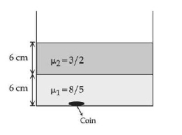
Two immiscible liquids of refractive indices $\frac{8}{5}$ and $\frac{3}{2}$ respectively are put in a beaker as shown in the figure. The height of each column is $6 \mathrm{~cm}$. A coin is placed at the bottom of the beaker. For near normal vision, the apparent depth of the coin is $\frac{\alpha}{4} \mathrm{~cm}$. The value of $\alpha$ is__________.
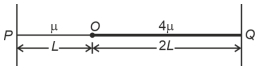
Two uniform strings of mass per unit length $\mu$ and $4 \mu$, and length $L$ and $2 L$, respectively, are joined at point $O$, and tied at two fixed ends $P$ and $Q$, as shown in the figure. The strings are under a uniform tension $T$. If we define the frequency $v_0=\frac{1}{2 L} \sqrt{\frac{T}{\mu}}$, which of the following statement($s$) is(are) correct?

$(A)$ With a node at $O$, the minimum frequency of vibration of the composite string is $v_0$

$(B)$ With an antinode at $O$, the minimum frequency of vibration of the composite string is $2 v_0$

$(C)$ When the composite string vibrates at the minimum frequency with a node at $O$, it has $6$ nodes, including the end nodes

$(D)$ No vibrational mode with an antinode at $O$ is possible for the composite string
The correct relation between $\gamma=\frac{ C _p}{ c _v}$ and temperature $T$ is :
Water of volume $2$ litre in a container is heated with a coil of $1\,kW$ at $27\,^\circ C$. The lid of the container is open and energy dissipates at rate of $160\,J/s.$ In how much time temperature will rise from $27\,^\circ C$ to $77\,^\circ C$ [Given specific heat of water is $4.2\,kJ/kg$]
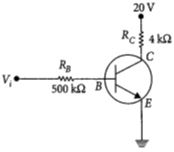
In the circuit shown in the figure, the input voltage $V_i$ is $20\,\, V, \,\,V_{BE} = 0 $ and $V_{CE}= 0.$ The values of $I_B\,,\,I_c$ and $\beta$ are given by
A charged particle projected in a limited magnetic field according to figure. The charged  particle does not strike to the opposite plate provided
A bulb rated at ($100\,W$ - $200\,V$) is used on a $100\,V$ line. The current in the bulb is
A polaroid is placed at  $45^{o}$  to an incoming light of intensity ${I_0}$. Now the intensity of light passing through polaroid after polarisation would be
The force $F$ on a sphere of radius $'a'$ moving in a medium with velocity $'v'$ is given by $F = 6\pi \eta av$. The dimensions of $\eta $ are
Water flows in a horizontal tube (see figure). The pressure of water changes by $700\; \mathrm{Nm}^{-2}$ between $\mathrm{A}$ and $\mathrm{B}$ where the area of cross section are $40\; \mathrm{cm}^{2}$ and $20\; \mathrm{cm}^{2},$ respectively. Find the rate of flow of water through the tube. ........ $\mathrm{cm}^{3} / \mathrm{s}$

(density of water $=1000\; \mathrm{kgm}^{-3}$ )