Water flows in a horizontal tube (see figure). The pressure of water changes by $700\; \mathrm{Nm}^{-2}$ between $\mathrm{A}$ and $\mathrm{B}$ where the area of cross section are $40\; \mathrm{cm}^{2}$ and $20\; \mathrm{cm}^{2},$ respectively. Find the rate of flow of water through the tube. ........ $\mathrm{cm}^{3} / \mathrm{s}$
(density of water $=1000\; \mathrm{kgm}^{-3}$ )
JEE MAIN 2020, Diffcult
Download our app for free and get started
Rate of flow of water $=\mathrm{A}_{\mathrm{A}} \mathrm{V}_{\mathrm{A}}=\mathrm{A}_{\mathrm{B}} \mathrm{V}_{\mathrm{B}}$
$(40) \mathrm{V}_{\mathrm{A}}=(20) \mathrm{V}_{\mathrm{B}}$
$\mathrm{V}_{\mathrm{B}}=2 \mathrm{V}_{\mathrm{A}}$
Using Bernoulli's theorem
$\mathrm{P}_{\mathrm{A}}+\frac{1}{2} \rho \mathrm{V}_{\mathrm{A}}^{2}=\mathrm{P}_{\mathrm{B}}+\frac{1}{2} \rho \mathrm{V}_{\mathrm{B}}^{2}$
$\mathrm{P}_{\mathrm{A}}-\mathrm{P}_{\mathrm{B}}=\frac{1}{2} \rho\left(\mathrm{V}_{\mathrm{B}}^{2}-\mathrm{V}_{\mathrm{A}}^{2}\right)$
$700=\frac{1}{2} \times 1000\left(4 \mathrm{V}_{\mathrm{A}}^{2}-\mathrm{V}_{\mathrm{A}}^{2}\right)$
$\mathrm{V}_{\mathrm{A}}=0.68 \mathrm{m} / \mathrm{s}=68 \mathrm{cm} / \mathrm{s}$
Rate of flow $=\mathrm{A}_{\mathrm{A}} \mathrm{V}_{\mathrm{A}}$
$=(40)(68)=2720\; \mathrm{cm}^{3} / \mathrm{s}$

Download our appand get started for free
Experience the future of education. Simply download our apps or reach out to us for more information. Let's shape the future of learning together!No signup needed.*
Similar Questions
- 1A pump draws water from a tank which is at $2.5\; m$ down from outlet and issues it from the end of a hose which the water is drawn. The cross sectional area is $10\; cm ^{2}$, and the water leaves the end of the hose at a speed of $5\; m / s$. What is the rate at which the pump is working ?View Solution
- 2Two cylindrical vessels of equal cross-sectional area $16\,cm ^{2}$ contain water upto herghts $100\,cm$ and $150\,cm$ respectively. The vessels are interconnected so that the water levels in them become equal. The work done by the force of gravity during the process, is $......J$ [Take density of water $=10^{3}\,kg / m ^{3}$ and $g =10\,ms ^{-2}$ ]View Solution
- 3A plane is in level flight at constant speed and each of its two wings has an area of $25 \;m ^{2}$ If the speed of the air is $180 \;km / h$ over the lower wing and $234\; km / h$ over the upper wing surface, determine the plane's mass in $kg$. (Take air density to be $1\; kg m ^{-3}$ ).View Solution
- 4A thin tube sealed at both ends is $100\, cm$ long. It lies horizontally, the middle $20\, cm$ containing mercury and two equal ends containing air at standard atmospheric pressure . If the tube is now turned to a vertical position, by what amount will the mercury be displaced ? (Given : cross-section of the tube can be assumed to be uniform) ........ $cm$View Solution

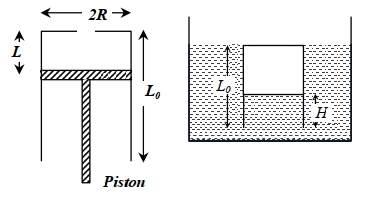
- 5A fixed thermally conducting cylinder has a radius $\mathrm{R}$ and height $\mathrm{L}_0$. The cylinder is open at its bottom and has a small hole at its top. A piston of mass $M$ is held at a distance $L$ from the top surface, as shown in the figure. The atmospheric pressure is $\mathrm{P}_0$.View Solution
$1.$ The piston is now pulled out slowly and held at a distance $2 \mathrm{~L}$ from the top. The pressure in the cylinder between its top and the piston will then be
$(A)$ $\mathrm{P}_0$ $(B)$ $\frac{\mathrm{P}_0}{2}$ $(C)$ $\frac{P_0}{2}+\frac{M g}{\pi R^2}$ $(D)$ $\frac{\mathrm{P}_0}{2}-\frac{\mathrm{Mg}}{\pi \mathrm{R}^2}$
$2.$ While the piston is at a distance $2 \mathrm{~L}$ from the top, the hole at the top is sealed. The piston is then released, to a position where it can stay in equilibrium. In this condition, the distance of the piston from the top is
$(A)$ $\left(\frac{2 \mathrm{P}_0 \pi \mathrm{R}^2}{\pi \mathrm{R}^2 \mathrm{P}_0+\mathrm{Mg}}\right)(2 \mathrm{~L})$ $(B)$ $\left(\frac{\mathrm{P}_0 \pi R^2-\mathrm{Mg}}{\pi R^2 \mathrm{P}_0}\right)(2 \mathrm{~L})$
$(C)$ $\left(\frac{\mathrm{P}_0 \pi \mathrm{R}^2+\mathrm{Mg}}{\pi \mathrm{R}^2 \mathrm{P}_0}\right)(2 \mathrm{~L})$ $(D)$ $\left(\frac{\mathrm{P}_0 \pi \mathrm{R}^2}{\pi \mathrm{R}^2 \mathrm{P}_0-\mathrm{Mg}}\right)(2 \mathrm{~L})$
$3.$ The piston is taken completely out of the cylinder. The hole at the top is sealed. A water tank is brought below the cylinder and put in a position so that the water surface in the tank is at the same level as the top of the cylinder as shown in the figure. The density of the water is $\rho$. In equilibrium, the height $\mathrm{H}$ of the water column in the cylinder satisfies
$(A)$ $\rho g\left(\mathrm{~L}_0-\mathrm{H}\right)^2+\mathrm{P}_0\left(\mathrm{~L}_0-\mathrm{H}\right)+\mathrm{L}_0 \mathrm{P}_0=0$
$(B)$ $\rho \mathrm{g}\left(\mathrm{L}_0-\mathrm{H}\right)^2-\mathrm{P}_0\left(\mathrm{~L}_0-\mathrm{H}\right)-\mathrm{L}_0 \mathrm{P}_0=0$
$(C)$ $\rho g\left(\mathrm{~L}_0-\mathrm{H}\right)^2+\mathrm{P}_0\left(\mathrm{~L}_0-\mathrm{H}\right)-\mathrm{L}_0 \mathrm{P}_0=0$
$(D)$ $\rho \mathrm{g}\left(\mathrm{L}_0-\mathrm{H}\right)^2-\mathrm{P}_0\left(\mathrm{~L}_0-\mathrm{H}\right)+\mathrm{L}_0 \mathrm{P}_0=0$
Give the answer question $1,2$ and $3.$
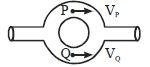
- 6In the figure shown, a liquid is flowing through a tube at the rate of $0.1\, m^3/sec$. The tube is branched into two semicircular tubes of cross-sectional area $A/3$ and $2A/3$. The velocity of liquid at $Q$ is ......... $ m/sec$ (The cross-section of the main tube $= A =10^{-2}\, m^2$ and $v_p = 20\, m/sec$)View Solution
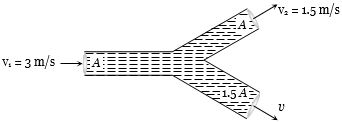
- 7An incompressible liquid flows through a horizontal tube as shown in the following fig. Then the velocity $ v$ of the fluid is .......$m/s$View Solution
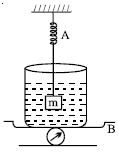
- 8The spring balance $A$ reads $2$ $kg$ with a block $m $ suspended from it. $A$ balance $B$ reads $5$ $kg$ when a beaker with liquid is put on the pan of the balance. The two balances are now so arranged that the hanging mass is inside the liquid in the beaker as shown in the figure in this situation:View Solution
- 9The diameter of an air bubble which was initially $2\,mm$, rises steadily through a solution of density $1750\,kg\,m\,m ^{-3}$ at the rate of $0.35\,cms ^{-1}$. The coefficient of viscosity of the solution is poise (in nearest integer). (the density of air is negligible).View Solution
- 10A cylindrical vessel open at the top is $20$ $cm $ high and $10$ $cm$ in diameter. A circular hole whose cross-sectional area $1$ $cm^2$ is cut at the centre of the bottom of the vessel. Water flows from a tube above it into the vessel at the rate $100$ $cm^3$ $s^{^{-1}}$. The height of water in the vessel under steady state is ....... $cm$ (Take $g$ $=$ $1000 $ $cm s^{^{-2}})$View Solution