MCQ
At iso-electric point
- Acone. of cation is equal to cone of anion
- BNet charge is zero.
- CMaximum cone. of di-polar ion (Zwitter ion) will be present
- ✓All of the above
Isoelectronic point is usually defined for amino acids.
Amino acids have an amino and carboxylic group
The carboxylic group forms an anion and the amino group forms a cation. Therefore, amino acids are of two types: anionic and cationic. The $pH$ at which a particular molecule carries no net electric charge is known as isoelectronic point When the anionic and cationic charge is contained within the same molecule, it is known as the Zwitter ion.
Zwitter ion exists at isoelectronic $pH$
Therefore, at isoelectronic $pH$,
$1.$ Net charge is zero (As the cationic and anionic charge is equal)
$2.$ Concentration of cation and anion are equal
$3.$ Maximum concentration of zwitterion is present
Below is the example of the zwitterion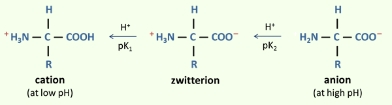
Generate a complete, print-ready paper with questions like this in minutes — across 16+ boards, with answer keys.


$CH_3-CH_2-OH$ $\mathop {\xrightarrow{{(i)\,KMn{O_4}/\mathop O\limits^\Theta H/\Delta }}}\limits_{(ii)\,{H^ \oplus }} (A)\mathop {\xrightarrow{{(i)\,SOC{l_2}}}}\limits_{(ii)\,N{H_3}/\Delta } (B)$ $\xrightarrow{{B{r_2}/KOH}}(C)$
$(C)$ will be :