MCQ
At nodes in stationary waves
  • Change in pressure and density are maximum
  • B
    Change in pressure and density are minimum
  • C
    Strain is zero
  • D
    Energy is minimum

Answer

Correct option: A.
Change in pressure and density are maximum
a
(a) In a longitudinal standing wave, such as in an organ pipe, there are fixed locations in the pipe where molecules oscillate back and forth at maximum amplitude, but there is no variation in $pressure- the$ density remains constant; this is a pressure node. At $1 / 4$ wavelength away from this node there is a pressure antinode, where the density alternates from high to low, with corresponding alternations in pressure. At the center of this antinode there is no particle motion, but particles on either side alternately move toward and away from the centre

Need a full question paper?

Generate a complete, print-ready paper with questions like this in minutes — across 16+ boards, with answer keys.

Start Generating Free

Similar questions

Dimensions of pair are same. Identify the pair
The coordinates of the positions of particles of mass $7,\,4{\rm{  and 10}}\,gm$ are ${\rm{(1,}}\,{\rm{5,}}\, - {\rm{3),}}\,\,{\rm{(2,}}\,5,7{\rm{) }}$ and ${\rm{(3, 3, }} - {\rm{1)}}\,cm$ respectively. The position of the centre of mass of the system would be
Consider all possible isomeric ketones, including stereoisomers of $MW$ $=100$. All these isomers are idependently reacted with $NaBH _4$ ($NOTE$ : stereoisomers are also reacted separately). The total number of ketones that give a racemic product$(s)$ is/are
A rocket with a lift-off mass $2 \times 10^4\,kg$ is blasted upwards with an intial acceleration of $5\,m\,s^{-2}$ . The initial thrust of the blast is (Take $g = 10\,m\,s^{-2}$ )
A pipe’s lower end is immersed in water such that the length of air column from the top open end has a certain length $25\,\, cm$. The speed of sound in air is $350 \,\,m/s$. The air column is found to resonate with a tuning fork of frequency $1750 \,\,Hz$. By what minimum distance should the pipe be raised in order to make the air column resonate again with the same tuning fork ... $cm$ ?
For a nucleus ${ }_Z^A X$ having mass number $A$ and atomic number $Z$

$A.$ The surface energy per nucleon $\left(b_s\right)=a_1 A^{2 / 3}$

$B.$ The Coulomb contribution to the binding energy $b_c=-a_2 \frac{Z(Z-1)}{A^{4 / 3}}$

$C.$ The volume energy $b_v=a_3 A$

$D.$ Decrease in the binding energy is proportional to surface area.

$E.$ While estimating the surface energy, it is assumed that each nucleon interacts with $12$ nucleons, $\left(a_1, a_2\right.$ and $a _3$ are constants)

Choose the most appropriate answer from the options given below:
A particle executing $S.H.M.$ of amplitude 4 cm and $T = 4 \,sec.$ The time taken by it to move from positive extreme position to half the amplitude is ..... $\sec$
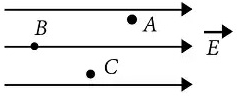
$A, B$ and $C$ are three points in a uniform electric field. The electric potential is
A stationary object at $4°C$ and weighing $3.5\, kg$ falls from a height of $2000\, m$ on a snow mountain at  $0°C$. If the temperature of the object just before hitting the snow is $0°C$ and the object comes to rest immediately $(g = 10\,m/{s^2})$ and (latent heat of ice$ = 3.5 \times {10^5}\,joule/\sec $), then the object will melt
If Young's modulus for a material is zero, then the state of material should be