At room temperature, copper has free electron density of $8.4 \times {10^{28}}$ per ${m^3}$. The copper conductor has a cross-section of $10^{-6} \,m^2$ and carries a current of $5.4\, A$. The electron drift velocity in copper is
Easy
Download our app for free and get started
(c) ${V_d} = \frac{i}{{nAe}} = \frac{{5.4}}{{8.4 \times {{10}^{28}} \times {{10}^{ - 6}} \times 1.6 \times {{10}^{ - 19}}}}$
$= $ $0.4 \times {10^{ - 3}}m/sec = 0.4\,mm/sec$.

Download our appand get started for free
Experience the future of education. Simply download our apps or reach out to us for more information. Let's shape the future of learning together!No signup needed.*
Similar Questions
- 1View SolutionThe alloys constantan and manganin are used to make standard resistance due to they have
- 2A $50 \,W$ bulb connected in series with a heater coil is put to an $AC$ mains. Now the bulb is replaced by a $100 \,W$ bulb. The heater output will ...........View Solution
- 3The temperature dependence of resistances of $Cu$ and undoped $Si$ in the temperature range $300-400\ K$, is best described byView Solution
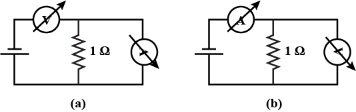
- 4A student uses the resistance of a known resistor $(1 \,\Omega)$ to calibrate a voltmeter and an ammeter using the circuits shown below. The student measures the ratio of the voltage to current to be $1 \times 10^3 \,\Omega$ in circuit $(a)$ and $0.999 \,\Omega$ in circuit $(b)$. From these measurements, the resistance (in $\Omega$ ) of the voltmeter and ammeter are found to be close toView Solution
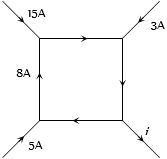
- 5The figure shows a network of currents. The magnitude of currents is shown here. The current $i$ will be ................. $A$View Solution
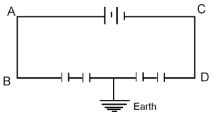
- 6Four equal capacitors are connected to a battery as shown in the adjoining figure. The potential of $A$ and $B$ areView Solution
- 7A potentiometer wire of length $L$ and a resistance $r$ are connected in series with a battery of e.m.f. $E_0$ and a resistance $r_1$. An unknown e.m.f. $E$ is balanced at a length $l$ of the potentiometer wire. The e.m.f. $E$ will be given byView Solution
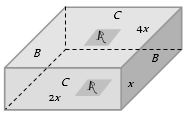
- 8In figure shows a rectangular block with dimensions $x,\, 2x$ and $4x$. Electrical contacts can be made to the block between opposite pairs of faces (for example, between the faces labelled $A-A, B-B$ and $C-C$). Between which two faces would the maximum electrical resistance be obtained ($A-A$ : Top and bottom faces, $B-B$ : Left and right faces, $C-C$ : Front and rear faces)View Solution
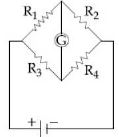
- 9The Wheatstone bridge shown in Fig. here, gets balanced when the carbon resistor used as $R_1$ has the colour code (Orange, Red, Brown). The resistors $R_2$ and $R_4$ are $80\, \Omega $ and $40\,\Omega $, respectively. Assuming that the colour code for the carbon resistors gives their accurate values, the colour code for the carbon resistor, used as $R_3$ would beView Solution
- 10To get the maximum current from a parallel combination of $n$ identical cells each of internal resistance $r$ in an external resistance $R$, whenView Solution