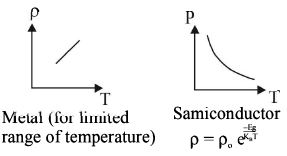
The temperature dependence of resistances of $Cu$ and undoped $Si$ in the temperature range $300-400\ K$, is best described by
JEE MAIN 2016, Easy


Download our appand get started for free
Experience the future of education. Simply download our apps or reach out to us for more information. Let's shape the future of learning together!No signup needed.*
Similar Questions
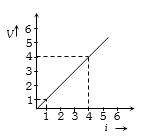
- 1Variation of current and voltage in a conductor has been shown in the diagram below. The resistance of the conductor is. ........... $ohm$View Solution
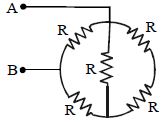
- 2The equivalent resistance between $A$ and $B$ isView Solution
- 3Ratio of thermal energy released in two resistor $R$ and $3 R$ connected in parallel in an electric circuit is :View Solution
- 4$32$ cells, each of $emf$ $3V$, are connected in series and kept in a box. Externally, the combination shows an $emf$ of $84\, V$. The number of cells reversed in the combination isView Solution
- 5A cell of $e.m.f.$ $1.5\,V$ having a finite internal resistance is connected to a load resistance of $2\,\Omega $. For maximum power transfer the internal resistance of the cell should be ............. $ohm$View Solution
- 6A wire of resistance $R$ and radius $r$ is stretched till its radius became $r / 2$. If new resistance of the stretched wire is $x R$, then value of $x$ is $\qquad$View Solution
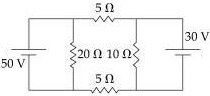
- 7In the circuit shown, current (in $A$) through $50\; V$ and $30\; V$ batteries are, respectivelyView Solution
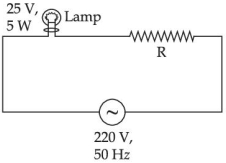
- 8A $220 \; V , 50 \; Hz$ AC source is connected to a $25 \; V$, $5 \; W$ lamp and an additional resistance $R$ in series (as shown in figure) to run the lamp at its peak brightness, then the value of $R$ (in ohm) will beView Solution
- 9A uniform metallic wire has a resistance of $18\,\Omega $ and is bent into an equilateral triangle. Then, the resistance between any two vertices of the triangle is .................. $\Omega$View Solution
- 10In a wire of cross section radius $r,$ free electrons travel with drift velocity $v$ when a current $I$ flows through the wire. What is the current in another wire of half the radius and of the same material when the drift velocity is $2v$ ?View Solution