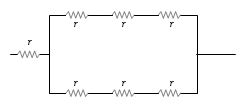
At room temperature, copper has free electron density of $8.4 \times {10^{28}}$ per ${m^3}$. The copper conductor has a cross-section of $10^{-6} \,m^2$ and carries a current of $5.4\, A$. The electron drift velocity in copper is
Easy


Download our appand get started for free
Experience the future of education. Simply download our apps or reach out to us for more information. Let's shape the future of learning together!No signup needed.*
Similar Questions
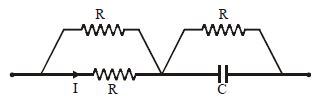
- 1View SolutionThe capacitor shown in fig. is in steady state. The energy stored in the capacitor is
- 2A resistor dissipates $192\, {J}$ of energy in $1\, {s}$ when a current of $4\, {A}$ is passed through it. Now, when the current is doubled, the amount of thermal energy dissipated in $5 \,{s}$ in $.....\,J.$View Solution
- 3View SolutionIf an observer is moving with respect to a stationary electron, then he observes
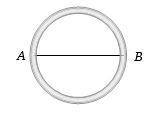
- 4The resistance of a wire is ${10^{ - 6}}\,\Omega $ per meter. It is bend in the form of a circle of diameter $2\,m$. A wire of the same material is connected across its diameter. The total resistance across its diameter $AB$ will beView Solution
- 5A dry cell has an $e.m.f.$ of $1.5\, V$ and an internal resistance of $0.05\,\Omega $. The maximum current obtainable from this cell for a very short time interval is ................... $A$View Solution
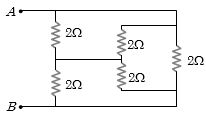
- 6Find the equivalent resistance across $AB$ .............. $\Omega$View Solution
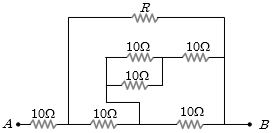
- 7For what value of $R$ the net resistance of the circuit will be $18\, ohms$ ............... $\Omega$View Solution
- 8Two conductors are made of the same material and have the same length. Conductor $A$ is a solid wire of diameter $1.0\, mm$. Conductor $B$ is a hollow tube of outside diameter $2.0\, mm$ and inside diameter $1.0\, mm$. The resistance ratio $R_A/R_B$ will beView Solution
- 9In the diagram resistance between any two junctions is $R$. Equivalent resistance across terminals $A$ and $B$ isView Solution

- 10View SolutionReferring to the figure below, the effective resistance of the network is