Two conductors are made of the same material and have the same length. Conductor $A$ is a solid wire of diameter $1.0\, mm$. Conductor $B$ is a hollow tube of outside diameter $2.0\, mm$ and inside diameter $1.0\, mm$. The resistance ratio $R_A/R_B$ will be
Medium
Download our app for free and get started
For conductor $A$, ${R_A} = \frac{{\rho \,l}}{{\pi r_1^2}}$,
For conductor $B$, ${R_B} = \frac{{\rho \,l}}{{\pi (r_2^2 - r_1^2)}}$
$ \Rightarrow $ $\frac{{{R_A}}}{{{R_B}}} = \frac{{r_2^2 - r_1^2}}{{r_1^2}} = {\left( {\frac{{{r_2}}}{{{r_1}}}} \right)^2} - 1 = {\left( {\frac{{{d_2}}}{{{d_1}}}} \right)^2} - 1 = {\left( {\frac{2}{1}} \right)^2} - 1 = 3$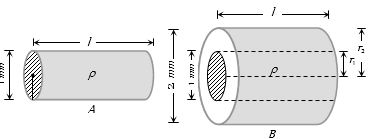

Download our appand get started for free
Experience the future of education. Simply download our apps or reach out to us for more information. Let's shape the future of learning together!No signup needed.*
Similar Questions
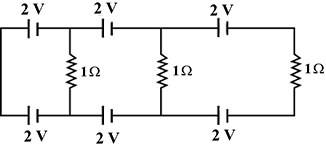
- 1View SolutionIn the below circuit the current in each resistance is
- 2A potentiometer wire of length $100\, cm$ has a resistance of $10\,\Omega $. It is connected in series with a resistance and a cell of $emf$ $2\, V$ and of negligible internal resistance. A source of $emf$ $10\,mV$ is balanced against a length of $40\, cm$ of the potentiometer wire. What is the value of external resistance ? .................. $\Omega$View Solution
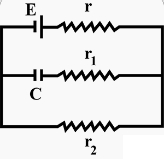
- 3In the given circuit diagram when the current reaches steady state in the circuit, the charge on the capacitor of capacitance $C$ will beView Solution
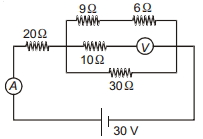
- 4In the circuit shown in figure, if ammeter and voltmeter are ideal, then the power consumed in $9 \,\Omega$ resistor will be .......... $W$View Solution
- 5An electric wire of length ‘$I$’ and area of cross-section $a$ has a resistance $R\, ohms$. Another wire of the same material having same length and area of cross-section $4a$ has a resistance ofView Solution
- 6Given below are two statements:View Solution
Statement $I$ : A uniform wire of resistance $80\,\Omega$ is cut into four equal parts. These parts are now connected in parallel. The equivalent resistance of the combination will be $5\,\Omega$.
Statement $II :$ Two resistance $2\,R$ and $3\,R$ are connected in parallel in a electric circuit. The value of thermal energy developed in $3\,R$ and $2\,R$ will be in the ratio $3:2.$
In the light of the above statements, choose the most appropriate answer from the options given below
- 7In a meter bridge experiment null point is obtained at $40\, cm$ from one end of the wire when resistance $X$ is balanced against another resistance $Y$. If $X < Y$, then the new position of the null point from the same end, if one decides to balance a resistance of $3X$ against $Y$, will be close to .............. $cm$View Solution
- 8View SolutionThe resistance of an incandescent lamp is
- 9View SolutionIn charging a battery of motor-car, the following effect of electric current is used
- 10A $1\,m$ long copper wire carries a current of $1\,A$. If the cross section of the wire is $2.0\,mm ^{2}$ and the resistivity of copper is $1.7 \times 10^{-8}\,\Omega\,m$. the force experienced by moving electron in the wire is $\times 10^{-23}\,N$. (charge on electron $=1.6 \times 10^{-19}\,C$ )View Solution