MCQ
At the highest point of the path of a projectile, its
  • A
    Kinetic energy is maximum
  • B
    Potential energy is minimum
  • Kinetic energy is minimum
  • D
    Total energy is maximum

Answer

Correct option: C.
Kinetic energy is minimum
c
(c) At the highest point of the path. Potential energy is maximum, so the kinetic energy will be minimum.

Need a full question paper?

Generate a complete, print-ready paper with questions like this in minutes — across 16+ boards, with answer keys.
Start Generating Free

Similar questions

The motion of planets in the solar system is an example of the conservation of 
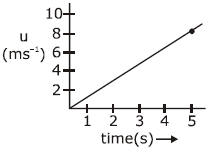
The speed verses time graph for a particle is shown in the figure. The distance travelled (in $m$ ) by the particle during the time interval $t=0$ to $t=5\, s$ will be
A cricketer can throw a ball to a maximum horizontal distance of $100 \,m$. With the same effort, he throws the ball vertically upwards. The maximum height attained by the ball is  ......... $m$
The name of the particle ‘Boson' is associated with the name of:
Consider a rubber ball freely falling from a height $h =4.9\ m$ onto a horizontal elastic plate. Assume that the duration of collision is negligible and the collision with the plate is totally elastic.

Then the velocity as a function of time and the height as a function of time will be

Triple point of water is
A steel ball of radius $2\, cm$ is at rest on a frictionless surface. Another ball of radius $4\,cm$ moving at a velocity of $81 \,cm/sec$ collides elastically with first ball. After collision the smaller ball moves with speed of ............. $\mathrm{cm} / \mathrm{sec}$
Two uniform solid spheres having unequal masses and unequal radii are released from rest from the same height on a rough incline. If the spheres roll without slipping:
One mole of an ideal monatomic gas undergoes a process described by the equation $PV^3 =$ constant. The heat capacity of the gas during this process is 
A capacitor $C _1$ of capacitance $1 \mu F$ and a capacitor $C _2$ of capacitance $2 \mu F$ are separately charged by a common battery for a long time. The two capacitors are then separately discharged through equal resistors. Both the discharge circuits are connected at $t =0$.