At time $\mathrm{t}=0$, a battery of $10 \mathrm{~V}$ is connected across points $\mathrm{A}$ and $\mathrm{B}$ in the given circuit. If the capacitors have no charge initially, at what time (in seconds) does the voltage across them becomes $4$ volt?
[take $\ln 5=1.6, \ln 3=1.1]$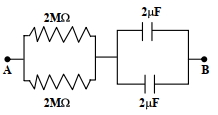
IIT 2010, Advanced


Download our appand get started for free
Experience the future of education. Simply download our apps or reach out to us for more information. Let's shape the future of learning together!No signup needed.*
Similar Questions
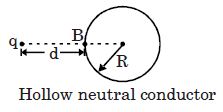
- 1View SolutionFor the situation shown in the figure below, mark out the correct statement
- 2A capacitor $C$ is charged to a potential difference $V$ and battery is disconnected. Now if the capacitor plates are brought close slowly by some distance :View Solution
- 3A $10\, \mu F$ capacitor is fully charged to a potential difference of $50\, V$. After removing the source voltage it is connected to an uncharged capacitor in parallel. Now the potential difference across them becomes $20\, V$. The capacitance of the second capacitor is......$\mu F$View Solution
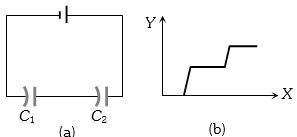
- 4Figure $(A)$ shows two capacitors connected in series and joined to a battery. The graph in figure $(B)$ shows the variation in potential as one moves from left to right on the branch containing the capacitors, ifView Solution
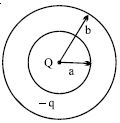
- 5Aspherical shell with an inner radius $'a'$ and an outer radius $'b' $ is made of conducting material. A point charge $+Q$ is placed at the centre of the spherical shell and a total charge $- q $ is placed on the shell.View Solution
Charge $- q $ is distributed on the surfaces as
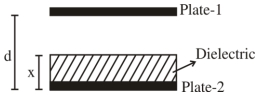
- 6A parallel plate capacitor with plate area $A$ and plate separation $d$ is filled with a dielectric material of dielectric constant $K =4$. The thickness of the dielectric material is $x$, where $x < d$.View Solution
Let $C_1$ and $C_2$ be the capacitance of the system for $x =\frac{1}{3} d$ and $x =\frac{2 d }{3}$, respectively. If $C _1=2 \mu F$ the value of $C _2$ is $........... \mu F$
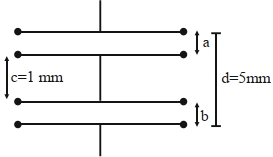
- 7As shown in the figure, two parallel plate capacitors having equal plate area of $200\,cm ^2$ are joined in such a way that $a \neq b$. The equivalent capacitance of the combination is $x \varepsilon_0 F$. The value of $x$ is $..........$.View Solution
- 8View SolutionThree identical capacitors are combined differently. For the same voltage to each combination, the one that stores the greatest energy is
- 9A neutral spherical copper particle has a radius of $10 \,nm \left(1 \,nm =10^{-9} \,m \right)$. It gets charged by applying the voltage slowly adding one electron at a time. Then, the graph of the total charge on the particle versus the applied voltage would look likeView Solution
- 10A capacitor of capacitance $C$ is charged to a potential difference $V$ from a cell and then disconnected from it. A charge $+Q$ is now given to its positive plate. The potential difference across the capacitor is now $Q$View Solution
if $V < CV$