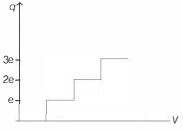
A neutral spherical copper particle has a radius of $10 \,nm \left(1 \,nm =10^{-9} \,m \right)$. It gets charged by applying the voltage slowly adding one electron at a time. Then, the graph of the total charge on the particle versus the applied voltage would look like
- A

- B

- C

- D

KVPY 2019, Advanced


Download our appand get started for free
Experience the future of education. Simply download our apps or reach out to us for more information. Let's shape the future of learning together!No signup needed.*
Similar Questions
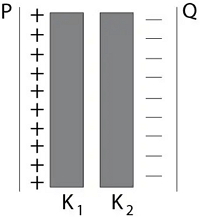
- 1Two thin dielectric slabs of dielectric constants $K_1$ and $K_2$ $(K_1 < K_2)$ are inserted between plates of a parallel plate capacitor, as shown in the figure. The variation of electric field $E$ between the plates with distance $d$ as measured from plate $P$ is correctly shown byView Solution
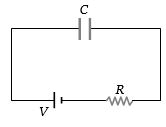
- 2Two point charges $100\,\mu \,C$ and $5\,\mu \,C$ are placed at points $A$ and $B$ respectively with $AB = 40\,cm$. The work done by external force in displacing the charge $5\,\mu \,C$ from $B$ to $C$, where $BC = 30\,cm$, angle $ABC = \frac{\pi }{2}$ and $\frac{1}{{4\pi {\varepsilon _0}}} = 9 \times {10^9}\,N{m^2}/{C^2}$.........$J$View Solution
- 3A uniform electric field having a magnitude ${E_0}$ and direction along the positive $X - $ axis exists. If the potential $V$ is zero at $x = 0$, then its value at $X = + x$ will beView Solution
- 4A non-conducting ring of radius $0.5\,m$ carries a total charge of $1.11 \times {10^{ - 10}}\,C$ distributed non-uniformly on its circumference producing an electric field $\vec E$ everywhere in space. The value of the line integral $\int_{l = \infty }^{l = 0} {\, - \overrightarrow E .\overrightarrow {dl} } \,(l = 0$ being centre of the ring) in volt isView Solution
- 5Consider a spherical shell of radius $R$ with a total charge $+ Q$ uniformly spread on its surface (centre of the shell lies at the origin $x=0$ ). Two point charges $+q$ and $-q$ are brought, one after the other from far away and placed at $x=-a / 2$ and $x=+a / 2( < R)$, respectively. Magnitude of the work done in this process isView Solution
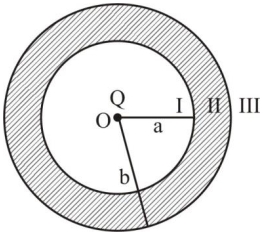
- 6As shown in the figure, a point charge $Q$ is placed at the centre of conducting spherical shell of inner radius a and outer radius $b$. The electric field due to charge $Q$ in three different regions I, II and III is given by: $( I : r < a , II : a < r < b , III : r > b )$View Solution
- 7The capacitance of a parallel plate capacitor is $12\,\mu \,F$. If the distance between the plates is doubled and area is halved, then new capacitance will be.........$\mu \,F$View Solution
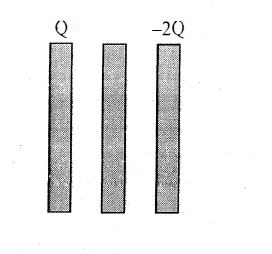
- 8The identical metal plates with large surface areas are kept parallel to each other as shown in figure. The left most plate is given a charge $Q$ , the rightmost a charge $-2Q$ and the middle one remains neutral. Find the charge appearing on the outer surface of the rightmost plateView Solution
- 9View SolutionA capacitor is charged by using a battery which is then disconnected. A dielectric slab is then slipped between the plates, which results in
- 10As in figure shown, if a capacitor $C$ is charged by connecting it with resistance $R$, then energy is given by the battery will beView Solution