MCQ
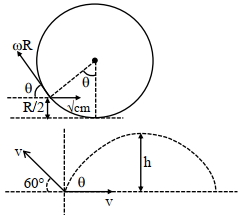
At time $t=0$, a disk of radius $1 m$ starts to roll without slipping on a horizontal plane with an angular acceleration of $\alpha=\frac{2}{3} rad s ^{-2}$. A small stone is stuck to the disk. At $t=0$, it is at the contact point of the disk and the plane. Later, at time $t=\sqrt{\pi} s$, the stone detaches itself and flies off tangentially from the disk. The maximum height (in $m$ ) reached by the stone measured from the plane is $\frac{1}{2}+\frac{x}{10}$. The value of $x$ is. . . . . . .[Take $g=10 m s ^{-2}$.]
  • A
    $0.20$
  • B
    $0.30$
  • $0.52$
  • D
    $0.60$

Answer

Correct option: C.
$0.52$
c
(image)

$\text { At } t =0, \omega=0$

$\text { at } t =\sqrt{\pi}, \omega=\alpha t =\frac{2}{3} \sqrt{\pi}, v =\omega r =\frac{2}{3} \sqrt{\pi}$

$\theta=\frac{1}{2} \alpha t ^2$

$\theta=\frac{1}{2} \times \frac{2}{3} \times \pi=\frac{\pi}{3}$

$\theta=60^{\circ}$

$v _y= v \sin 60=\frac{\sqrt{3}}{2} V$

$h =\frac{ u _Y^2}{2 g }=\frac{\frac{3}{4} v ^2}{2 g }$

$h =\frac{\frac{3}{4} \times \frac{4}{9} \pi}{2 g }$

$h =\frac{3 \pi}{9 \times 2 g }=\frac{\pi}{6 g }$

Maximum height from plane, $H=\frac{R}{2}+h$

$H =\frac{1}{2}+\frac{\pi}{6 \times 10}$

$x =\frac{\pi}{6} ; x =0.52$

Need a full question paper?

Generate a complete, print-ready paper with questions like this in minutes — across 16+ boards, with answer keys.

Start Generating Free

Similar questions

During an experiment, an ideal gas is found to obey a condition $VP^2 =$ constant. The gas is initially at a temperature $T$, pressure $P$ and volume $V.$ The gas expands to volume $4V$. 
If a simple harmonic oscillator has got a displacement of $0.02\, m$ and acceleration equal to $2.0\,m{s^{ - 2}}$ at any time, the angular frequency of the oscillator is equal to .... $rad\,{s^{ - 1}}$
A cup of tea cools from ${80^0}C$ to ${60^o}C$ in one minute. The ambient temperature is ${30^o}C$. In cooling from ${60^o}C$ to ${50^o}C$ it will take ....... $\sec$
If $C_P, C_V$ are molar specific heats of a solid and $R$ is universal gas constant, then:
At a certain instant of time the mass of a rocket going up vertically is $100 \,kg$. If it is ejecting $5 \,kg$ of gas per second at a speed of $400\, m/s$, the acceleration of the rocket would be ........ $m/{s^2}$ (taking $g = 10\,m/{s^2})$
A particle has an initial velocity of ($3\hat i + 4\hat j)\;ms^{-1}$ and an acceleration of $(0.4\hat i + 0.3\hat j)\;ms^{-1}$ Its speed after $10\;s$ is:
The velocity of water waves $v$ may depend upon their wavelength $\lambda $, the density of water $\rho $ and the acceleration due to gravity $g$. The method of dimensions gives the relation between these quantities as
Which of the following equations represents a travelling wave ?
A man is standing between two parallel cliffs and fires a gun. If he hears first and second echoes after $1.5 \,s$ and $3.5\,s$ respectively, the distance between the cliffs is .... $ m$ (Velocity of sound in air $= 340 ms^{-1}$)
The number of degrees of freedom for translatory motion are: