MCQ
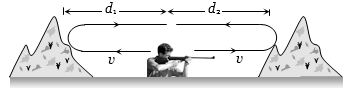
A man is standing between two parallel cliffs and fires a gun. If he hears first and second echoes after $1.5 \,s$ and $3.5\,s$ respectively, the distance between the cliffs is .... $ m$ (Velocity of sound in air $= 340 ms^{-1}$)
  • A
    $1190$
  • $850$
  • C
    $595$
  • D
    $510$

Answer

Correct option: B.
$850$
b
(b) $2{d_1} + 2{d_2} = v \times {t_1} + v \times {t_2}$

==> $2({d_1} + {d_2}) = v({t_1} + {t_2})$

${d_1} + {d_2} = \frac{{v({t_1} + {t_2})}}{2}$

$=\frac{{340 \times (1.5 + 3.5)}}{2} = 850\,  m.$

Need a full question paper?

Generate a complete, print-ready paper with questions like this in minutes — across 16+ boards, with answer keys.

Start Generating Free

Similar questions

Five moles of helium are mixed with two moles of hydrogen to form a mixture. Take molar mass of helium $M_1=4\ g$ and that of hydrogen $M_2=2\ g$ The equivalent degree of freedom $f$ of the mixture is
The molecules of a given mass of a gas have $r.m.s.$ velocity of $200 \,m s^{-1}$ at $27^o C$ and $1.0 \times 10^5 \,Nm^{-2}$ pressure. When the temperature and pressure of the gas are respectively, $127^o C$ and $0.05 \times 10^5 \,Nm^{-2},$ the $r.m.s.$ velocity of its molecules in $m s^{-1}$ is 
The angular momentum of a particle rotating with an angular velocity $\omega$ distant $r$ from a given origin is $I$. If the origin is shifted by $2r$, then the new angular momentum of the particle with same angular velocity will be:
The heavier nuclei tend to have larger $\frac{\text{N}}{\text{Z}}$ ratio because:
  1. A neutron is heavier than a proton.
  2. A neutron is an unstable particle.
  3. A neutron does not exert electric repulsion.
  4. Coulomb forces have longer range compared to the nuclear forces.
When $20\ \text{cal}$ of heat is supplied to a system, the increase in internal energy is $50J$. If the external work done is $35J$, the mechanical equivalent of heat is:
An open pipe is in resonance in its $2^{nd}$ harmonic with tuning fork of frequency ${f_1}$. Now it is closed at one end. If the frequency of the tuning fork is increased slowly from ${f_1}$ then again a resonance is obtained with a frequency ${f_2}$. If in this case the pipe vibrates ${n^{th}}$ harmonics then
According to Reynolds, what will be the value of critical velocity?
The value of surface tension of a liquid at critical temperature is
A tap supplies water at $10\,^oC$ and another tap at $100\,^oC$. .......... $kg$ hot water must be taken so that we get $20\, kg$ water at $35\,^oC$ ?
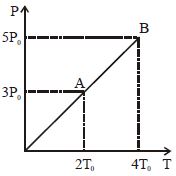
Pressure $Vs$ temperature graph of an ideal gas is shown in figure. Density of the gas at point $A$ is $\rho _0$ , Density at $B$ will be