MCQ
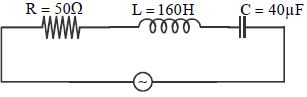
At what angular frequency $\omega $ the following circuit consumes maximum power?.......$rad/s$
  • $12.5$
  • B
    $50$
  • C
    $80$
  • D
    $64$

Answer

Correct option: A.
$12.5$
a
a
$\omega=\frac{1}{\sqrt{\mathrm{LC}}}=\frac{1}{\sqrt{160 \times 40 \times 10^{-6}}}=\frac{1}{\sqrt{6400 \times 10^{-6}}}$

$\frac{1}{80 \times 10^{-3}}=\frac{1000}{80}=12.5 \mathrm{\,rad} / \mathrm{s}$

Need a full question paper?

Generate a complete, print-ready paper with questions like this in minutes — across 16+ boards, with answer keys.
Start Generating Free

Similar questions

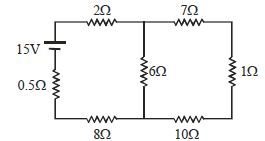
The current from the battery in the given circuit is ................ $A$
Three capacitors of capacitances $6\mu\text{F}$ each are available. The minimum and maximum capacitances, which may be obtained are:
According to Kirchhoff's law, at any junction in an electric circuit:
A plano-convex lens made of material of refractive index $\mu$ with radius of curvature $R$ is silvered on the curved side. How far away from the lens-mirror must you place a point object, so that the image coincides with the object?
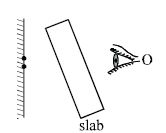
The observer at $O$ views two closely spaced spots on a vertical wall through an angled glass slab as shown. As seen by observer, the spots appear
The energy density associated with electric field $\overrightarrow{ E }$ and magnetic field $B$ of an electromagnetic wave in free space is given by ( $\in_0-$ permittivity of free space, $\mu_0$ - permeability of free space)
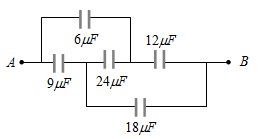
In the connections shown in the adjoining figure, the equivalent capacity between A and B will be
A beam of electromagnetic radiation of intensity $6.4 \times 10^{-5}\; \mathrm{W} / \mathrm{cm}^{2}$ is comprised of wavelength, $\lambda=310 \;\mathrm{nm} .$ It falls normally on a metal (work function $\varphi=2 \;\mathrm{eV}$ ) of surface area of $1\; \mathrm{cm}^{2} .$ If one in $10^{3}$ photons ejects an electron, total number of electrons ejected in $1 \;s$ is $10^{\mathrm{x}}$.then $\mathrm{x}$ is

$\left(\mathrm{hc}=1240\; \mathrm{eV} \mathrm{nm}, 1\; \mathrm{eV}=1.6 \times 10^{-19} \;\mathrm{J}\right)$
An average emf of $32V$ is induced in a coil in which the current drops from $10A$ to $2A $ in$ 0.1s$. The inductance of the coil is:
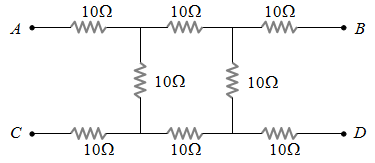
What will be the equivalent resistance between the two points A and D