Question
At what separation should two equal charges, 1.0C each, be placed so that the force between them equals the weight of a 50kg person?

Answer

Given:

Magnitude of charges, $\text{q}_1=\text{q}_2=1\text{C}$

Electrostatic force between them,

F = Weight of a 50kg person

$\text{mg}=50\times9.8=490\text{N}$

$\text{mg}=490\text{N}$

Let the required distance be r.

By Coulomb's Law, electrostatic force,

$\text{F}=\frac{1}{4\pi\in_0}\frac{\text{q}_1\text{q}_2}{\text{r}^2}$

$\Rightarrow490=\frac{9\times10^9\times1\times1}{\text{r}^2}$

$\Rightarrow\text{r}^2=\frac{9\times10^9}{490}$

$\Rightarrow\text{r}=\sqrt{\frac{9}{49}\times10^8}$

$=\frac{3}{7}\times10^4\text{m}$

$=4.3\times10^3\text{m}$

Need a full question paper?

Generate a complete, print-ready paper with questions like this in minutes — across 16+ boards, with answer keys.
Start Generating Free

Similar questions

The metre is defined as the distance travelled by light in $\frac{1}{299,792,458}$ second. Why didn't people choose some 1 easier number such as $\frac{1}{300,000,000}$ second? Why not 1 second?
A liquid has a definite volume but no shape of its own. Explain.
If the volume of a gas is reduced at a constant temperature, its pressure increases. Explain from molecular kinetic theory.
Why are the springs made of steel and not of copper?
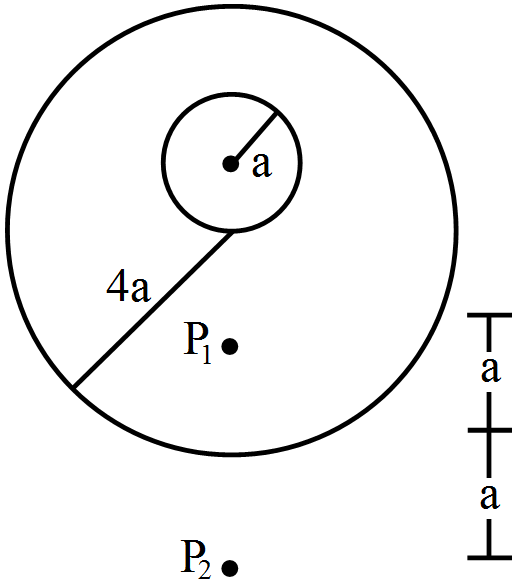
A uniform metal sphere of radius a and mass M is surrounded by a thin uniform spherical shell of equal mass and radius 4a The centre of the shell falls on the surface of the inner sphere. Find the gravitational field at the points P1 and P2 shown in the figure.

Given the moment of inertia of a disc of mass M and R radius R about any of its diameters to be $\frac{\text{MR}^2}{4},$ find its moment of inertia about an axis normal to the disc and passing through a point on its rim.
Prove the following statement, “For Elevation which exceed or fall short of 45° by equal amount, the range is equal.”
An ideal Carnot engine uses an ideal gas. The source temperature is 500 K and the arrival temperature is 375 K . If the engine takes 500 K cal from the source per cycle then estimate (a) efficiency of engine (b) work done per cycle (c) per heat dissipated in bicycle access.
A transverse harmonic wave on a string is described by
$\text{y}(\text{x, t})=3.0\sin\big(36\text{t}+0.018\text{x}+\frac{\pi}{4}\big)$
where x and y are in cm and t in s. The positive direction of x is from left to right.
What are its amplitude and frequency?
When a bus decends a hilly road at a constant speed, the brake drums become hot, why?