Question types

Electric Field and Potential question types

107 questions across 5 question groups — pick any mix to generate a Physics paper with step-by-step answer keys.

107
Questions
5
Question groups
5
Question types
Sample Questions

Electric Field and Potential questions

One sample from each question group in this chapter. Select any group above to see the full set with answer keys.
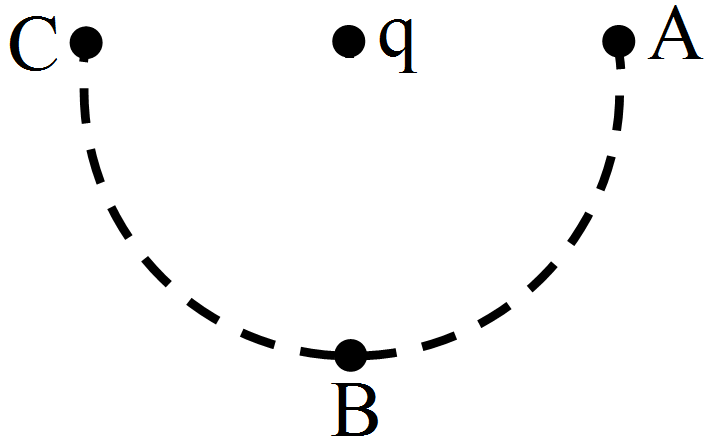
Consider the situation of figure. The work done in taking a point charge from P to A is WA, from P to B is WB and from P to C is WC.

  1. WA < WB < WC
  2. WA > WB > WC
  3. WA = WB = WC
  4. None of these.

View full solution
When the separation between two charges is increased the electric potential energy of the charges.
  1. Increases.
  2. Decreases.
  3. Remains the same.
  4. May increase or decrease.
View full solution
Which of the following quantities do not depend on the choice of zero potential or zero potential energy?
  1. Potential at a point.
  2. Potential difference between two points.
  3. Potential energy of a two-charge system.
  4. Change in potential energy of a two-charge system.
View full solution
Two equal positive charges are kept at points A and B. The electric potential at the points between A and B (excluding these points) is studied while moving from A to B. The potential.
  1. Continuously increases.
  2. Continuously decreases.
  3. Increases then decreases.
  4. Decreases then increases.
View full solution
A point charge q is rotated along a circle in the electric field generated by another point charge Q. The work done by the electric field on the roatating charge in one complete revolution is:
  1. Zero.
  2. Positive.
  3. Negative.
  4. Zero if the charge Q is at the centre and nonzero otherwise.
View full solution
NaCl molecule is bound due to the electric force between the sodium and the chlorine ions when one electron. of sodium is transferred to chlorine. Taking the separation between the ions to be 2.75 × 10cm, find the force of attraction between them· State the assumptions (if any) that you have made.
View full solution
Two charged particles are placed at a distance 1.0cm apart. What is the minimum possible magnitude of the electric force acting on each charge?
View full solution
Two charged particles having charge 2.0 × 10-8C each are joined by an insulating string of length 1m and the system is kept on a smooth horizontal table. Find the tension in the string.
View full solution
A sample of HCI gas is placed in an electric field of 2.5 × 104NC-1. The dipole moment of each HCI molecule is 3.4 × 10-30Cm. Find the maximum torque that can act on a molecule.
View full solution
An electric field $\vec{\text{E}}=\vec{\text{i}}\text{Ax}$ exists in the space, where A= 10Vm-2. Take the potential at (10m, 20m) to be zero. Find the potential at the origin.
View full solution
A positive charge q is placed in front of a conducting solid cube at a distance d from its centre. Find the electric field at the centre of the cube due to the charges appearing on its surface.
View full solution
A hydrogen atom contains one proton and one electron. It may be assumed that the electron revolves in a circle of radius 0.53 angstrom (1 angstrom = 10-10m and is abbreviated as A) with the proton at the centre. The hydrogen atom is said to be in the ground state in this case. Find the magnitude of the electric force between the proton and the electron of a hydrogen atom in its ground state.
View full solution
In some old texts it is mentioned that $4\pi$ lines of force originate from each unit positive charge. Comment on the statement in view of the fact that $4\pi$ is not an integer.
View full solution
The electric force experienced by a charge of 1.0 × 10-6C is 1.5 × 10-3N. Find the magnitude of the electric field at the position of the charge.
View full solution
Q 163 Marks Question3 Marks
Assume that each atom in a copper wire contributes one free electron. Estimate the number of free electrons in a copper wire having a mass of 6.4g (take the atomic weight of copper to be 64g mol-1.
View full solution
Q 173 Marks Question3 Marks
Suppose an attractive nuclear force acts between two protons which may be written as $\text{F}=\text{Ce}^{-\text{kr}}/\text{r}^2.$
  1. Write down the dimensional formulae and appropriate SI units of C and k.
  2. Suppose that k = 1 fermi-1 and that the repulsive electric force between the protons is just balanced by the attractive nuclear force when the separation is 5 fermi. Find the value of C.
View full solution
Q 183 Marks Question3 Marks
Suppose an attractive nuclear force acts between two protons which may be written as $\text{F}=\text{Ce}^{-\text{kr}}/\text{r}^2.$
  1. Write down the dimensional formulae and appropriate SI units of C and k.
  2. Suppose that k = 1 fermi-1 and that the repulsive electric force between the protons is just balanced by the attractive nuclear force when the separation is 5 fermi. Find the value of C.
View full solution
Q 193 Marks Question3 Marks
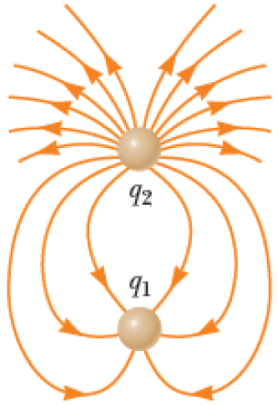
Consider the situation shown in figure. What are the signs of q1 and q2? If the lines are drawn in proportion to the charge, what is the ratio $\frac{\text{q}_1}{\text{q}_2}?$

View full solution
Q 203 Marks Question3 Marks
A water particle of mass 10.0mg and having a charge of 1.50 × 10-6C stays suspended in a room. What is the magnitude of electric field in the room? What is its direction?
View full solution
Two identical pith balls, each carrying a charge q, are suspended from a common point by two strings of equal length l. Find the mass of each ball if the angle between the strings is $2\theta$ in equilibrium.
View full solution
Positive charge Q is distributed uniformly over a circular ring of radius R. A particle having a mass m and a negative charge q, is placed on its axis at a distance x from the centre. Find the force on the particle. Assuming x << R, find the time period of oscillation of the particle if it is released from there.
View full solution
Consider a circular ring of radius r, uniformly charged with linear charge density $\lambda.$ Find the electric potential at a point on the axis at a distance x from the centre of the ring. Using this expression for the potential, find the electric field at this point.
View full solution
A particle A having a charge of 2.0 × 10-6C is held fixed on a horizontal table. A second charged particle of mass 80g stays in equilibrium on the table at a distance of 10cm from the first charge. The coefficient of friction between the table and this second particle is $\mu=0.2.$ Find the range within which the charge of this second particle may lie.
View full solution
Two particles A and B having charges q and 2q respectively are placed on a smooth table with a separation d. A third particle C is to be clamped on the table in such a way that the particles A and B remain at rest on the table under electrical forces. What should be the charge on C and where should it be clamped?
View full solution

Generate a Electric Field and Potential paper free

Pick question groups from the list above, set marks and difficulty, and export a branded PDF with step-by-step answer keys. First 3 chapters free — no signup.

Download App