MCQ
At which place, earth's magnetism become horizontal
  • A
    Magnetic pole
  • B
    Geographical pole
  • C
    Magnetic meridian
  • Magnetic equator

Answer

Correct option: D.
Magnetic equator
d
(d)At equator angle of dip is zero.

Need a full question paper?

Generate a complete, print-ready paper with questions like this in minutes — across 16+ boards, with answer keys.

Start Generating Free

Similar questions

If a concave lens is placed in path of converging rays real image will be produced if the distance of the pole from the point of convergence of incident rays lies between ($f =$ magnitude of focal length of lens)
Plane of eddy currents makes an angle with the plane of magnetic lines of force equal to.....$^o$
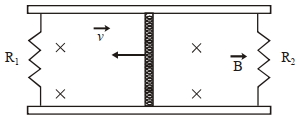
A conducting bar of length $L$ is free to slide on two parallel conducting rails as shown in the figure  Two resistors $R _{1}$ and $R _{2}$ are connected across the ends of the rails. There is a uniform magnetic field $\vec{B}$ pointing into the page. An external agent pulls the bar to the left at a constant speed $v$

The correct statement about the directions of induced currents $I _{1}$ and $I _{2}$ flowing through $R _{1}$ and $R _{2}$ respectively is
The electric field at a point on equatorial line of a dipole and direction of the dipole moment
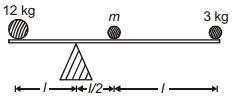
For equilibrium of the system, value of mass $m$ should be .......... $kg$
A particle of mass $m$ in a unidirectional potential field have potential energy $U(x)=\alpha+2 \beta x^2$, where $\alpha$ and $\beta$ are positive constants. Find its time period of oscillation.
A thin metal disc of radius $r$ floats on water surface and bends the surface downwards along the perimeter making an angle $\theta$ with vertical edge of the disc. If the disc displaces a weight of water $ W $ and surface tension of water is $T$, then the weight of metal disc is
In Jager's method, at the time of bursting of the bubble
Water enters through end $A$  with speed ${v_1}$ and leaves through end $B$ with speed ${v_2}$ of a cylindrical tube $AB$. The tube is always completely filled with water. In case $I$  tube is horizontal and in case $ II$  it is vertical with end $ A $ upwards and in case $ III $ it is vertical with end $B$ upwards. We have ${v_1} = {v_2}$ for
If force $({F})$, length $({L})$ and time $({T})$ are taken as the fundamental quantities. Then what will be the dimension of density