Question
Atomic number of a few elements are given below:
10, 20, 7, 14
  1. Identify the elements.
  2. Identify the Group number of these elements in the Periodic Table.
  3. Identify the Periods of these elements in the Periodic Table.
  4. What would be the electronic configuration for each of these elements?
  5. Determine the valency of these elements.
Answer

Atomic Number
10
20
7
14
Element
Neon
Calcium
Nitrogen
Silicon
Group Number
(8 + 10) = 18
2
(5 + 10) = 15
(4 + 10) = 14
Period Number
2nd
4th
2nd
3rd
Electronic Configuration
2, 8
2, 8, 8, 2
2, 5
2, 8, 4
Valency
Zero
2
(8 - 5) = 3
4

Need a full question paper?

Generate a complete, print-ready paper with questions like this in minutes — across 16+ boards, with answer keys.

Start Generating Free

Similar questions

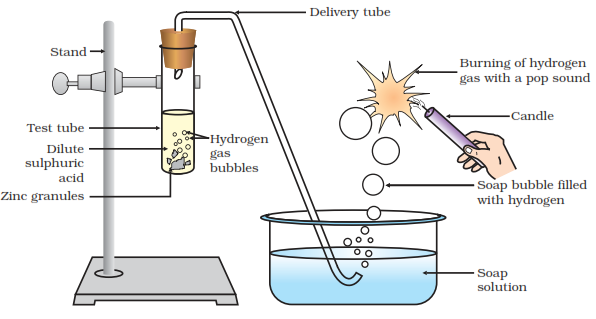
In the following schematic diagram for the preparation of hydrogen gas as shown in Figure, what would happen if following changes are made?

  1. In place of zinc granules, same amount of zinc dust is taken in the test tube.
  2. Instead of dilute sulphuric acid, dilute hydrochloric acid is taken.
  3. In place of zinc, copper turnings are taken.
  4. Sodium hydroxide is taken in place of dilute sulphuric acid and the tube is heated.
Why detergents are better cleansing agents than soaps? Explain.
When water is added gradually to a white solid X, a hissing sound is heard and a lot of heat is produced forming a product Y. A suspension of Y in water is applied to the walls of a house during white washing. A clear solution of Y is also used for testing carbon dioxide gas in the laboratory.
  1. What could be solid X? Write its chemical formula.
  2. What could be product Y? Write its chemical formula.
  3. What is the common name of the solution of Y which is used for testing carbon dioxide gas?
  4. Write chemical equation of the reaction which takes place on adding water to slid X.
  5. Which characteristic of chemical reactions is illustrated by this example?
Write the names and symbols of two very reactive metals belonging to group 1 of the periodic table. Explain by drawing electronic structure, how either one of the two metals reacts with a halogen. With which name is the bond formed between these elements known and what is the class of the compound so formed known? State any four physical properties of such compounds.
A salt X is formed and a gas is evolved when ethanoic acid reacts with sodium hydrogencarbonate. Name the salt X and the gas evolved. Describe an activity and draw the diagram of the apparatus to prove that the evolved gas is the one which you have named. Also, write chemical equation of the reaction involved.
Write the structural formulae of all the isomers of an alkane with seven C - atoms (C7H16).
An organic compound A having the molecular formula C3H8O is a liquid at room temperature. The organic liquid A reacts with sodium metal to evolve a gas which burns causing a little explosion. When the organic liquid A heated with concentrated sulphuric acid at 170°C, it forms a compound B which decolourizes bromine water. The compound B adds on one molecule of hydrogen in the presence of Ni as catalyst to forms compound C which gives substitution reactions with chlorine.
  1. What is compound A?
  2. What is compound B?
  3. What type of reaction occurs when A is converted into B?
  4. What is compound C?
  5. What type of reaction takes place when B is converted into C?
The following diagram shows a part of the periodic table in which the elements are arranged according to their atomic numbers.
(The letters given here are not the chemical symbols of the elements):
a
3
b
4
 
c
5
d
6
e
7
f
8
g
9
h
10
i
11
j
12
 
k
13
l
14
m
15
n
16
o
17
p
18
  1. Which element has a bigger atom, a or f?
  2. Which element has a higher valency, k or o?
  3. Which element is more metallic, i or k?
  4. Which element is more non-metallic, d or g?
  5. Select a letter which represents a metal of valency 2.
  6. Select a letter which represents a non-metal of valency 2.
You are provided with two containers made up of copper and aluminium. You are also provided with solutions of dilute HCl, dilute HNO3, ZnCl2 and H2O. In which of the above containers these solutions can be kept?
A metal X which is resistant to corrosion is produced by the electrolysis of its molten oxide whereas another metal Y which is also resistant to corrosion is produced by the reduction of its oxide with carbon. Metal X can be used in powder form in thermite welding whereas metal Y is used in making cathodes of ordinary dry cells.
  1. Name the metals X and Y.
  2. Which of the two metals is more reactive : X or Y?
  3. Name one ore or metal X. Also write its chemical formula.
  4. Name one ore of metal Y. Also write its chemical formula.
  5. Name one alloy of metal X and one alloy of metal Y.