Question
Attempt any five of the following:
$(a)$ Define native state in reference to proteins.
$(b)$ Define the following terms:
$a.$ Polysaccharides
$b.$ Nucleotides
$(c)$ Deficiency of which vitamin causes scurvy?
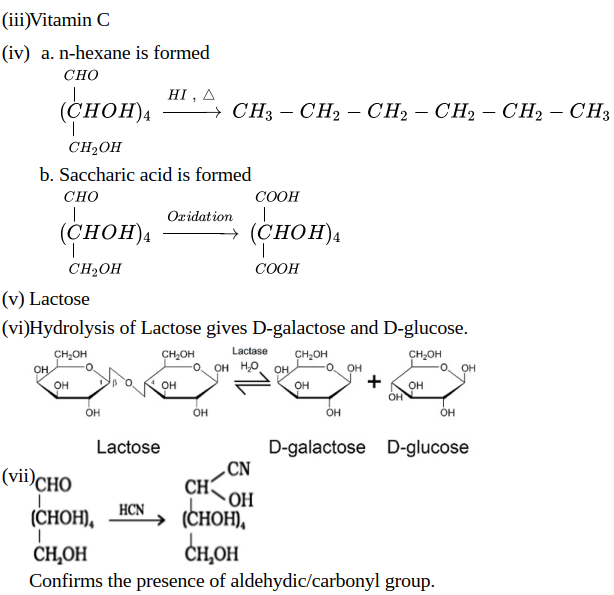
$(d)$ What happens when $D-$glucose is treated with the following? Give equations to support your answer.
$a. HI$
$b. HNO_3$
$(e) $Name the disaccharide which on hydrolysis gives glucose and galactose.
$(f)$ Write the products obtained after hydrolysis of lactose.
$(g)$ Give the reaction of glucose with hydrogen cyanide. Presence of which group is confirmed by this reaction?
Answer

Attempt any five of the following:
$(i)$ Native state of protein is the sequence in which the amino acids are linked together with the help of peptide bond.
$(ii) a.$ Polysaccharides contain a large number of monosaccharide units joined together by glycosidic linkages.
$b.$ Sugar $+$ Phosphate $+$ base  Nucleoside linked to a phosphate group.
Image

Need a full question paper?

Generate a complete, print-ready paper with questions like this in minutes — across 16+ boards, with answer keys.

Start Generating Free

Similar questions

(a) Write the principle of manufacture of sulphuric acid by contact process.###(b) Write the reaction of concentrated sulphuric acid with oxalic acid.
i. Write one chemical reaction for each
a. Carbylamine reaction
b. Acetylation reaction
ii. Write structure of N,N-ethylmethylethanamide
Match the statements given in Column $I$ with the oxidation states given in Column II.
  Column $I$   Column $II$
$(i)$ Oxidation state of Mn in $MnO2$ is $(a)$ $+2$
$(ii)$ Most stable oxidation state of $Mn$ is $(b)$ $+3$
$(iii)$ Most stable oxidation state of $Mn$ in oxides is $(c)$ $+4$
$(iv)$ Characteristic oxidation state of lanthanoids is $(d)$ $+5$
    $(e)$ $+7$
Why is the mass determined by measuring a colligative property in case of some solutes abnormal? Discuss it with the help of Van’t Hoff factor.
Describe the differences in the properties of lanthanoids and actinoids.
  1. Account for the following:
    1. Mn shows the highest oxidation state of $+7$ with oxygen but with fluorine it shows the highest oxidation state of $+4.$
    2. $Cr^{2+}$ is a strong reducing agent.
    3. $Cu^{2+}$ salts are coloured while $Zn^{2+}$ salts are white.
  2. Complete the following equations:
    1. $2\text{MnO}_{2} + 4\text{KOH} + \text{O}_{2} \xrightarrow{\Delta}$
    2. $\text{Cr}_{2}\text{O}^{2-}_{7}+ 14\text{H}^{+} + 6\text{I}^{-}\rightarrow.$
Primary alkyl halide C4H9Br (a) reacted with alcoholic KOH to give compound (b). Compound (b) is reacted with HBr to give (c) which is an isomer of (a). When (a) is reacted with sodium metal it gives compound (d), C8H18 which is different from the compound formed when n-butyl bromide is reacted with sodium. Give the structural formula of (a) and write the equations for all the reactions.
Discuss the different chemical properties of amines.
Define the following modes of expressing the concentration of a solution. Which of these modes are independent of temperature and why?
  1. w/w (mass percentage)
  2. V/V (volume percentage)
  3. w/V (mass by volume percentage)
  4. ppm. (parts per million)
  5. x (mole fraction)
  6. M (Molarity)
  7. m (Molality)
Describe graphically the experimental method of measuring the conductivity of electrolyte solutions (ionic solution).