$(a)$ Give plausible explanation for each of the following:
$i.$ Why are amines less acidic than alcohols of comparable molecular masses?
$ii.$ Why are primary amines highest boiling than tertiary amines?
$iii.$ Why are aliphatic amines stronger bases than aromatic amines?
$(b)$ Complete the following reactions:
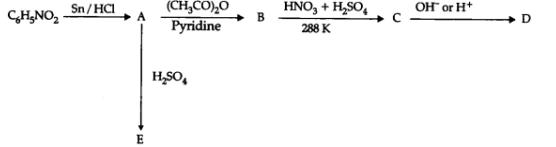
$i. C _6 H _5 N_2 Cl + C _2 H _5 OH \rightarrow$
$ii. C _6 H _5 NH _2+\left( CH _3 CO \right)_2 O \rightarrow$
Answer
$(a).\ i.$ Loss of proton from amines give ion whereas loss of a proton from alcohol gives an alkoxide ion.
Since $O$ is more electronegative than $N,$ therefore, $RO^-$ can accommodate the -ve charge more easily than $RNH^-.$ Consequently, $RO^-$ is more stable than $RNH^-.$ Thus, alcohols are more acidic than amines.
$ii.$ Primary amines $(RNH_2)$ have two hydrogen atoms on the $N$ atom and therefore, form intermolecular hydrogen bonding.Tertiary amines $(R_3N)$ donot have hydrogen atoms on the $N$ atom and therefore, these donot form hydrogen bonds. As a result of hydrogen bonding in primary amines, they have higher boiling points than tertiary amines of comparable molecular mass.
$iii.$ Both arylamines and alkylamines are basic in nature due to the presence of lone pair on $N-$atom. But arylamines are less basic than alkylamines.
$(b).$
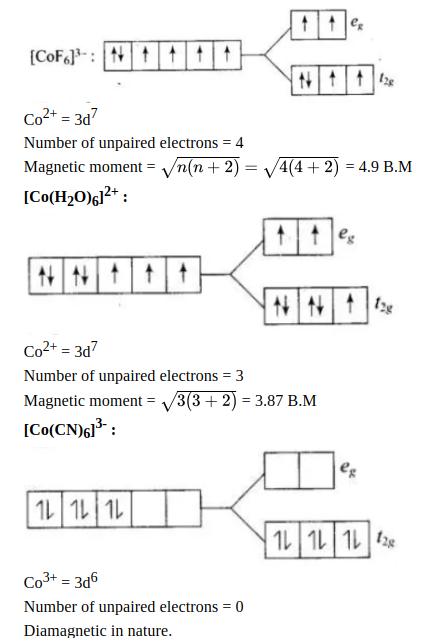
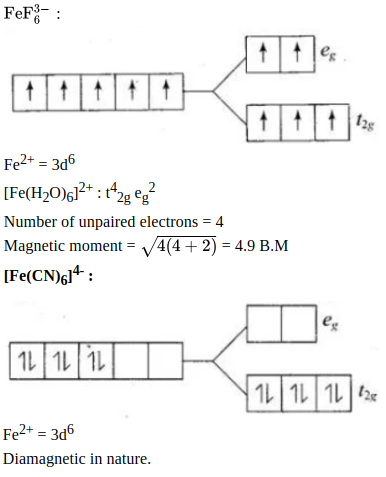
Using crystal field theory, draw energy level diagram, write the electronic configuration of the central metal atom/ion and determine the magnetic moment value in the following: i. $\left[ CoF _6\right]^{3-},\left[ Co \left( H _2 O \right)_6\right]^{2+},\left[ Co ( CN )_6\right]^{3-}$ ii. $\left[ FeF _6\right]^{3-},\left[ Fe \left( H _2 O \right)_6\right]^{2+},\left[ Fe ( CN )_6\right]^{4-}$
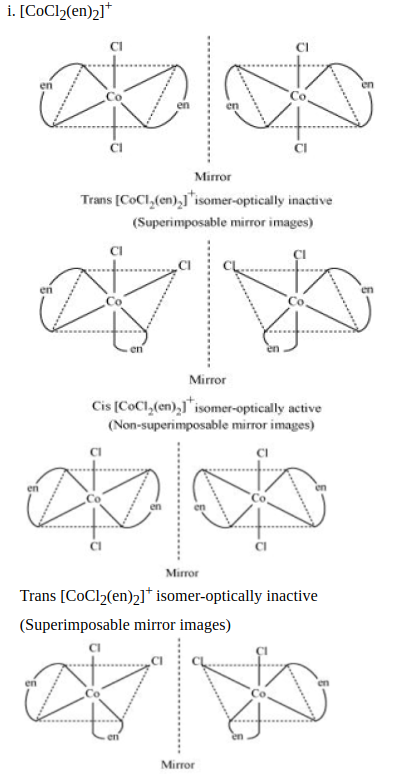
Draw all the isomers of: (geometrical and optical) i. $\left[ CoCl _2( en )_2\right]^{+}$ ii. $\left[ Co \left( NH _3\right) Cl ( en )^2\right]^{2+}$ iii. $\left[ Co \left( NH _3\right)_2 Cl _2( en )\right]^{+}$
Answer
Cis $\left[ CoCl _2( en )_2\right]^{+}$isomer-optically active (Non-superimposable mirror images) In total, three isomers are possible. ii. $\left[ Co \left( NH _3\right) Cl ( en )^2\right]^{2+}$ Trans-isomers are optically inactive. Cis-isomers are optically active. iii. $\left[ Co \left( NH _3\right)_2 Cl _2( en )\right]^{+}$
Attempt any five of the following:
$(a)$ Define native state in reference to proteins.
$(b)$ Define the following terms:
$a.$ Polysaccharides
$b.$ Nucleotides
$(c)$ Deficiency of which vitamin causes scurvy?
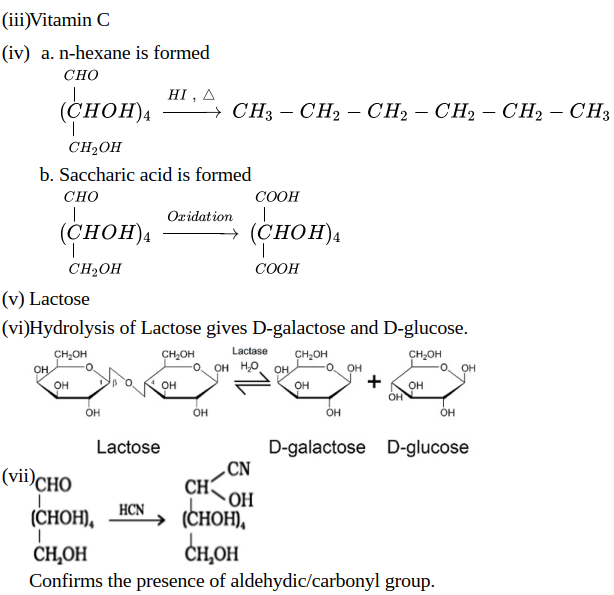
$(d)$ What happens when $D-$glucose is treated with the following? Give equations to support your answer.
$a. HI$
$b. HNO_3$
$(e) $Name the disaccharide which on hydrolysis gives glucose and galactose.
$(f)$ Write the products obtained after hydrolysis of lactose.
$(g)$ Give the reaction of glucose with hydrogen cyanide. Presence of which group is confirmed by this reaction?
Answer
Attempt any five of the following:
$(i)$ Native state of protein is the sequence in which the amino acids are linked together with the help of peptide bond.
$(ii) a.$ Polysaccharides contain a large number of monosaccharide units joined together by glycosidic linkages.
$b.$ Sugar $+$ Phosphate $+$ base Nucleoside linked to a phosphate group.