Question
Attempt any five of the following:
(a) Define native state in reference to proteins.
(b) Define the following terms:
    a. Polysaccharides
    b. Nucleotides
(c) Deficiency of which vitamin causes scurvy?
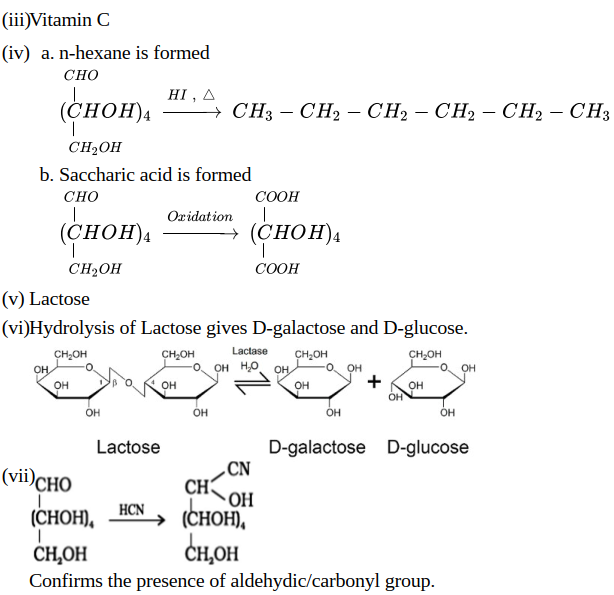
(d) What happens when D-glucose is treated with the following? Give equations to support your answer.
    a. HI
    b. HNO3
(e) Name the disaccharide which on hydrolysis gives glucose and galactose.
(f) Write the products obtained after hydrolysis of lactose.
(g) Give the reaction of glucose with hydrogen cyanide. Presence of which group is confirmed by this reaction?
Answer

Attempt any five of the following:
(i) Native state of protein is the sequence in which the amino acids are linked together with the help of peptide bond.
(ii) a. Polysaccharides contain a large number of monosaccharide units joined together by glycosidic linkages.
b. Sugar + Phosphate + base / Nucleoside linked to a phosphate group.
Image

Need a full question paper?

Generate a complete, print-ready paper with questions like this in minutes — across 16+ boards, with answer keys.

Start Generating Free

Similar questions

Discuss the nature of bonding in the following coordination entities on the basis of valence bond theory : 
(i) $\left[ Fe ( CN )_6\right]^{4-}$
(ii) $\left[ FeF _6\right]^{3-}$
(iii) $\left[ Co \left( C _2 O _4\right)_3\right]^{3-}$
(iv) $\left[ CoF _6\right]^{3-}$
Explain the limitations of valence bound theory.
i. How will you convert:
a. Nitrobenzene to phenol,
b. Aniline to chlorobenzene
Match the solutions given in Column I and the colours given in Column II.
 
Column I
(Aqueous solution of salt)
 
Column II
(Colour)
(i)
FeSO4.7H2O
(a)
Green
(ii)
NiCl2.4H2O
(b)
Light pink
(iii)
MnCl2.4H2O
(c)
Blue
(iv)
CoCl2.6H2O
(d)
Pale green
(v)
Cu2Cl2
(e)
Pink
 
 
(f)
Colourless
  1. A 10% solution (by mass) of sucrose in water has a freezing point of 269.15 K. Calculate the freezing point of 10% glucose in water if the freezing point of pure water is 273.15 K. Given:

(Molar mass of sucrose = 342 g mol-1)

(Molar mass of glucose = 180 g mol-1)

  1. Define the following terms:
  1. Molality (m)
  2. Abnormal molar mass
CoSO4Cl.5NH3 exists in two isomeric forms 'A' and 'B'. Isomer 'A' reacts with AgNO3 to give white precipitate but does not react with BaCl2. Isomer 'B' gives a white precipitate with BaCl2 but does not react with AgNO3. Answer the following questions.
i. Identify 'A' and 'B' and write their structural formulas.
ii. Name the type of isomerism involved.
iii. Give the IUPAC name of 'A' and 'B'.
  1. Explain the following:
  1. Henry's law about dissolution of a gas in a liquid.
  2. Boiling point elevation constant for a solvent.
  1. A solution of glycerol (C3H8O3) in water was prepared by dissolving some glycerol in 500 g of water. This solution has a boiling point of 100.42°C. What mass of glycerol was dissolved to make this solution? (Kb for water = 0.512 K kg mol–1).
How does colour appear in coordination compounds? Its explanation is based on crystal field theory.
Differentiate between DNA and RNA.
  1. 30 g of urea (M = 60 g mol-1) is dissolved in 846 g of water. Calculate the vapour pressure of water for this solution if vapour pressure of pure water at 298 K is 23.8 mm Hg.
  2. Write two differences between ideal solutions and non-ideal solutions.