MCQ
Auto-oxidation of bleaching powder gives
  • A
    only calcium chlorate
  • only calcium chloride
  • C
    only calcium hypochlorite
  • D
    both $(A)$ and $(B)$

Answer

Correct option: B.
only calcium chloride
b
$Br_2$, formed by adding chlorine water to a solution of $KBr$, further reacts with $Cl_2$ to form reddish yellow or orange red $BrCl$.

              $Br_2 + Cl_2 \to 2BrCl$

Need a full question paper?

Generate a complete, print-ready paper with questions like this in minutes — across 16+ boards, with answer keys.

Start Generating Free

Similar questions

Match the column

  Column $-I$   Column $-II$
$(a)$ $[Pt(NH_3)_3Cl]Br$ $(P)$ Coordination
isomerism
$(b)$ $[Cr(NH_3)_5(NCS)]^{+2}$ $(Q)$ Ionisation
isomerism
$(c)$ $[Co(H_2O)_6]Cl_3$ $(R)$ Linkase
isomerism
$(d)$ $[PtCl_4] [Pt(NH_3)_4]$ $(S)$ Hydrated
isomerism


Which of the following is correct order of acidity?
Which of the following pentoses will be optically active

$\begin{array}{*{20}{c}}{CHO}\\|\\{HCOH}\\|\\{HOCH}\\|\\{HCOH}\\|\\{C{H_2}OH}\\I\end{array}$                    $\begin{array}{*{20}{c}}{CHO}\\|\\{HCOH}\\|\\{HCOH}\\|\\{HOCH}\\|\\{C{H_2}OH}\\{II}\end{array}$            $\begin{array}{*{20}{c}}{CHO}\\|\\{HCOH}\\|\\{HCOH}\\|\\{HCOH}\\|\\{C{H_2}OH}\\{III}\end{array}$

Which of the following pairs of solutions are expected to be isotonic, temperature being the same?
Which of the following polymers are condensation polymers?
$a.$ Bakelite.
$b.$ Teflon.
$c.$ Butyl rubber.
$d.$ Melamine formaldehyde resin.
The reaction $2 NO + Br _2 \rightarrow 2 NOBr$

takes places through the mechanism given below :

$NO + Br _2 \Leftrightarrow NOBr _2 \text { (fast) }$

$NOBr _2+ NO \rightarrow 2 NOBr \text { (slow) }$

The overall order of the reaction is $.....$.
In the preparation of $\mathrm{HNO}_3,$ we get $NO$ gas by catalytic oxidation of ammonia. The moles of $NO$ produced by the oxidation of two moles of $\mathrm{NH}_3$ will be $......$
The reaction of an aldehyde with hydroxylamine gives a product which is called
Select the correct $I.U.P.A.C.$  name for $[Pt(NH_3)_4]$  $[PtCl_4]$
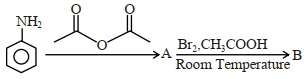
The major products $\mathrm{A}$ and $\mathrm{B}$ formed in the following reaction sequence are :