Questions · Page 1 of 32

M.C.Q (1 Marks)

🎯

Test yourself on this topic

50 questions · timed · auto-graded

MCQ 11 Mark
Given below are two statements:

Statement $I$: The boiling point of hydrides of Group $16$ elements follow the order

$\mathrm{H}_2 \mathrm{O}>\mathrm{H}_2 \mathrm{Te}>\mathrm{H}_2 \mathrm{Se}>\mathrm{H}_2 \mathrm{~S}$.

Statement $II$: On the basis of molecular mass, $\mathrm{H}_2 \mathrm{O}$ is expected to have lower boiling point than the othe members of the group but due to the presence of extensive $\mathrm{H}$-bonding in $\mathrm{H}_2 \mathrm{O}$, it has higher boiling point.

In the light of the above statements, choose the correct answer from the options given below:

  • A
     Both Statement $I$ and Statement $II$ are false
  • B
    Statement $I$ is true but Statement $II$ is false
  •  Statement $I$ is false but Statement $II$ is true
  • D
    Both Statement $I$ and Statement $II$ are true
Answer
Correct option: C.
 Statement $I$ is false but Statement $II$ is true
c
Statement $I$ is correct, because boiling point of hydrides of group $16$ follows the order

$\mathrm{H}_2 \mathrm{O}>\mathrm{H}_2 \mathrm{Te}>\mathrm{H}_2 \mathrm{Se}>\mathrm{H}_2 \mathrm{~S}$ .

Statement $II$ due to intermolecular $\mathrm{H}$-bonding $\mathrm{H}_2 \mathrm{O}$ shows higher boiling point than respective hydrides of group $16$.

(Both Statement are true)

Order from $\mathrm{H}_2 \mathrm{Te}$ to $\mathrm{H}_2 \mathrm{~S}$ is due to decreasing molar mass.
View full question & answer
MCQ 21 Mark
Among Group $16$ elements, which one does $NOT$ show $-2$ oxidation state?
  • A
    $\mathrm{Se}$
  • B
    $\mathrm{Te}$
  • C
     $\mathrm{Po}$
  • D
     $0$
View full question & answer
MCQ 31 Mark
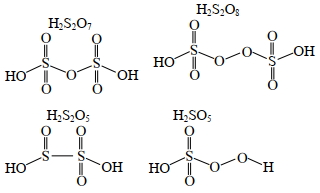
Match List$-l$ with List$-ll$ :

List$-I$ (Oxoacids of Sulphur) List$-II$ (Bonds)
$A$. Peroxodisulphuric acid $I$. Two $S - OH$, Four $S = O$, One $S - O - S$
$B$. Sulphuric acid $II$. Two $S - OH$, One $S = O$
$C$. Pyrosulphuric acid $III$. Two $S - OH$, Four $S = O$, One $S - O - O - S$
$D$. Sulphurous acid $IV$. Two $S - OH$, Two $S = O$

Choose the correct answer from the options given below.

  • A
    $A-III, B-IV, C-II, D-I$
  • B
    $A-I, B-III, C-II, D-IV$
  • C
    $A-III, B-IV, C-I, D-II$
  • D
    $A-I, B-III, C-IV, D-II$
View full question & answer
MCQ 41 Mark
The element expected to form largest ion to achieve the nearest noble gas configuration is
  • A
    $Na$
  • B
    $O$
  • C
    $F$
  • $N$
Answer
Correct option: D.
$N$
d
For isoelectronic species, as the charge on anion increases, ionic size increases So, $N$ forms $N ^{3-}$ anion with largest ionic size
View full question & answer
MCQ 51 Mark
Given below are two statements : one is labelled as Assertion $A$ and the other is labelled as Reason $F$

Assertion $A$: Helium is used to dilute oxygen in diving apparatus.

Reason $R:$ Helium has high solubility in $O _2$.

In the light of the above statements, choose the correct answer from the options given below

  • A
    $A$ is false but $R$ is true
  • B
    Both $A$ and $R$ are true and $R$ is the correct explanation of $A$
  • C
    Both $A$ and $R$ are true and $R$ is NOT the correct explanation of $A$
  • $A$ is true but $R$ is false
Answer
Correct option: D.
$A$ is true but $R$ is false
d
Helium is used as diluent for oxygen in modern diving apparatus because of its very low solubility in blood.

Gases diffuses easily with each other.

View full question & answer
MCQ 61 Mark
Given below are two statements : one is labelled as Assertion $A$ and the other is labelled as Reason $R:$

Assertion $A:$ Metallic sodium dissolves in liquid ammonia giving a deep blue solution, which is paramagnetic.

Reason $R:$ The deep blue solution is due to the formation of amide.

In the light of the above statements, choose the correct answer from the options given below :

  • A
    $A$ is false but $R$ is true
  • B
    Both $A$ and $R$ are true and $R$ is the correct explanation of $A$
  • C
    Both $A$ and $R$ are true but $R$ is NOT the correct explanation of $A$
  • $A$ is true but $R$ is false
Answer
Correct option: D.
$A$ is true but $R$ is false
d
On dissolving alkali metal (sodium) in liquid ammonia, a deep blue solution is developed due to ammoniated electron which absorbs energy in visible region of light and imparts blue colour. Due to unpaired electron, solution is paramagnetic.

$M +(x+y) NH _3 \rightarrow\left[ M \left( NH _3\right)\right]^{+}+\left[e\left( NH _3\right) y\right]^{-}$

So, assertion statement is correct but reason is incorrect.

View full question & answer
MCQ 71 Mark
Given below are two statements :

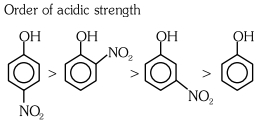
Statement $I:$ The acidic strength of monosubstituted nitrophenol is higher than phenol because of electron withdrawing nitro group.

Statement $II :$ $o-$nitrophenol, $m$-nitrophenol and $p$-nitrophenol will have same acidic strength as they have one nitro group attached to the phenolic ring.

In the light of the above statements, choose the most appropriate answer from the options given below:

  • A
    Both Statement $I$ and Statement $II$ are incorrect.
  • Statement $I$ is correct but Statement $II$ is incorrect.
  • C
    Statement $I$ is incorrect but Statement $II$ is correct.
  • D
    Both Statement $I$ and Statement $II$ are correct.
Answer
Correct option: B.
Statement $I$ is correct but Statement $II$ is incorrect.
b
Acidic strength of phenolic group increases due to electron withdrawing groups.
View full question & answer
MCQ 81 Mark
Given below are two statements :

Statement $I :$ The boiling points of the following hydrides of group $16$ elements increases in the order -
$H _{2} O < H _{2} S < H _{2} Se < H _{2} \text { Te. }$

Statement $II :$ The boiling points of these hydrides increase with increase in molar mass.
In the light of the above statements, choose the most appropriate answer from the options given below

  • Both Statement $I$ and Statement $II$ are incorrect
  • B
    Statement $I$ is correct but Statement $II$ is incorrect
  • C
    Statement $I$ is incorrect but Statement $II$ is correct
  • D
    Both Statement $I$ and Statement $II$ are correct
Answer
Correct option: A.
Both Statement $I$ and Statement $II$ are incorrect
a
Hydrides of group $16^{\text {th }}$

$H _{2} O \,\,\,\,\,\,\,\,\,\,\,\,\,\, \underbrace{ H _{2} S \,\,\, H _{2} Se \,\,\, H _{2} Te}$

$\,\,$H-Bond $\,\,\,\,\,\,\,\,\,\,$ VMA $\propto$ mol.wt.

$\text { B.P. } \rightarrow H _{2} S < H _{2} Se < H _{2} Te < H _{2} O$

View full question & answer
MCQ 91 Mark
Given below are two statements $:$ one is labelled as Assertion $(A)$ and the other is labelled as Reason $(R).$

Assertion $(A) :$ $I - Cl$ is more reactive than $I _{2}$.

Reason $(R):$ $I - Cl$ bond is weaker than $I-I$ bond.

In the light of the above statements, choose the most appropriate answer from the options given below:

  • A
    Both $(A)$ and $(R)$ are correct but $(R)$ is not the correct explanation of $(A).$
  • B
    $(A)$ is correct but $(R)$ is not correct.
  • C
    $(A)$ is not correct but $(R)$ is correct.
  • D
    Both $(A)$ and $(R)$ are correct and $(R)$ is the correct explanation of $(A).$
Answer
Interhalogen compound group $17^{\text {th }}$

$ICl$ is more reactive due to polar bonds.

$X-X'$ bond is weaker than $X - X$ bond except $F _{2}$

View full question & answer
MCQ 101 Mark
Statement $I :$ Acid strength increases in the order given as $\mathrm{HF}<\mathrm{HCl}<<\mathrm{HBr}<<\mathrm{HI}$

Statement $II :$ As the size of the elements $\mathrm{F}, \mathrm{Cl}, \mathrm{Br}, \mathrm{I}$ increases down the group, the bond strength of $\mathrm{HF}$, HCl, HBr and HI decreases and so the acid strength increases.

In the light of the above statements, choose the correct answer from the options given below.

  • A
    Both Statement $I$ and Statement $II$ are true.
  • B
    Both Statement $I$ and Statement $II$ are false.
  • C
    Statement $I$ is correct but Statement $II$ is false.
  • D
    Statement $I$ is incorrect but Statement $II$ is true.
Answer
In hydra acids acidic strength increases an moving down the group as acid easily release $\mathrm{H}^{+}$ and conjugate anion stabilise due to decrease in charge density
View full question & answer
MCQ 111 Mark
The correct sequence of bond enthalpy of $'\mathrm{C}-\mathrm{X}'$ bond is :
  • A
    $\mathrm{CH}_{3}-\mathrm{F}<\mathrm{CH}_{3}-\mathrm{Cl}<\mathrm{CH}_{3}-\mathrm{Br}<\mathrm{CH}_{3}-\mathrm{I}$
  • B
    $\mathrm{CH}_{3}-\mathrm{F}>\mathrm{CH}_{3}-\mathrm{Cl}>\mathrm{CH}_{3}-\mathrm{Br}>\mathrm{CH}_{3}-\mathrm{I}$
  • C
    $\mathrm{CH}_{3}-\mathrm{F}<\mathrm{CH}_{3}-\mathrm{Cl}>\mathrm{CH}_{3}-\mathrm{Br}>\mathrm{CH}_{3}-\mathrm{I}$
  • D
    $\mathrm{CH}_{3}-\mathrm{Cl}>\mathrm{CH}_{3}-\mathrm{F}>\mathrm{CH}_{3}-\mathrm{Br}>\mathrm{CH}_{3}-\mathrm{I}$
Answer
Bond enthalpy of $C-X$ bond

$\mathrm{CH}_{3}-\mathrm{F}>\mathrm{CH}_{3}-\mathrm{Cl}>\mathrm{CH}_{3}-\mathrm{Br}>\mathrm{CH}_{3}-\mathrm{I}$

Down the group with the increase in size of halogen in C-X bond, energy decreases.

View full question & answer
MCQ 121 Mark
Noble gases are named because of their inertness towards reactivity. Identify an incorrect statement about them.
  • A
    Noble gases are sparingly soluble in water.
  • B
    Noble gases have very high melting and boiling points.
  • Noble gases have weak dispersion forces.
  • D
    Noble gases have large positive values of electron gain enthalpy.
Answer
Correct option: C.
Noble gases have weak dispersion forces.
c
Fact
View full question & answer
MCQ 131 Mark
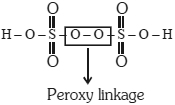
Which of the following oxoacid of sulphur has $- O - O -$ linkage $?$
  • A
    $H _{2} S _{2} O _{7},$ pyrosulphuric acid
  • B
    $H _{2} SO _{3},$ sulphurous acid
  • C
    $H _{2} SO _{4},$ sulphuric acid
  • $H _{2} S _{2} O _{8},$ peroxodisulphuric acid
Answer
Correct option: D.
$H _{2} S _{2} O _{8},$ peroxodisulphuric acid
d

View full question & answer
MCQ 141 Mark
Match the oxide given in column $A$ with its property given in column $B$

Column $A$ Column $B$
$(i) \;\mathrm{Na}_{2} \mathrm{O}$ $(a)$ Neutral
$(ii) \;\mathrm{Al}_{2} \mathrm{O}_{3}$ $(b)$ Basic
$(iii)\;\mathrm{N}_{2} \mathrm{O}$ $(c)$ Acidic
$(iv)\;\mathrm{Cl}_{2} \mathrm{O}_{7}$ $(d)$ Amphoteric

Which of the following options has all correct palrs

  • A
    $(i)-(b), (ii)-(a), (iii)-(d), (iv)-(c)$
  • B
    $(i)-(c), (ii)-(b), (iii)-(a), (iv)-(d)$
  • $(i)-(a), (ii)-(d), (iii)-(b), (iv)-(c)$
  • D
    $(i)-(b), (ii)-(d), (iii)-(a), (iv)-(c)$
Answer
Correct option: C.
$(i)-(a), (ii)-(d), (iii)-(b), (iv)-(c)$
c

View full question & answer
MCQ 151 Mark
Which is the correct thermal stablity order for $\mathrm{H}_{2} \mathrm{E}(\mathrm{E}=\mathrm{O}, \mathrm{S}, \mathrm{Se}, \text { Te and Po) } ?$
  • A
    $\mathrm{H}_{2} \mathrm{S} < \mathrm{H}_{2} \mathrm{O} < \mathrm{H}_{2} \mathrm{Se} < \mathrm{H}_{2} \mathrm{Te} < \mathrm{H}_{2} \mathrm{Po}$
  • $\mathrm{H}_{2} \mathrm{O} < \mathrm{H}_{2} \mathrm{S} < \mathrm{H}_{2} \mathrm{Se} < \mathrm{H}_{2} \mathrm{Te} < \mathrm{H}_{2} \mathrm{Po}$
  • C
    $\mathrm{H}_{2} \mathrm{Po} < \mathrm{H}_{2} Te  < \mathrm{H}_{2} \mathrm{Se} < \mathrm{H}_{2} \mathrm{S} < \mathrm{H}_{2} \mathrm{O}$
  • D
    $\mathrm{H}_{2} \mathrm{Se} < \mathrm{H}_{2} \mathrm{Te} < \mathrm{H}_{2} \mathrm{Po} < \mathrm{H}_{2} \mathrm{O} < \mathrm{H}_{2} \mathrm{S}$
Answer
Correct option: B.
$\mathrm{H}_{2} \mathrm{O} < \mathrm{H}_{2} \mathrm{S} < \mathrm{H}_{2} \mathrm{Se} < \mathrm{H}_{2} \mathrm{Te} < \mathrm{H}_{2} \mathrm{Po}$
b
$(A)$ $Pb _3 O _4$ is insoluble in water or do not react with water.

$(B)$ $2 KO _2+2 H _2 O \rightarrow 2 KOH + H _2 O _2+ O _{2( g )} \uparrow$

$(C)$ $Na _2 O _2+2 H _2 O \rightarrow 2 NaOH + H _2 O _2$

$(D)$ $Li _2 O _2+2 H _2 O \rightarrow 2 LiOH + H _2 O _2$

View full question & answer
MCQ 161 Mark
Identify the correct formula of oleum from the following
  • $H_2S_2O_7$
  • B
    $H_2SO_3$
  • C
    $H_2SO_4$
  • D
    $H_2S_2O_8$
Answer
Correct option: A.
$H_2S_2O_7$
a
Oleum $\to$ pyrosulphuric acid ($H_2S_2O_7$)
View full question & answer
MCQ 171 Mark
Which of the following oxoacids of phosphorus has strongest reducing property?
  • A
    $H_4P_2O_7$
  • B
    $H_3PO_3$
  • $H_3PO_2$
  • D
    $H_3PO_4$
Answer
Correct option: C.
$H_3PO_2$
c
Reducing property $\propto$ no. of $P-H$ bond $\mathrm{H}_{3} \mathrm{PO}_{2}$ contalns maximum $\mathrm{P}-\mathrm{H}$ bond
View full question & answer
MCQ 181 Mark
Match the Xenon compounds in Column$-I$ with its structure in Column$-II$ and assign the correct code

Column$-I$ Column$-II$
$(a)$ $\mathrm{XeF}_{4}$ $(i)$ pyramidal
$(b)$ $\mathrm{XeF}_{6} $ $(ii)$ square planar
$(c)$ $\mathrm{XeOF}_{4}$ $(iii)$ distorted octahedral
$(d)$ $\mathrm{XeO}_{3} $ $(iv)$ square pyramidal

code : $(a) \quad (b)\quad  (c) \quad (d)$

  • A
    $(i)\quad  (ii) \quad (iii) \quad (iv)$
  • $(ii)\quad  (iii) \quad (iv) \quad (i)$
  • C
    $(ii)\quad  (iii) \quad (i)\quad  (iv)$
  • D
    $(iii)\quad  (iv)\quad  (i)\quad  (ii)$
Answer
Correct option: B.
$(ii)\quad  (iii) \quad (iv) \quad (i)$
b
$\mathrm{XeF}_{4}-\mathrm{sp}^{3} \mathrm{d}^{2}, \quad$ square planar

$\mathrm{XeF}_{6}-\mathrm{sp}^{3} \mathrm{d}^{3}, \quad$ Distorted octahedral

$\mathrm{XeOF}_{4}-\mathrm{sp}^{3} \mathrm{d}^{2},\quad$ Square pyramidal

$\mathrm{XeO}_{3}-\mathrm{sp}^{3}, \quad$ Pyramidal

View full question & answer
MCQ 191 Mark
Match the following

(a) Pure nitrogen (i) Chlorine
(b) Haber process (ii) Sulphuric acid
(c) Contact process (iii) Ammonia
(d) Deacon's process (iv) Sodium azide or Barium azide

Which of the following is the correct option ?

$(a)\quad (b)\quad  (c) \quad (d)$

  • A
    $(i)\quad  (ii)\quad  (iii)\quad  (iv)$
  • B
    $(ii)\quad  (iv)\quad  (i)\quad  (iii)$
  • C
    $(iii)\quad  (iv)\quad  (ii)\quad  (i)$
  • $(iv) \quad (iii)\quad  (ii) \quad (i)$
Answer
Correct option: D.
$(iv) \quad (iii)\quad  (ii) \quad (i)$
d
Pure nitrogen $\Rightarrow$ Thermal decomposition of sodiumazide or Bariumazide

${\left(2 \mathrm{NaN}_{3} \stackrel{4}{\longrightarrow} 2 \mathrm{Na}+3 \mathrm{N}_{2}\right)}$

${\left(\mathrm{Ba}\left(\mathrm{N}_{3}\right)_{2} \stackrel{\Delta}{\longrightarrow} \mathrm{Ba}+3 \mathrm{N}_{2}\right)}$

Haber process $\Rightarrow$ Formation of Ammonia

$\left(\mathrm{N}_{2}+3 \mathrm{H}_{2} \rightleftharpoons 2 \mathrm{NH}_{3}\right)$

Contact process $\Rightarrow$ manufacture of $\mathrm{H}_{2} \mathrm{SO}_{4}$

Deacon's process $\Rightarrow$ Formation of $\mathrm{Cl}_{2}$ gas $\left(\mathrm{HCl}+\mathrm{O}_{2(\mathrm{Atmosphere})} \stackrel{\mathrm{cucl_2}}{\longrightarrow} \mathrm{H}_{2} \mathrm{O}+\mathrm{Cl}_{2}\right)$

View full question & answer
MCQ 201 Mark
The number of moles of hydrogen molecules required to produce $20$ moles of ammonla through Haber's process is
  • A
    $10$
  • B
    $20$
  • $30$
  • D
    $40$
Answer
Correct option: C.
$30$
c
$\mathrm{N}_{2}(\mathrm{g})+3 \mathrm{H}_{2}(\mathrm{g}) \rightarrow 2 \mathrm{NH}_{3}(\mathrm{g})$

$2\; mole \;\mathrm{NH}_{3}(\mathrm{g})$ requires $3\; mole \;\mathrm{H}_{2}(\mathrm{g})$

$20 \;mole\; \mathrm{NH}_{3}(\mathrm{g})$ requires

$=\frac{3}{2} \times 20 \text { mole } \mathrm{H}_{2}(\mathrm{g})$

$=30\;mole$

View full question & answer
MCQ 211 Mark
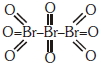
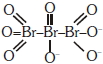
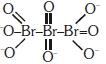
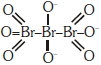
The correct structure of tribromooctaoxide is
  • A

  • B


  • D

Answer
Correct option: C.

c
$Xe +2 O _2 F _2 \rightarrow XeF _4+2 O _2$

$3 XeF _4+6 H _2 O \rightarrow 2 Xe + XeO _3+\frac{3}{2} O _2+12 HF$

$\therefore$ One mole of $XeF _4$ gives 4 moles of $HF$ on hydrolysis.

View full question & answer
MCQ 221 Mark
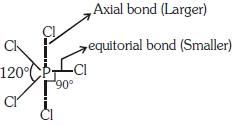
Identify the incorrect statement related to $\mathrm{PCl}_{5}$ from the following 
  • A
    Three equatorial $\mathrm{P}-\mathrm{Cl}$ bonds make an angle of $120^{\circ}$ with each other
  • B
    Two axial $\mathrm{P}-\mathrm{Cl}$ bonds make an angle of $180^{\circ}$ with each other
  • C
    Axial $\mathrm{P}-\mathrm{Cl}$ bonds are longer than equatorial  bonds
  • $\mathrm{PCl}_{5}$ molecule is non-reactive
Answer
Correct option: D.
$\mathrm{PCl}_{5}$ molecule is non-reactive
d
$\mathrm{PCl}_{5}$ is reactlive molecule
View full question & answer
MCQ 231 Mark
In the structure of $ClF_3$, the number of lone pairs of electrons on central atom $Cl$ is
  • A
    $1$
  • B
    $2$
  • C
    $4$
  • D
    $3$
Answer
$2$ lone pair at equitorial position.
View full question & answer
MCQ 241 Mark
The correct order of $N-$compounds in its decreasing order of oxidation states is
  • $\mathrm{HNO}_{3}, \mathrm{NO}, \mathrm{N}_{2}, \mathrm{NH}_{4} \mathrm{Cl}$
  • B
    $\mathrm{HNO}_{3}, \mathrm{NO}, \mathrm{NH}_{4} \mathrm{Cl}, \mathrm{N}_{2}$
  • C
    $\mathrm{HNO}_{3}, \mathrm{NH}_{4} \mathrm{Cl}, \mathrm{NO}, \mathrm{N}_{2}$
  • D
    $\mathrm{NH}_{4} \mathrm{Cl}, \mathrm{N}_{2}, \mathrm{NO}, \mathrm{HNO}_{3}$
Answer
Correct option: A.
$\mathrm{HNO}_{3}, \mathrm{NO}, \mathrm{N}_{2}, \mathrm{NH}_{4} \mathrm{Cl}$
a
$\mathrm{HNO}_{3} \to +5$

$\mathrm{NO} \to +2$

$\mathrm{N}_{2} \to 0$

$\mathrm{NH}_{4} \mathrm{Cl}\to -3$

View full question & answer
MCQ 251 Mark
Which of the following statements is not true for halogens ?
  • A
    All form monobasic oxyacids.
  • B
    All are oxidizing agents.
  • Chlorine has the highest electron-gain enthalpy.
  • D
    All but fluorine show positive oxidation states.
Answer
Correct option: C.
Chlorine has the highest electron-gain enthalpy.
c
$\begin{array}{l} HClO _3+ HCl \rightarrow \underset{\text { (Paramagnetic) }}{ ClO _2}+\frac{1}{2} Cl _2+ H _2 O \\ 2 ClO _2+2 O _3 \rightarrow Cl _2 O _6+2 O _2\end{array}$
View full question & answer
MCQ 261 Mark
Which oxide of nitrogen is not a common pollutant introduced into the atmosphere both due to natural and human activity ?
  • $N_2O_5$
  • B
    $NO_2$
  • C
    $N_2O$
  • D
    $NO$
Answer
Correct option: A.
$N_2O_5$
a
Nitrous oxide $(N_{2}O)$ occurs naturally in environment. In automobile engine, when fossil is burnt dinitrogen and dioxygen combine to yield $\mathrm{NO} \;and\; \mathrm{NO}_{2}$
View full question & answer
MCQ 271 Mark
Consider the following species 

$CN^+, CN^-, NO$ and $CN$

Which one of these will have the highest bond order?

  • A
    $NO$
  • $CN^-$
  • C
    $CN^+$
  • D
    $CN$
Answer
Correct option: B.
$CN^-$
b
lon/Species $\quad$Total electron $\quad$ Bond order

$\mathrm{NO} \quad \quad \quad \quad \quad 15 \quad \quad \quad \quad \quad \quad 2.5$

$\mathrm{CN}^{-} \quad \quad \quad \quad \;\;14 \quad \quad \quad \quad \quad \quad 3$

${\mathrm{CN}^{+}} \quad \quad \quad \quad \;\; {12} \quad \quad \quad \quad \quad \quad {2}$

${\mathrm{CN}} \quad \quad \quad \quad \quad {13}\quad \quad \quad \quad \quad \quad {2.5}$

View full question & answer
MCQ 281 Mark
Among halogens, the one which can oxidise water to oxygen is:
  • A
    chlorine
  • B
    bromine
  • fluorine
  • D
    iodine
Answer
Correct option: C.
fluorine
fluorine
View full question & answer
MCQ 291 Mark
Which of the following pairs shows highest bond dissociation enthalpy among halogens and lowest bond dissociation enthalpy among] hydrogen halides?
  • A
    $I _{2}, HI$
  • B
    $Cl _{2}, HCl$
  • C
    $Br _{2}, HBr$
  • D
    $Cl_2 , HI$
Answer
Bonus
View full question & answer
MCQ 301 Mark
Match the interhalogen compounds of  $column-I$ with the geometry in $column-II$ and assign the correct code.
Column $I$      Column $II$
$(A) \,XX '$ $(i)$ $T-$shape
$(B)\,XX'_3$ $(ii)$ Pentagonal bipyramidal
$(C)\,XX '_5$ $(iii)$ Linear
$(D)\,XX '_7$ $(iv)$ Square pyramidal
  $(v)$ Tetrahedral
  • $A-(iii),B-(i),C-(iv),D-(ii)$
  • B
    $A-(v),B-(iv),C-(iii),D-(ii)$
  • C
    $A-(iv),B-(iii),C-(ii),D-(i)$
  • D
    $A-(iii),B-(iv),C-(i),D-(ii)$
Answer
Correct option: A.
$A-(iii),B-(i),C-(iv),D-(ii)$
a
$(a)-(iii),$

$XX$ ' has linear geometry as only two atoms are present.

$(b)-(i)$

$XX _3^{\prime}$ has T-shaped geometry as $3$ bond pairs and $2$ lone pairs of electrons are present. The electron pair geometry is trigonal bipyramidal.

$(c)-(iv),$

$XX _5^{\prime}$ has Square - pyramidal geometry as $5$ bond pairs and $1$ lone pair of electrons are present. The electron pair geometry is octahedral.

$(d)-(ii)$

$XX _7^{\prime}$ has pentagonal bipyramidal geometry as $7$ bond pairs and $0$ lone pairs of electrons are present.

View full question & answer
MCQ 311 Mark
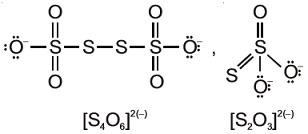
In which pair of ions both the species contain $S - S$ bond ?
  • $S_4O_6^{2-}, S_2O_3^{2-}$
  • B
    $S_2O_7^{2-}, S_2O_8^{2-}$
  • C
    $S_4O_6^{2-}, S_2O_7^{2-}$
  • D
    $S_2O_7^{2-}, S_2O_3^{2-}$
Answer
Correct option: A.
$S_4O_6^{2-}, S_2O_3^{2-}$
a

View full question & answer
MCQ 321 Mark
Strong reducing behaviour of $H _{3} PO _{2}$ is due to
  • A
    Low oxidation state of $P$
  • B
    Presence of one $-OH$ group and two $P-H$ bonds
  • C
    Presence of two $-OH$ groups and one $P-H$ bonds
  • Low coordination number of $P$
Answer
Correct option: D.
Low coordination number of $P$
d
$P$ ની નીચી કો-ઓર્ડિનેશન સંખ્યા
View full question & answer
MCQ 331 Mark
Match the compounds given in $column\, I$ with the hybridisation and shape given in $column\, II$ and mark the correct option.

 $\begin{array}{|l|l|} \hline Column\,\,I & Column\,\,II \\ \hline (A)\,XeF_6 & (i)\,\,distortedoctahedral \\ \hline (B)\,XeO_3 & (ii)\,\,square\,\,planar \\ \hline (C)\,XeOF_4 & (iii)\,\,pyramidal \\ \hline (D)\,XeF_4 & (iv)\,\,square\,\,pyramidal \\ \hline \end{array}$

  • A
    $A-(iv),B-(iii),C-(i),D-(ii)$
  • B
    $A-(iv),B-(i),C-(ii),D-(iii)$
  • $A-(i),B-(iii),C-(iv),D-(ii)$
  • D
    $A-(i),B-(ii),C-(iv),D-(iii)$
Answer
Correct option: C.
$A-(i),B-(iii),C-(iv),D-(ii)$
c
In $XeF _6$, the central $Xe$ atom undergoes $sp ^3 d ^3$ hybridisation and the molecular geometry is distorted octahedral with $1$ lone pair and $6$ bond pairs of electrons.

In $XeO _3$, the central $Xe$ atom undergoes $sp ^3$ hybridisation and the molecular geometry is pyramidal with $1$ lone pair and $3$ bonding domains of electrons.

In $XeOF _4$, the central $Xe$ atom undergoes $sp ^3 d ^2$ hybridization and the molecular geometry is square pyramidal with $1$ lone pair and $5$ bond pairs of electrons.

In $XeF _4$, the central $Xe$ atom undergoes $sp ^3 d ^2$ hybridization and the molecular geometry is square planar with $2$ lone pairs and $4$ bond pairs of electrons.

View full question & answer
MCQ 341 Mark
Among the following, the correct order of acidity is
  • A
    $HClO_2 < HClO < HClO_3 < HClO_4$
  • B
    $HClO_4 < HClO_2 < HClO < HClO_3$
  • C
    $HClO_3 < HClO_4 < HClO_2 < HCl$
  • $HClO < HClO_2 < HClO_3 < HClO_4$
Answer
Correct option: D.
$HClO < HClO_2 < HClO_3 < HClO_4$
d
Acidic strength $\propto E N \propto+v e$  $O . S .$

$H C l O < H C l O_{2} < H C l O_{3} < H C l O_{4}$

$+1\quad \quad +3\quad\quad\quad+5\quad\quad\quad+7$

View full question & answer
MCQ 351 Mark
Which one of the following orders is correct for the bond dissociation enthalpy of halogen molecules ?
  • A
    $Br_2 > I_2 > F_2 > Cl_2$
  • B
    $F_2 > Cl_2 > Br_2 > I_2$
  • C
    $I_2 > Br_2 > Cl_2 > F_2$
  • $Cl_2 > Br_2 > F_2 > I_2$
Answer
Correct option: D.
$Cl_2 > Br_2 > F_2 > I_2$
d
$\mathrm{Cl}_{2}>\mathrm{Br}_{2}>\mathrm{F}_{2}>\mathrm{I}_{2}$

Bond dissociation energy of $F_{2}$ less than $C l_{2}$ and $B r_{2}$ because small size of atom result in strong lone pair repulsion.

View full question & answer
MCQ 361 Mark
When copper is heated with conc. $HNO_3$ it produces
  • A
    $Cu(NO_3)_2, NO$ and $NO_2$
  • B
    $Cu(NO_3)_2$ and $N_2O$
  • $Cu(NO_3)_2$ and $NO_2$
  • D
    $Cu(NO_3)_2$ and $NO$
Answer
Correct option: C.
$Cu(NO_3)_2$ and $NO_2$
c
When copper react with conc. $HNO_3$ reddish brown gas $NO$, evolved

$\mathrm{Cu}+4 \mathrm{HNO}_{3} \longrightarrow \mathrm{Cu}\left(\mathrm{NO}_{3}\right)_{2}+2 \mathrm{H}_{2} \mathrm{O}+2 \mathrm{NO}_{2}$

View full question & answer
MCQ 371 Mark
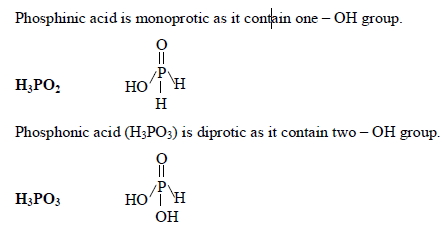
Which is the correct statement for the given acids ?
  • Phosphinic acid is a monoprotic acid while phosphonic acid is a diprotic acid.
  • B
    Phosphinic acid is a diprotic acid whilephosphonic acid is a monoprotic acid.
  • C
    Both are diprotic acids.
  • D
    Both are triprotic acids.
Answer
Correct option: A.
Phosphinic acid is a monoprotic acid while phosphonic acid is a diprotic acid.
a

View full question & answer
MCQ 381 Mark
Strong reducing behaviour of $H_3PO_2$ is due to
  • A
    low co-ordination number of phosphorus
  • B
    high oxidation state of phosphorus
  • C
    presence of two $-OH$ groups and one $P-H$ bond
  • presence of one $-OH$ group and two $P-H$ bonds.
Answer
Correct option: D.
presence of one $-OH$ group and two $P-H$ bonds.
d
Strong reducing behaviour of $\mathrm{H}_{3} \mathrm{PO}_{2}$

All oxy-acid of phosphorus which contain $\mathrm{P}-\mathrm{H}$ bond act as reductant.

presence of one -OH group and two $P-H$ bonds

View full question & answer
MCQ 391 Mark
Nitrogen dioxide and sulphur dioxide have some properties in common. Which property is shown by one of these compounds, but not by the other ?
  • A
    Is soluble in water.
  • Is used as a food preservative.
  • C
    Forms 'acid-rain'.
  • D
    Is a reducing agent.
Answer
Correct option: B.
Is used as a food preservative.
b
$S O_{2}$ is used as a food-preservative. It is an antioxidant.

$N O_{2}$ is not used as food preservative.

View full question & answer
MCQ 401 Mark
The variation of the boiling points ofthe hydrogen halides is in the order $HF > HI > HBr > HCl.$ What explains the higher boiling point of hydrogen fluoride ?
  • There is strong hydrogen bonding between $HF$ molecules.
  • B
    The bond energy of $HF$ molecules is greater than in other hydrogen halides.
  • C
    The effect of nuclear shielding is much reduced in fluorine which polarises the $HF$ molecule.
  • D
    The electronegativity of fluorine is much higher than for other elements in the group.
Answer
Correct option: A.
There is strong hydrogen bonding between $HF$ molecules.
a
Due to strong $H-$bonding in $HF$ molecule, boiling point is highest for $HF$

$\mathrm{HF} > \mathrm{Hl} > \mathrm{HBr} > \mathrm{Hl}$

View full question & answer
MCQ 411 Mark
Acidity of diprotic acids in aqueous solutions increases in the order
  • $H_2S < H_2Se < H_2Te$
  • B
    $H_2Se < H_2S < H_2Te$
  • C
    $H_2Te < H_2S < H_2Se$
  • D
    $H_2Se < H_2Te < H_2S$
Answer
Correct option: A.
$H_2S < H_2Se < H_2Te$
a
Acidic strength of hydrides increases as the size

of central atom increases which weakens the

$\mathrm{M}-\mathrm{H}$ bond. Since, the size increases from $\mathrm{S}$ to $\mathrm{Te}$

thus acidic strength follows the order.

$H_{2} S < H_{2} S e < H_{2} T e$

Acidic nature $\propto \frac{1}{\text { Bond disspciation enthalpy }}$

$S$ to $Te$ size increases, bond dissociation enthalpy

decreases and acidic nature increases.

View full question & answer
MCQ 421 Mark
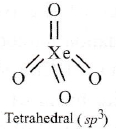
Identify the incorrect statement, regarding the molecule $XeO_4$ :
  • $XeO_4$ molecule is square planar.
  • B
    There are four $p\pi - d\pi$ bonds.
  • C
    There are four $sp^3 - p, \sigma$ bonds.
  • D
    $XeO_4$ molecule is tetrahedral.
Answer
Correct option: A.
$XeO_4$ molecule is square planar.
a

View full question & answer
MCQ 431 Mark
Which of the following does not give oxygen on heating ?
  • A
    $K_2Cr_2O_7$
  • $(NH_4)_2Cr_2O_7$
  • C
    $KClO_3$
  • D
    $Zn(ClO_3)_2$
Answer
Correct option: B.
$(NH_4)_2Cr_2O_7$
b
$\left(\mathrm{NH}_{4}\right)_{2} \mathrm{Cr}_{2} \mathrm{O}_{7} \stackrel{\Delta}{\longrightarrow} \mathrm{N}_{2}+\mathrm{Cr}_{2} \mathrm{O}_{3}+4 \mathrm{H}_{2} \mathrm{O}$ do not produces $\mathrm{O}_{2}$
View full question & answer
MCQ 441 Mark
Which of the following order is correct ?
  • A
    $He > Ne > Ar > Kr$ (Adsorption tendency)
  • B
    $He > Ne > Ar > Kr$ (Critical temperature)
  • C
    $He > Ne > Ar > Kr$ (Boiling point)
  • $Xe > Kr > Ar > Ne$ (Polarisation)
Answer
Correct option: D.
$Xe > Kr > Ar > Ne$ (Polarisation)
d
View full question & answer
MCQ 451 Mark
Order of liquification of noble gases is
  • A
    $He > Ne > Ar > Kr > Xe$
  • $Xe > Kr > Ar > Ne > He$
  • C
    $Ar > Kr > Xe > He > Ne$
  • D
    $Xe > Kr > Ne > He > Ar$
Answer
Correct option: B.
$Xe > Kr > Ar > Ne > He$
b
The ease of liquefaction decreases with decrease in critical temperature.

He has the lowest critical temperature $(5.1 \,K$ ) while $Rn$ has the highest critical temperature $(373.5\, K$ ). It increases as we move down the group from helium to radon.

The decrease of the critical temperature follows the trend $Xe \,>\, Kr \,>\, Ar \,>\,Ne\, >\, He$ and hence, the same trend is followed for liquefaction.

View full question & answer
MCQ 461 Mark
Which of the following gases is adsorbed to maximum extent
  • A
    $He$
  • B
    $Ne$
  • C
    $Ar$
  • $Xe$
Answer
Correct option: D.
$Xe$
d
View full question & answer
MCQ 471 Mark
$\mathop {Xe\,\, + \,\,{F_2}}\limits_{(1:20)} \,\xrightarrow{{573\,\,K,60.70\,\,bar}}A$

What is $A$

  • $XeF_6$
  • B
    $XeF_5$
  • C
    $XeF_2$
  • D
    $XeF_4$
Answer
Correct option: A.
$XeF_6$
a
View full question & answer
MCQ 481 Mark
Which of the following is not correct for given reaction

$Xe{F_6}\,\xrightarrow{{ + {H_2}O}}A\,\xrightarrow{{ + {H_2}O}}B\,\xrightarrow{{ + {H_2}O}}C$

  • A
    $C$ is $XeO_3$ and pyramidal in shape
  • $B$ is $XeOF_2$
  • C
    $A$ is $XeOF_4$ and has $sp^3d^2$ hybridisation
  • D
    $A,\,B$ and $C$ have same oxidation state of $Xe$
Answer
Correct option: B.
$B$ is $XeOF_2$
b
View full question & answer
MCQ 491 Mark
Which of the following Xenon compound does not produce explosive $XeO_3$ on its complete hydrolysis?
  • A
    $XeO_2F_2$
  • $XeF_2$
  • C
    $XeF_4$
  • D
    $XeF_6$
Answer
Correct option: B.
$XeF_2$
b
$(a)$ $\mathrm{X} \mathrm{eO}_{2} \mathrm{F}_{2}+\mathrm{H}_{2} \mathrm{O} \longrightarrow \mathrm{XeO}_{3}+2 \mathrm{HF}$

$(b)$ $2 \mathrm{XeF}_{2}+2 \mathrm{H}_{2} \mathrm{O} \rightarrow 2 \mathrm{Xe}+4 \mathrm{HF}+\mathrm{O}_{2}$

$(c)$ $6 \mathrm{XeF}_{4}+12 \mathrm{H}_{2} \mathrm{O} \longrightarrow 4 \mathrm{Xe}+2 \mathrm{XeO}_{3}+24 \mathrm{HF}+3 \mathrm{O}_{2}$

$(d)$ $\mathrm{XeF}_{6}+3 \mathrm{H}_{2} \mathrm{O} \longrightarrow \mathrm{XeO}_{3}+6 \mathrm{HF}$

View full question & answer
M.C.Q (1 Marks) - Chemistry STD 12 Science Questions - Vidyadip