MCQ
Average speed of a car between points A and B is 20m/s, between B and C is 15m/s, between C and D is 10m/s. What is the average speed between A and D, if the time taken in the mentioned sections is 20s, 10s and 5s respectively?
  • A
    17.14 m/s
  • B
    15 m/s
  • C
    10 m/s
  • D
    45 m/s

Answer

  1. 17.14 m/s

Explanation:

Average speed is the total distance divided by total time taken.

Total displacement (d = vt) = 20 × 20 + 15 × 10 + 10 × 5 = 600m.

Total time = 20 + 10 + 5 = 35s.

Therefore, average speed $=\frac{600}{35}=17.14\text{m}/\ \text{s}.$

Need a full question paper?

Generate a complete, print-ready paper with questions like this in minutes — across 16+ boards, with answer keys.

Start Generating Free

Similar questions

The vectors $\vec{A}$ and $\vec{B}$ are such that

$|\vec{A}+\vec{B}|=|\vec{A}-\vec{B}|$

The angle between the two vectors is

The pressure at the bottom of a tank of water is $3P$ where $P$ is the atmospheric pressure . If the water is drawn out till the level of water is lowered by one fifth., the pressure at the bottom of the tank will now be
The $x$ and $y$ coordinates of a particle at any time $t$ are given by $x = 7t + 4{t^2}$ and $y = 5t$, where $x$ and $y$ are in metre and $t$ in seconds. The acceleration of particle at $t = 5\;s$ is.........$m/{s^2}$
A diatomic gas $(\gamma=1.4)$ does $400 J$ of work when it is expanded isobarically. The heat given to the gas in the process is ............ $J$
A force of $F=(5 y+20) \hat{j} \,N$ acts on a particle. The work done by this force when the particle is moved from $y=0 \,m$ to $y=10 \,{m}$ is $...\,{J}.$
Two bodies $M$ and $N $ of equal masses are suspended from two separate massless springs of force constants $k_1$ and $k_2$ respectively. If the two bodies oscillate vertically such that their maximum velocities are equal, the ratio of the amplitude $M$ to that of $N$ is
A fruit hanging from the top branch of a tree possesses:
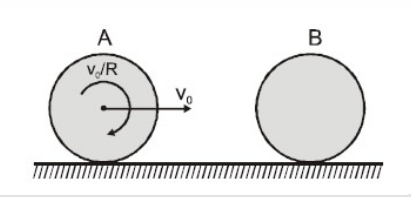
A hollow smooth uniform sphere A of mass m rolls without sliding on a smooth horizontal surface. It collides elastically and head-on with another stationary smooth hollow sphere B of the same mass mm and same radius. The ratio of the kinetic energy of B to that of A just after the collision is:
If the force and displacement of particle in the direction of force are doubled, then work done would be:
A bullet hits and gets embedded in a solid block resting on a horizontal frictionless table. What is conserved ?