MCQ
$A\xrightarrow{{}}{(C{H_3})_2}C = CHCOC{H_3}\,\,\,\,A$  is
  • Acetone
  • B
    Acetaldehyde
  • C
    Propionaldehyde
  • D
    Formaldehyde

Answer

Correct option: A.
Acetone
a
(a)Two molecules of acetone condense in presence of dry $HCl$ gas to form mesityl oxide.

$\begin{array}{*{20}{c}}
  {C{H_3}} \\ 
  {C{H_3}} 
\end{array} > C = O\, + \,$ $\begin{array}{*{20}{c}}
  {\,\,\,\,\,\,\,\,\,\,\,\,\,O} \\ 
  {\,\,\,\,\,\,\,\,\,\,\,\,||} \\ 
  {{H_2} - CH - C - C{H_3}} 
\end{array}$ $\xrightarrow[{ - \,{H_2}O}]{{HCl}}$ $\mathop {{{(C{H_3})}_2}C = CH.COC{H_3}}\limits_{Mesityl\,\,oxide} $

Need a full question paper?

Generate a complete, print-ready paper with questions like this in minutes — across 16+ boards, with answer keys.
Start Generating Free

Similar questions

Consider a plane parallel beam of light incident on a plano-cylindrical lens as shown below. Which of the following will you observe on a screen placed at the focal plane of the lens?
The half-life of a particle of mass $1.6 \times 10^{-26} \,kg$ is $6.9 \,s$ and a stream of such particles is travelling with the kinetic energy of a particle being $0.05 \,eV$. The fraction of particles which will decay, when they travel a distance of $1 \,m$ is
In the Arctic region, hemispherical houses called Igloos are made of ice. It is possible to maintain a temperature inside an Igloo as high as $20^{\circ} C$ because
A particle is moving along a circle such that it completes one revolution in $40$ seconds. In $2$ minutes $20$ seconds, the ratio $\frac{\mid \text { displacement } \mid}{\text { distance }}$ is .........
A hot air balloon with a payload rises in the air. Assume that the balloon is spherical in shape with diameter of $11.7 \,m$ and the mass of the balloon and the payload (without the hot air inside) is $210 \,kg$. Temperature and pressure of outside air are $27^{\circ} C$ and $1 atm =10^5 \,N / m ^2$, respectively. Molar mass of dry air is $30 \,g$. The temperature of the hot air inside is close to .......... $^{\circ} C$ [The gas constant, $R=8.31 \,JK ^{-1} mol ^{-1}$ ]
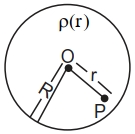
A spherically symmetric charge distribution is considered with charge density varying as

$\rho(r)=\left\{\begin{array}{ll}\rho_{0}\left(\frac{3}{4}-\frac{r}{R}\right) & \text { for } r \leq R \\ \text { Zero } & \text { for } r>R\end{array}\right.$

Where, $r ( r < R )$ is the distance from the centre $O$ (as shown in figure). The electric field at point $P$ will be.
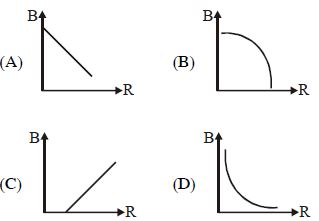
Which of the following graphs correctly represents the variation of magnetic field with distance $R$ from a long straight current carrying conductor ?
A paramagnetic sample shows a net magnetisation of $6 \,A / m$ when it is placed in an external magnetic field of $0.4 \,T$ at a temperature of $4\, K$. When the sample is placed in an external magnetic field of $0.3\, T$ at a temperature of $24\, K$, then the magnetisation will be$......A/m$
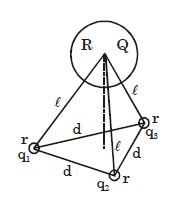
Three identical uncharged metal spheres are at the vertices of an equilateral triangle. One at a time, a small sphere is connected by a conducting wire with a large metal sphere that is charged. The center of the large sphere is in the straight line perpendicular to the plane of equilateral triangle and passing through its centre (see figure). As a result, the first small sphere acquires charge $q_1$ and second charge $q_2 (q_2 < q_1)$ . The charge that the third sphere $q_3$ will acquire is (Assume $l >> R$ , $l >> r$ , $d >> R$ , $d >> r$ )
A small satellite is revolving near earth's surface. Its orbital velocity will be nearly......... $km/sec$