In the Arctic region, hemispherical houses called Igloos are made of ice. It is possible to maintain a temperature inside an Igloo as high as $20^{\circ} C$ because
KVPY 2012, Medium


Download our appand get started for free
Experience the future of education. Simply download our apps or reach out to us for more information. Let's shape the future of learning together!No signup needed.*
Similar Questions
- 1$Assertion :$ A tube light emits white light.View Solution
$Reason :$ Emission of light in a tube takes place at a very high temperature. - 2The sun radiates electromagnetic energy at the rate of $3.9 \times 10^{26}\,W$. It's radius is $6.96 \times 10^8\,m$. The intensity of sun light at the solar surface will be (in $W/m^2$)View Solution
- 3View SolutionThe velocity of heat radiation in vacuum is
- 4$Assertion :$ A hollow metallic closed container maintained at a uniform temperature can act as a source of black body radiation.View Solution
$Reason :$ All metals act as black bodies. - 5rod of $40\, cm$ in length and temperature difference of ${80^o}C$ at its two ends. $A$ nother rod $B$ of length $60\, cm$ and of temperature difference ${90^o}C$, having the same area of cross-section. If the rate of flow of heat is the same, then the ratio of their thermal conductivities will beView Solution
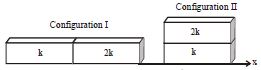
- 6Two rectangular blocks, having identical dimensions, can be arranged either in configuration $I$ or in configuration $II$ as shown in the figure. One of the blocks has thermal conductivity $k$ and the other $2k$. The temperature difference between the ends along the $x-$ axis is the same in both the configurations. It takes $9s$ to transport a certain amount of heat from the hot end to the cold end in the configuration $I$. The time to transport the same amount of heat in the configuration $II$ is .......... $\sec$View Solution
- 7View SolutionAccording to Wein's law
- 8A liquid in a beaker has temperature $\theta (t)$ at time $t$ and $\theta_0$ is temperature of surroundings, then according to Newton's law of cooling the correct graph between loge $log_e(\theta - \theta_0) $ and $t$ isView Solution
- 9An incandescent bulb has a thin filament of tungsten that is heated to high temperature by passing an electric current. The hot filament emits black-body radiation. The filament is observed to break up at random locations after a sufficiently long time of operation due to non-uniform evaporation of tungsten from the filament. If the bulb is powered at constant voltage, which of the following statement($s$) is(are) true?View Solution
($A$) The temperature distribution over the filament is uniform
($B$) The resistance over small sections of the filament decreases with time
($C$) The filament emits more light at higher band of frequencies before it breaks up
($D$) The filament consumes less electrical power towards the end of the life of the bulb
- 10Two spherical stars $A$ and $B$ emit blackbody radiation. The radius of $A$ is $400$ times that of $B$ and $A$ emits $10^4$ times the power emitted from $B$. The ratio $\left(\lambda_A / \lambda_B\right)$ of their wavelengths $\lambda_A$ and $\lambda_B$ at which the peaks occur in their respective radiation curves isView Solution