Question
Balance $\text{P}+\text{HNO}_3\xrightarrow{ \ \ \ \ \ \ \ \ }\text{H}_3\text{PO}_4+\text{NO}_2+\text{H}_2\text{O}$ by oxidation number method.
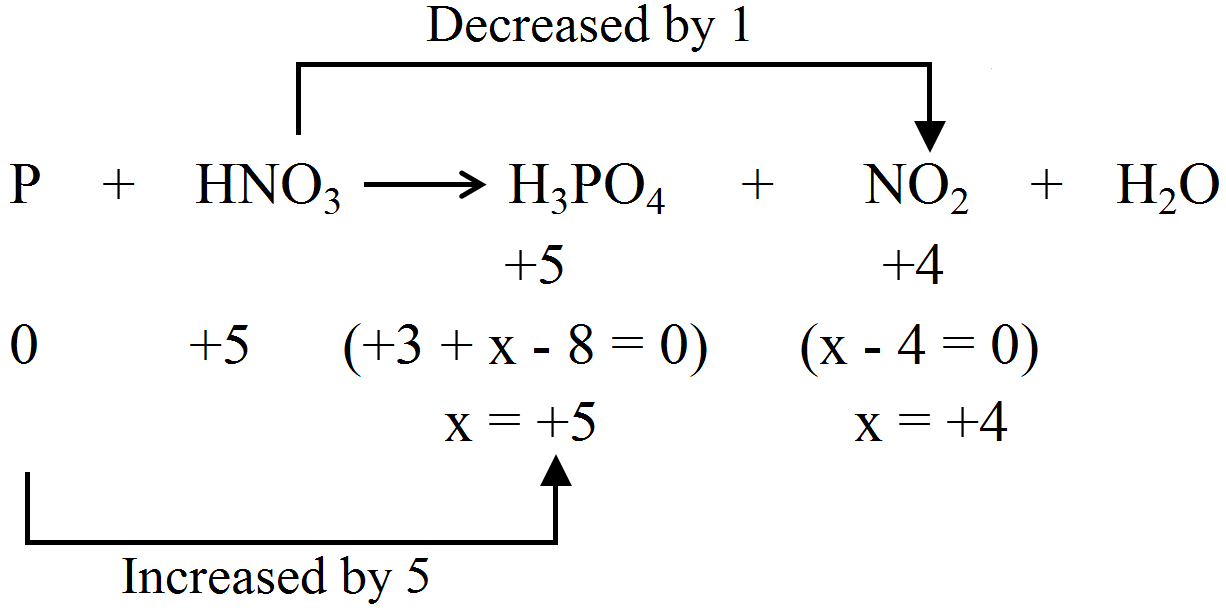
Answer


Multiply P by l, HNO3 by 5, we get$\text{P}+5\text{HNO}_3\xrightarrow{ \ \ \ \ \ \ \ \ }\text{H}_3\text{PO}_4+5\text{NO}_2+\text{H}_2\text{O}$

Need a full question paper?

Generate a complete, print-ready paper with questions like this in minutes — across 16+ boards, with answer keys.

Start Generating Free

Similar questions

Hydrocarbon A (molecular formula is $C _5 H _8$ ) gave a white precipitate with ammoniacal silver nitrate. Oxidation of A with hot alkaline $KMnO _4$ gave 2-methyl propanoic acid. What is the structural formula of A?
The first ($(\Delta_{1}\text{H}_{1})$ and the second $(\Delta_{1}\text{H}_{1})$ ionization enthalpies (in kJ mol–1) and the $(\Delta_{1}\text{H}_{1})$ electron gain enthalpy (in kJ mol–1) of a few elements are given below:
Elements $\Delta\text{H}_{1}$ $\Delta{\text{H}}_{2}$ $\Delta_{\text{eg}}\text{H}$
I 520 7300 -60
II 419 3051 -48
III 1681 3374 -328
IV 1008 1846 -295
V 2372 5251 +48
VI 738 1451 -40
Which of the above elements is likely to be:
The most reactive non-metal.
(a) Calculate number of significant figures in following.
(i) mass of proton $=1.672 \times 10^{-24} gm$
(ii) mass of electron $=9.108 \times 10^{-28} gm$
(b) Express the following in scientific notation?
(i) 7067(ii) 738.5
How many seconds are there in 2 days?
Explain the Lewis concept of acid and base? How it is different from Bronsted-Lowry concept? Explain.
Eka-aluminium and eka-silicon were the names given by Mandeleev for the then unknown elements gallium and germanium respectively. A recently discovered element was first named as eka-mercury. What is its atomic number? Write its group number, electronic configuration, IUPAC and official names.
The $\text{H}-\text{S}-\text{H}$ bond angle in H2S is 92.2° whereas the $\text{H}-\text{O}-\text{H}$ bond angle in H2O is 104.5°, why?
Calcium carbonate reacts with aqueous HCl to give $CaCl _2$ and $CO _2$ according to the reaction, $CaCO _3(s)+2 HCl ( aq ) \rightarrow CaCl _2( aq )+ CO _2(g)+ H _2 O ( l )$
What mass of $CaCO _3$ is required to react completely with 25 mL of 0.75 M HCl ?
  1. CO is isoelectronic with which of the following compounds:

$\text{NO}^+,\text{N}_2,\text{SnCl}_2,\text{NO}^-_2$

  1. Which of the following species have the same shape?

$\text{CO}_2\text{CCl}_4,\text{O}_3,\text{NO}^-_2$

Describe the effect of :
(a) addition of $H _2$
(b) addition of $CH _3 OH$
(c) removal of CO
(d) removal of $CH _3 OH$
on the equilibrium of the reaction :
$
2 H_2(g)+CO(g) \rightleftharpoons CH_3 OH(g)
$