Question 12 Marks
Consider the elements: Cs, Ne, I and F
Identify the element that exhibits both positive and negative oxidation states.
AnswerI. Because of the presence of seven electrons in the valence shell, I shows an oxidation state of -1 (in compounds of I with more electropositive elements such as H, Na, K, Ca, etc.) or an oxidation state of +1 compounds of I with more electronegative elements, i.e., O, F, etc.) and because of the presence of d-orbitals it also exhibits +ve oxidation states of +3, +5 and +7.
View full question & answer→Question 22 Marks
Assign oxidation number to the underlined elements in the following species:
H2S2O7
Answer$\begin{matrix} +1&\text{x}&-2\\\text{H}_2&\text{ S}_2&\ \text{ O}_7\end{matrix}$ Then, we have
2(+1) + 2(x) + 7(-2) = 0
⇒ 2 + 2x - 14 = 0
⇒ 2x = 12
⇒ x = +6
Hence, the oxidation number of S is +6.
View full question & answer→Question 32 Marks
Assign oxidation number to the underlined elements in the following species:
H4P2O7
Answer$\begin{matrix} +1&\text{x}&-2\\\text{H}_4&\text{ P}_2&\ \text{ O}_7\end{matrix}$ Then, we have
4(+1) + 2(x) + 7(-2) = 0
⇒ 4 + 2x - 14 = 0
⇒ 2x = +10
⇒ x = +5
Hence, the oxidation number of P is +5.
View full question & answer→Question 42 Marks
Assign oxidation number to the underlined elements in the following species:
NaBH4
Answer$\begin{matrix} +1&\text{x}&-1\\\text{Na}&\text{ B}&\ \text{ H}_4\end{matrix}$ Then, we have
1(+1) + 1(x) + 4(-1) = 0
⇒ 1 + x - 4 = 0
⇒ x = +3
Hence, the oxidation number of B is +3.
View full question & answer→Question 52 Marks
Assign oxidation number to the underlined elements in the following species:
KAl(SO4)2 .12 H2O
Answer$\stackrel{{+1}}{\hbox{k}}\ \stackrel{\ {3+}}{\hbox{Al}}\Big(\stackrel{{\text{x}}}{\hbox{S}}\ \stackrel{{2-}}{\hbox{O}_4}\Big)_2.12\stackrel{{+1}}{\ \hbox{H}_2}\stackrel{{-2}}{\ \ \hbox{O}}$ Then, we have
1(+1) + 1(+3) + 2(x) + 8(-2) + 24(+1) + 12(-2)=0
⇒ 1 + 3 + 2x - 16 + 24 - 24 = 0
⇒ 2x = 12
⇒ x = +6
Or,
We can ignore the water molecule as it is a neutral molecule. Then, the sum of the oxidation numbers of all atoms of the water molecule may be taken as zero. Therefore, after ignoring the water molecule, we have
1(+1) + 1(+3) + 2(x) + 8(-2) = 0
⇒ 1 + 3 + 2x - 16 = 0
⇒ 2x = 12
⇒ x = +6
Hence, the oxidation number of S is + 6.
View full question & answer→Question 62 Marks
Assign oxidation number to the underlined elements in the following species:
K2MnO4
Answer$\begin{matrix} +1&\text{x}&-2\\\text{K}_2&\text{ Mn}&\ \text{ O}_4\end{matrix}$ Then, we have
2(+1) + x + 4(-2) = 0
⇒ 2 + x - 8 = 0
⇒ x = +6
Hence, the oxidation number of Mn is +6.
View full question & answer→Question 72 Marks
Assign oxidation number to the underlined elements in the following species:
NaHSO4
Answer$\begin{matrix}\ \ +1&+1&\text{x}&-2\\\Rightarrow\ \text{Na}& \ \ \text{ H} &\text{S}&\ \text{ O}_4\end{matrix}$ Then, we have
1(+1) + 1(+1) + 1(x) + 4(-2) = 0
⇒ 1 + 1 + x - 8 = 0
⇒ x = +6
Hence, the oxidation number of S is +6.
View full question & answer→Question 82 Marks
Assign oxidation number to the underlined elements in the following species:
CaO2
Answer$\begin{matrix} +2&\text{x}\\\text{Ca}&\text{ O}_2\end{matrix}$ Then, we have
(+2) + 2(x) = 0
⇒ 2 + 2x = 0
⇒ x = -1
Hence, the oxidation number of O is -1.
View full question & answer→Question 92 Marks
The compound AgF2 is unstable compound. However, if formed, the compound acts as a very strong oxidising agent. Why?
AnswerThe oxidation state of Ag in AgF2 is +2. But, +2 is an unstable oxidation state of Ag. Therefore, whenever AgF2is formed, silver readily accepts an electron to form Ag+. This helps to bring the oxidation state of Ag down from +2 to a more stable state of +1. As a result, AgF2 acts as a very strong oxidizing agent.
View full question & answer→Question 102 Marks
Assign oxidation number to the underlined elements in the following species:
NaH2PO4
AnswerLet the oxidation number of P be x. We know that, Oxidation number of Na = +1 Oxidation number of H = +1 Oxidation number of O = -2 $\begin{matrix}\ \ +1&+1&\text{x}&-2\\\Rightarrow\ \text{Na}& \ \ \text{ H}_2 &\text{P}&\ \text{ O}_4\end{matrix}$ Then, we have 1(+1) + 2(+1) + 1(x) + 4(-2) = 0 ⇒ 1 + 2 + x - 8 = 0 ⇒ x = +5 Hence, the oxidation number of P is +5.
View full question & answer→Question 112 Marks
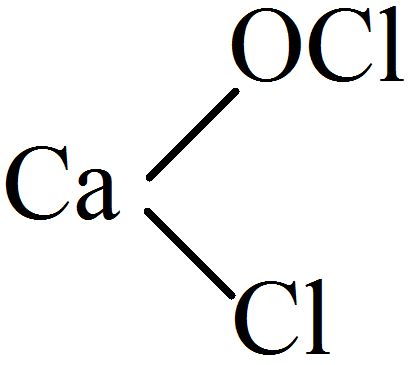
Find the oxidation number of Clin HCl, HClO, CIO4- and Ca(OCI)CI.
Question 122 Marks
Br2 + 2Cl- → Cl2 + 2Br-, will this reaction take place or not?
$\text{E}^0_\frac{\text{Br}_2}{\text{Br}^-}=+1.09\text{V}$
$\text{E}^0_\frac{\text{Cl}_2}{\text{Cl}^-}=+1.36\text{V}$
Answer$\text{E}^0_\text{cell}=\text{E}^0_\frac{\text{Br}_2}{\text{Br}^-}-\text{E}^0_\frac{\text{Cl}_2}{\text{Cl}^-}$
$=1.09\text{V}-1.36$
$=-0.27\text{V}$
Since Eo cell is -ve, reaction will not take place.
View full question & answer→Question 132 Marks
$\text{Fe}_2\text{O}_3+3\text{CO}\text{(g)}\xrightarrow{ \ \ \ \ \ \ \ }2\text{Fe}\text{(s)}+3\text{CO}_2\text{(g)}$
AnswerSubstance reduced is Fe2O3.
View full question & answer→Question 142 Marks
Can the following reaction,
$\text{Cr}_{2}\text{O}^{2-}_7 + \text{H}_{2}\text{O}\rightleftharpoons 2\text{CrO}^{2-}_{4} + 2\text{H}^{+}$
be regarded as a redox reaction?
AnswerIn this reaction, oxidation number of Cr in $\text{Cr}_{2}\text{O}^{2-}_{4}$ is +6 and oxidation number of Cr in $\text{Cr}_{2}\text{O}^{2-}_{4}$is + 6. Since, during the reaction, the oxidation number of Cr has neither decreased nor increased, therefore, the above reaction is not a redox reaction.
View full question & answer→Question 152 Marks
What is the relationship between standard oxidation potential and standard reduction potential?
AnswerBoth are equal in magnitude but opposite in sign.
View full question & answer→Question 162 Marks
AnswerIt is oxidation state of element in its compound or ion according to set rules based on fact shared pair of electron belongs to more electronegative atom.
View full question & answer→Question 172 Marks
Fe decomposes steam while Cu does not, why?
AnswerFe is more reactive than hydrogen, it has lower reduction potential than hydrogen whereas Cu has higher reduction potential than hydrogen, copper cannot displace hydrogen from steam because it is less reactive than hydrogen.
View full question & answer→Question 182 Marks
Refer to the periodic table given in your book and now answer the following questions:
Select three metals that can show disproportionation reaction.
AnswerIn disproportionation reactions, one of the reacting substances always contains an element that can exist in at least three oxidation states.
Mn, Cu, and Ga can show disproportionation reactions as these elements can exist in three or more oxidation states.
View full question & answer→Question 192 Marks
Calculate the oxidation number of underlinesd element in the following: $\text{Na}_2\text{B}_4,\text{O}_\text{S}\text{O}_4$
Answer$\text{Na}_2\text{B}_4\text{O}_7;$
$+2+4\text{x}-14$
$4\text{x}=12$
$\text{x}=-3$
$\text{O}_\text{S}\text{O}_4$
$\text{x}-8=0$
$\text{x}=+8$
View full question & answer→Question 202 Marks
What is the oxidation number of Fe in [Fe(CO)5]?
Answer[Fe(CO)5]
x + 5(0) = 0
x = 0
View full question & answer→Question 212 Marks
Using stock notation, represent the given compound MnO2.
Question 222 Marks
Write stock notation of MnO2 and AuCl3.
Question 232 Marks
A metal is higher than a particular metal in electrochemical series. Will the metal be stronger reducing agent or weaker reducing agent?
AnswerIt will be a weaker reducing agent if electrochemical series has elements in decreasing order of their reduction potential.
View full question & answer→Question 242 Marks
Why is anode negatively charged in an electrochemical cell?
AnswerAt anode, loss of electrons takes place, i.e. oxidation takes place, electron density is more, hence anode is negatively charged.
View full question & answer→Question 252 Marks
Write redox couples involved in the reactions (i) to (iv) given in question 34.
Answer$\text{Cu}^{2+}/\text{Cu, Zn}^{2+}/\text{Zn, Fe}^{2+}/\text{Fe,Cd}^{2+}/\text{Cd}.$
View full question & answer→Question 262 Marks
Can we store copper sulphate in an iron vessel? Why?
AnswerNo, because iron is more reactive than copper, and therefore, it will displace copper from its salt solution. Hence iron vessel will react with copper sulphate solution and is therefore, not suitable for its storage.
View full question & answer→Question 272 Marks
Explain why decomposition of H2O2 to form water and oxygen is disproportionation reaction.
Answer$2\text{H}_2\text{O}_2\xrightarrow{ \ \ \ \ \ \ }2\text{H}_2\text{O}+\text{O}_2\\ \ \ -1\ \ \ \ \ \ \ \ \ \ \ \ -2\ \ \ \ \ \ \ \ 0$
Since oxidation state of 'O' in H2O2 is -1 which is increasing to O as well as decreases to -2, therefore, H2O2 undergoes disproportionation reaction.
View full question & answer→Question 282 Marks
$\text{Zn}\text{(s)}+\text{Cu}^{2+}\text{(aq)}\xrightarrow{ \ \ \ \ \ \ \ \ }\text{Zn}^{2+}\text{(aq)}+\text{Cu}\text{(s)}$ Is this reaction redox reaction? If yes, name the oxidising agent as well as reducing agent.
AnswerYes, Cu2+ is oxidising agent, whereas Zn is reducing agent.
View full question & answer→Question 292 Marks
An iron rod is immersed in solution containing 1.0M NiSO4 and 1.0M ZnSO4. Predict giving reasons which of the following reactions is likely to proceed?
- Fe reduces Zn2+ ions,
- Iron reduces Ni2+ ions.
Given,
$\text{E}^\circ_{\frac{\text{Zn}^{2+}}{\text{Zn}}}=-0.76\text{V, E}^{\circ}_{\frac{\text{Fe}^{2+}}{\text{Fe}}}=-0.44\text{V and }$
$\text{E}^\circ_{\frac{\text{Ni}^{2+}}{\text{Ni}}}=-0.25\text{V}$
Answer - Since, E° of Zn is more negative than that of Fe therefore, Zn will be oxidised to Zn2+ ions while Fe2+ ions will be reduced to Fe. In other words, Fe will no reduce Zn2+ ions.
- Since, E° of Fe is more negative than that of Ni therefore, Fe will be oxidised to Fe2+ ions while Ni2+ ions will be reduced to Ni. Thus, Fe reduces Ni2+ ions.
View full question & answer→Question 302 Marks
Calculate the oxidation number of phosphorus in the following species.
- $\text{HPO}^{2-}_3$
- $\text{PO}^{3-}_4$
Answer - Let the oxidation number of phosphorus is x.
$\stackrel{\text{x}}{\text{HPO}}^{2-}_3$
+1 + x + (-2) × 3 = -2
+1 + x - 6 = -2
x - 2 = -2
x = -2 + 5
x = +3
Thus, O.S. of phosphorous is +3.
- $\stackrel{\text{x}}{\text{P}}\text{O}^{3-}_4$
x + (-2) × 4 = -3
x - 8 = -3
x = -3 + 8
x = +5
Thus, O.S. of phosphorous in this ion is +5.
View full question & answer→Question 312 Marks
\Dichromate ion in acidic medium reacts with ferrous ion to give ferrie and chromic ions. Write the balanced chemical equation corresponding to the reaction.
AnswerStep 1: $\text{Cr}_2\text{O}_7^{2-}\text{(aq)}+\text{Fe}^{2+}\text{(aq)}\xrightarrow{ \ \ \\ \ \ \\}\text{Cr}^{3+}\text{(aq)}+\text{Fe}^{3+}\text{(aq)}\\ +6\ \ \ \ \ \ \ \ \ \ \ \ \ \ \ \ \ \ +2 \ \ \ \ \ \ \ \ \ \ \ \ \ \ \ \ \ +3\ \ \ \ \ \ \ \ \ \ \ \ \ \ +3$
Step 2: The oxidation state of Cr decreases by 3 per chromium atom, total decrease is 6 for two chromium atoms, oxidation state of Fe changes from +2 to +3, i.e., increases by 1, therefore, to equalize the increase and decrease, we multiply Fe2+ by 6 and Cr2O72- by 1.
Step 3: Balancing Cr' and Fe on both sides.
$\text{Cr}_2\text{O}_7^{2-}\text{(aq)}+6\text{Fe}^{2+}\text{(aq)}\\\xrightarrow{ \ \ \ \ \ \ }2\text{Cr}^{3+}\text{(aq)}+6\text{Fe}^{3+}\text{(aq)}$
Step 4: To balance oxygen, we add 7 molecules of H2O on RHS.
$\text{Cr}_2\text{O}_7^{2-}\text{(aq)}+6\text{Fe}^{2+}\text{(aq)}\\\xrightarrow{ \ \ \ \ \ \ }2\text{Cr}^{3+}\text{(aq)}+6\text{Fe}^{3+}\text{(aq)}+7\text{H}_2\text{O}\text{(l)}$
Step 5: To balance hydrogen, we add 14H+ on LHS and we get balanced equation.
$\text{Cr}_2\text{O}_7^{2-}\text{(aq)}+6\text{Fe}^{2+}\text{(aq)}+14\text{H}^+\text{(aq)}\\\xrightarrow{ \ \ \ \ \ \ }2\text{Cr}^{3+}\text{(aq)}+6\text{Fe}^{3+}\text{(aq)}+7\text{H}_2\text{O}\text{(l)}$
View full question & answer→Question 322 Marks
Explain why?
- Reaction of $\text{FeSO}_4+\text{Cu}\xrightarrow{ \ \ \ \ \ }\text{CuSO}_4\text{(aq)}+\text{Fe}$ does not occur.
- Zinc can displace Cu from aqueous CuSo4 solution but Ag cannot.
- Solution of AgNO3 turns blue when Cu rod dipped in it.
Answer - It is because 'Cu' is less reactive than Fe, so cannot displace Fe from FeSO4 solution.
- Zinc is more reactive than Cu but Ag is less reactive than Cu.
- because Cu is more reactive than Ag.2)3 It is due to formation of Cu (NO3)2 because Cu is more reactive than Ag.$\text{Cu}\text{(s)}+\text{AgNO}_3\text{(aq)}\xrightarrow{ \ \ \ \ \ \ }\text{Cu(NO}_3)_2\text{(aq)}+2\text{Ag}\text{(s)}$
View full question & answer→Question 332 Marks
What are the net charges on the left and right side of the following equations? Add electrons as necessary to make each of them balanced half reactions.
- $\text{NO}^-_310\text{H}^+\xrightarrow{\ \ \ \ \ \ }\text{NH}^+_4+3\text{3H}_2\text{O}$
- $\text{Cl}_2+4\text{H}_2\text{O}\xrightarrow{\ \ \ \ \ \ \ }2\text{ClO}^-_2+\text{8}\text{H}^+$
Answer - +9 charge on the left, +1 charge on the right; add 8 electrons to the left side.
- O charge on the left, +6 charge on the right; add 6 electrons on the right side.
View full question & answer→Question 342 Marks
Nitric acid acts only as an oxidising agent while nitrous acid acts both as an oxidising as well as reducing agent. Explain.
Answer - HNO3
Oxidation number of N in HNO3 is +5.
Maximum oxidation number of N is +5 because it has five electrons in the valence shell (2s22p3).
Minimum oxidation number of N is -3 because it can accept 3 more electrons to get noble gas configuration. Since, oxidation number of N in HNO3 is maximum, therefore, it can only decrease.
Thus, HNO3 can act as an oxidising agent.
- HNO2
Oxidation number of N = +3
Maximum oxidation number of N = +5
Minimum oxidation number of N = -3
Therefore, the oxidation number of N can increase by losing electrons or can decrease by accepting electrons. Thus, HNO2 can act both as an oxidising as well as a reducing agent.
View full question & answer→Question 352 Marks
Permanganate ion reacts with bromide ion in basic medium to give manganese dioxide and bromate ion. Write the balanced chemical equation for the reaction.
AnswerStep 1: $\text{MnO}_4^-\text{(aq)}+\text{Br}\text{(aq)}\xrightarrow{ \ \ \ \ \ }\text{MnO}_2\text{(aq)}+\text{BrO}_3^-\text{(aq)}\\ \ +7\ \ \ \ \ \ \ \ \ \ \ \ \ \ \ -1\ \ \ \ \ \ \ \ \ \ \ \ \ \ \ \ +4\ \ \ \ \ \ \ \ \ \ \ \ \ \ \ \ +5$
Step 2: $\text{MnO}_4^-$ is oxidant because its oxidation state is decreasing. Br- is reductant because its oxidation state is increasing.
Step 3: Oxidation state of Mn is decreasing by 3. Oxidation state of Br is increasing by 6. To equalize increase and decrease, multiply $\text{MnO}_4^-$ by 2 and Br- by 1 we get.
$2\text{MnO}_4^-\text{(aq)}+\text{Br}^-\text{(aq)}\xrightarrow{ \ \ \ \ \ \ \ }\text{MnO}_2\text{(s)}+\text{Br}_2^-\text{(aq)}$
Step 4: Now for balncaing oxygen, we add 1 molecule of H2O on RHS.
$2\text{MnO}_4^-\text{(aq)}+\text{Br}^-\text{(aq)}\\\xrightarrow{ \ \ \ \ \ \ \ }\text{MnO}_2\text{(s)}+\text{BrO}_3^-\text{(aq)}+\text{H}_2\text{O}\text{(l)}$
Step 5: As the reaction is taking place in basic medium to balance hydrogen, add 2H2O molecules on LHS and 2OH- on RHS.
$2\text{MnO}_4^-\text{(aq)}+\text{Br}^-\text{(aq)}\\\xrightarrow{ \ \ \ \ \ \ \ }\text{MnO}_2\text{(s)}+\text{BrO}_3^-\text{(aq)}+\text{H}_2\text{O}\text{(l)}+2\text{OH}^-\text{(aq)}$
It can be seen 1 molecule of H2O gets cancelled on both sides, we get.
$2\text{MnO}_4^-\text{(aq)}+\text{Br}^-\text{(aq)}\\\xrightarrow{ \ \ \ \ \ \ \ }\text{MnO}_2\text{(s)}+\text{BrO}_3^-\text{(aq)}+\text{H}_2\text{O}\text{(l)}+2\text{OH}^-\text{(aq)}$
is a balanced equation.
View full question & answer→Question 362 Marks
Balance $\text{P}+\text{HNO}_3\xrightarrow{ \ \ \ \ \ \ \ \ }\text{H}_3\text{PO}_4+\text{NO}_2+\text{H}_2\text{O}$ by oxidation number method.
Answer
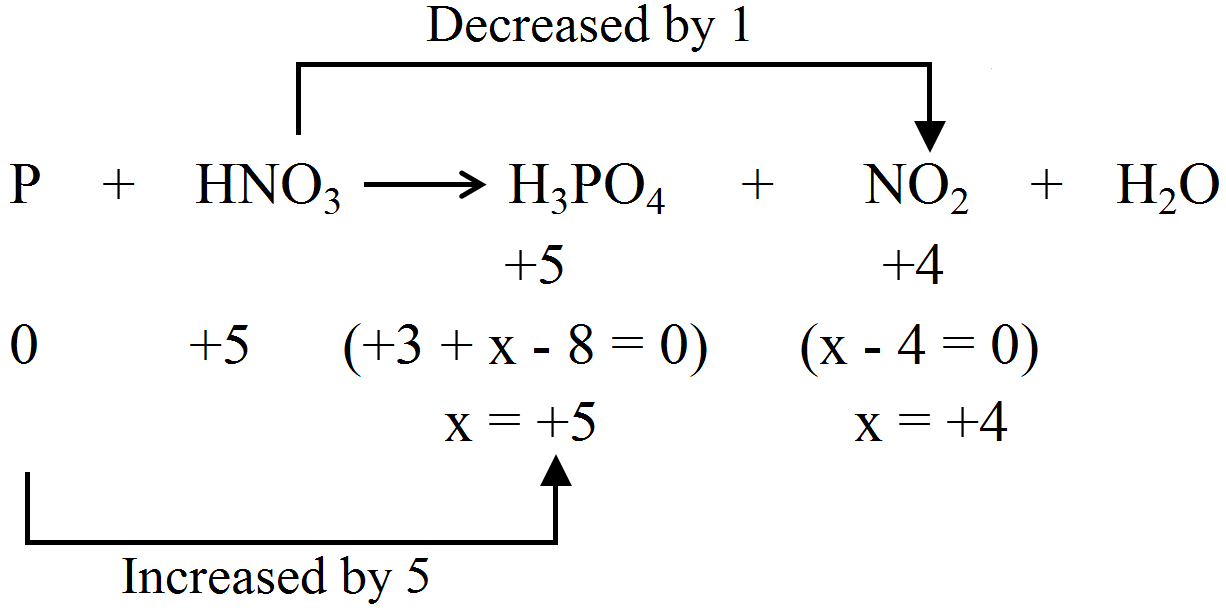
Multiply P by l, HNO3 by 5, we get$\text{P}+5\text{HNO}_3\xrightarrow{ \ \ \ \ \ \ \ \ }\text{H}_3\text{PO}_4+5\text{NO}_2+\text{H}_2\text{O}$
View full question & answer→Question 372 Marks
Depict the galvanic cell in which the reaction Zn(s) + 2Ag
+(aq) → Zn
2+(aq) + 2Ag(s) takes place, Further show:
Individual reaction at each electrode.
AnswerThe galvanic cell corresponding to the given redox reaction can be represented as: $\text{Zn}|\text{Zn}^{2+}_{(\text{aq})}||\text{Ag}^{+}_{(\text{aq})}|\text{Ag}$
The reaction taking place at Zn electrode can be represented as:
$\text{Zn}_{(\text{s})}\rightarrow\text{Zn}^{2+}_{(\text{aq})}+2\text{e}^-$
And the reaction taking place at Ag electrode can be represented as:
$\text{Ag}^+_{(\text{aq})}+\text{e}^-\rightarrow\text{Ag}_{(\text{s})}.$
View full question & answer→Question 382 Marks
Write electrode reaction when hydrogen acts as:
- Cathode.
- Anode.
Answer -
At Cathode: $2\text{H}^+\text{(aq)}+2\text{e}^-\xrightarrow{ \ \ \ \ \ \ \ }\text{H}_2\text{(g)}$
-
At Anode: $\text{H}_2\text{(g)}\xrightarrow{ \ \ \ \ \ }2\text{H}^+\text{(aq)}+2\text{e}^-$
View full question & answer→Question 392 Marks
Find oxidation state of ‘Cl' in
- $\text{ClO}_2$
- $\text{ClO}_3^-$
Answer - $\stackrel{{\text{x}-2}}{\hbox{ClO}_2}$
$\text{x}-4=0$
$\Rightarrow\text{x}=+4$
- $\stackrel{{\text{x}-2}}{\hbox{ClO}_3^-}$
$\text{x}-2\times3=-1$
$\text{x}-6=-1$
$\Rightarrow\text{x}=+5$
View full question & answer→Question 402 Marks
Consider the elements:
Cs, Ne, I and F
Identify the element which exhibits neither the negative nor does the positive oxidation state.
AnswerNe. It is an inert gas (with high ionization enthalpy and high positive electron gain enthalpy) and hence it neither exhibits -ve nor +ve oxidation states.
View full question & answer→Question 412 Marks
What is the oxidation number of alkali metals in their compounds?
Question 422 Marks
Predict the products of electrolysis in the following:
An aqueous solution AgNO3 with platinum electrodes.
AnswerPt cannot be oxidized easily. Hence, at the anode, oxidation of water occurs to liberate O2. At the cathode, Ag+ ions are reduced and get deposited.
View full question & answer→Question 432 Marks
Depict the galvanic cell in which the reaction Zn(s) + 2Ag+(aq) → Zn2+(aq) + 2Ag(s) takes place, Further show:
Which of the electrode is negatively charged.
AnswerThe galvanic cell corresponding to the given redox reaction can be represented as: $\text{Zn}|\text{Zn}^{2+}_{(\text{aq})}||\text{Ag}^{+}_{(\text{aq})}|\text{Ag}$
Zn electrode is negatively charged because at this electrode, Zn oxidizes to Zn2+ and the leaving electrons accumulate on this electrode.
View full question & answer→Question 442 Marks
Which is best reducing agent and best oxidising agent?
Answer - Li is best reducing agent due to lowest standard reduction potential.
- F2 is best oxidising agent due to highest standard reduction potential.
View full question & answer→Question 452 Marks
Depict the galvanic cell in which the reaction Zn(s) + 2Ag
+(aq) → Zn
2+(aq) + 2Ag(s) takes place, Further show:
The carriers of the current in the cell.
AnswerThe galvanic cell corresponding to the given redox reaction can be represented as: $\text{Zn}|\text{Zn}^{2+}_{(\text{aq})}||\text{Ag}^{+}_{(\text{aq})}|\text{Ag}$
Ions are the carriers of current in the cell.
View full question & answer→Question 462 Marks
PbO and PbO2 react with HCl according to following chemical equations: $2\text{PbO}+4\text{HCl}\xrightarrow{ \ \ \ \ \ \ \ }2\text{PbCl}_2+2\text{H}_2\text{O}$
$\text{PbO}_2+4\text{HCl}\xrightarrow{\ \ \ \ \ \ \ \ }\text{PbCl}_2+\text{Cl}_2+2\text{H}_2\text{O}$
Why do these compounds differ in their reactivity?
Answer$2\text{PbO}+4\text{HCl}\xrightarrow{ \ \ \ \ \ \ \ }2\text{PbCl}_2+2\text{H}_2\text{O}\text{(Acid base reaction)}$
$\text{PbO}_2+4\text{HCl}\xrightarrow{\ \ \ \ \ \ \ \ }\text{PbCl}_2+\text{Cl}_2+2\text{H}_2\text{O}\text{(Redox reaction)}$
In reaction (i), O.N. of none of the atoms reaction. It is an acid-base reaction, because PbO is a basic oxide which reacts with HCl acid.undergo a change. Therefore, it is not a redox
The reaction (ii) is a redox reaction in which PbO2 gets reduced and acts as an oxidizing agent.
View full question & answer→Question 472 Marks
The compound Y Ba2Cu3O7, which shows superconductivity, has copper in x oxidation state. Assume that the rare earth element yttrium is in its usual +3 oxidation state. Predict the value of x.
Answer1x (+3) + 2x (+ 2) + 3x + 7x (-2) = 0 3 + 4 + 3x - 14 = 0
3x = 7; $\text{x} = \frac{7}{3}$
View full question & answer→Question 482 Marks
Write formula for the following compound:
Nickel(II) sulphate.
AnswerNickel(II) sulphate:
NiSO4
View full question & answer→Question 492 Marks
Following cell is set up between copper and silver electrodes. $\text{Cu}|\text{Cu}^{2+}\text{(aq)}\|\text{Ag}^+\text{(aq)}|\text{Ag}$
If its two half cells work under standard conditions, calculate the emf of the cell.
$\Big[\text{Given E}^\circ_{\frac{\text{Cu}^{2+}}{\text{Cu}}}=+0.34\text{V},\text{E}^\circ_{\frac{\text{Ag}^+}{\text{Ag}}}=+0.80\text{V}\Big]$
Answer$\text{E}^{\circ}_\text{cell}=\text{E}^\circ_\text{cathode}-\text{E}^\circ_\text{anode}$
$=\text{E}^\circ_{\frac{\text{Ag}^+}{\text{Ag}}}-\text{E}^\circ_{\frac{\text{Cu}^{2+}}{\text{Cu}}}=+0.80-(+0.34)=0.46\text{V}$
View full question & answer→Question 502 Marks
Justify that the following reactions are redox reactions:
4BCl3(g) + 3LiAlH4(s) → 2B2H6(g) + 3LiCl(s) + 3AlCl3(s)
Answer4BCl3(g) + 3LiAlH4(s) → 2B2H6(g) + 3LiCl(s) + 3AlCl3(s) The oxidation number of each element in the given reaction can be represented as:
$\stackrel{{+3\ -1}}{4\ \ \ \ \ \hbox{BCl}_{3(\text{g})}}+\stackrel{{+1\ \ +3\ -1}}{3\ \ \ \ \hbox{LiAlH}_{4(\text{s})}}\ \rightarrow\stackrel{{-3}}{2\ \ \hbox{B}_2}\stackrel{{+1}}{\ \ \ \ \ \hbox{H}_{6(\text{g})}}+\stackrel{{+1}}{3\hbox{Li}}\stackrel{{-1}}{\ \ \ \ \hbox{Cl}_{(\text{s})}}+\stackrel{{+3}}{3\hbox{Al}}\stackrel{{-1}}{\ \ \ \ \ \ \hbox{Cl}_{3(\text{s})}}$
In this reaction, the oxidation number of B decreases from +3 in BCl3 to –3 in B2H6. i.e., BCl3 is reduced to B2H6. Also, the oxidation number of H increases from –1 in LiAlH4 to +1 in B2H6 i.e., LiAlH4 is oxidized to B2H6. Hence, the given reaction is a redox reaction.
View full question & answer→Question 512 Marks
Justify that the following reactions are redox reactions:
Fe2O3(s) + 3CO(g) → 2Fe(s) + 3CO2(g)
AnswerFe2O3(s) + 3CO(g) → 2Fe(s) + 3CO2(g) Let us write the oxidation number of each element in the given reaction as:
$\stackrel{{+3}}{\ \ \ \ \hbox{Fe}_2}\stackrel{{-2}}{\ \ \ \ \ \hbox{O}_{3(\text{s})}}+\stackrel{{+2-2}}{3\ \ \ \hbox{CO}_{(\text{g})}}\ \rightarrow\stackrel{{0}}{\ \ \ \ \hbox{2Fe}_{(\text{s})}}+\stackrel{{+4-2}}{3\ \ \ \ \ \hbox{CO}_{2(\text{g})}}$
Here, the oxidation number of Fe decreases from +3 in Fe2O3 to 0 in Fe i.e., Fe2O3 is reduced to Fe. On the other hand, the oxidation number of C increases from +2 in CO to +4 in CO2 i.e., CO is oxidized to CO2. Hence, the given reaction is a redox reaction.
View full question & answer→Question 522 Marks
Why is anode called oxidation electrode whereas cathode is called reduction electrode?
AnswerAt anode, loss of electrons i.e. oxidation take place therefore, it is called oxidation electrode.
View full question & answer→Question 532 Marks
Write formula for the following compound:
Chromium(III) oxide.
AnswerChromium(III) oxide:
Cr2O3
View full question & answer→Question 542 Marks
Write formula for the following compound:
Mercury(II) chloride.
AnswerMercury(II) chloride:
HgCl2
View full question & answer→Question 552 Marks
Justify that the following reactions are redox reactions:
2K(s) + F2(g) → 2K+F-(s)
Answer2K(s) + F2(g) → 2K+F-(s) The oxidation number of each element in the given reaction can be represented as:
$\stackrel{{0}}{2\ \ \text{K}_{(\text{s})}}+\stackrel{{0}}{\ \ \ \ \ \text{F}_{2(\text{g})}}\ \rightarrow\stackrel{{+1}}{2\ \ \text{K}^+}\stackrel{{-1}}{\ \ \ \ \text{F}^-_{(\text{s})}}$ In this reaction, the oxidation number of K increases from 0 in K to +1 in KF i.e., K is oxidized to KF. On the other hand, the oxidation number of F decreases from 0 in F2to -1 in KF i.e., F2 is reduced to KF. Hence, the above reaction is a redox reaction. View full question & answer→Question 562 Marks
Justify that the following reactions are redox reactions:
CuO(s) + H2(g) → Cu(s) + H2O(g)
AnswerCuO(s) + H2(g) → Cu(s) + H2O(g) Let us write the oxidation number of each element involved in the given reaction as:
$\stackrel{{+2}\ -2}{\hbox{Cu O}}_{(\text{s})}\ +\stackrel{{0}}{\ \ \ \ \ \ \hbox{H}_{2(\text{g})}}\ \rightarrow\stackrel{0}{\ \ \ \ \hbox{ Cu}_{(\text{s})}}+\stackrel{+1\ \ \ \ -2}{\ \ \ \hbox{H}_2\ \ \text{O}_{(\text{g})}}$ Here, the oxidation number of Cu decreases from +2 in CuO to 0 in Cu i.e., CuO is reduced to Cu. Also, the oxidation number of H increases from 0 in H2 to +1 in H2O i.e., H2 is oxidized to H2O. Hence, this reaction is a redox reaction. View full question & answer→Question 572 Marks
Justify that the following reactions are redox reactions:
4NH3(g) + 5O2(g) → 4NO(g) + 6H2O(g)
Answer4NH3(g) + 5O2(g) → 4NO(g) + 6H2O(g)
The oxidation number of each element in the given reaction can be represented as:
$\stackrel{{-3\ \ \ +1}}{\ \ \ \ 4\text{N H}_{3(\text{g})}}+\stackrel{{0}}{\ \ \ \ \ 5\text{O}_{2(\text{g})}}\ \rightarrow\stackrel{{+2-2}}{\ \ 4\text{NO}_{(\text{g})}}+\stackrel{+1\ \ \ \ \ -2}{ \ \ \ 6\text{H}_2\ \ \text{O}_{(\text{g})}}$
Here, the oxidation number of N increases from -3 in NH3 to +2 in NO. On the other hand, the oxidation number of O2 decreases from 0 in O2 to -2 in NO and H2O i.e., O2 is reduced. Hence, the given reaction is a redox reaction.
View full question & answer→Question 582 Marks
- Write the functions of salt bridge in electro chemical cell.
- Give one decomposition reaction which is redox reaction and one which is a redox reaction.
Answer - Salt bridge.
- Completes internal circuit.
- It maintains electroneutrality.
-
- $\stackrel{{+4}}{\hbox{C}\text{a}}\stackrel{{-2+2}}{\hbox{CO}_3}(\text{s})\xrightarrow{\ \ \ \ \ \ \ \ }\stackrel{{+2}}{\hbox{Ca}}\stackrel{{-2}}{\hbox{O}}(\text{s})+\stackrel{{+4-2}}{\hbox{CO}_2}\text{(g)}$
It is not a redox reaction.
- $\stackrel{{+2+6}}{\hbox{Fe}}\stackrel{{-2}}{\hbox{SO}_4}\xrightarrow{\ \ \ \Delta \ \ \ \ \ }\stackrel{+3}{\hbox{Fe}}\stackrel{-2}{\hbox{O}_3}+\stackrel{{_-2}}{\hbox{SO}_2}+\stackrel{{+6-2}}{\hbox{SO}_3}$
View full question & answer→Question 592 Marks
- The standard electrode potential of two metals 'A' and 'B' are -0.76V and +0.34V respectively. An electrochemical cell is formed using electrodes of these metals.
- Identify the cathode and anode.
- Write the direction of flow of electrons.
- HNO3 acts as oxidising agent while HNO2 can act as both oxidising as well as reducing agent, why?
Answer -
- Zn acts as anode due to lower reduction potential, it undergoes oxidation at anode. Cu acts as cathode due to highes reduction potential.
- Electrons flow from Zn rod to copper.
- HNO, has 'N' is +5 oxidation state (highest). It can gain electrons therefore, acts as oxidising agent only HNO, has 'N' in +3 oxidation state which can increase to +5 and decrease to +2, hence acts as both.
View full question & answer→Question 602 Marks
- Which of the following does not conduct electric current and why? Molten NaCl, Solid Pb, AgNO3 solution and Methanol.
- Why is anode called oxidation electrode, whereas cathode is called reduction electrode?
- Why is reduction potential of zinc -0.76V?
Answer - Methanol will not conduct electric current because it does not ionise.
- At anode, loss of electrons takes place, i.e. oxidation takes place, whereas at cathode, gain of electrons takes place, i.e. reduction takes place. Therefore, cathode is called reduction electrode and anode is called oxidation electrode.
- The reduction potential of Zn is -0.76V, because the potential difference between Zn electrodes dipped in 1M ZnSO4 solution and standard hydrogen electrode is 0.76V and Zn metal acts as anode, i.e., undergoes oxidation, therefore, its reduction potential is -ve.
View full question & answer→Question 612 Marks
- What is the oxidation number of Fe in Fe3O4?
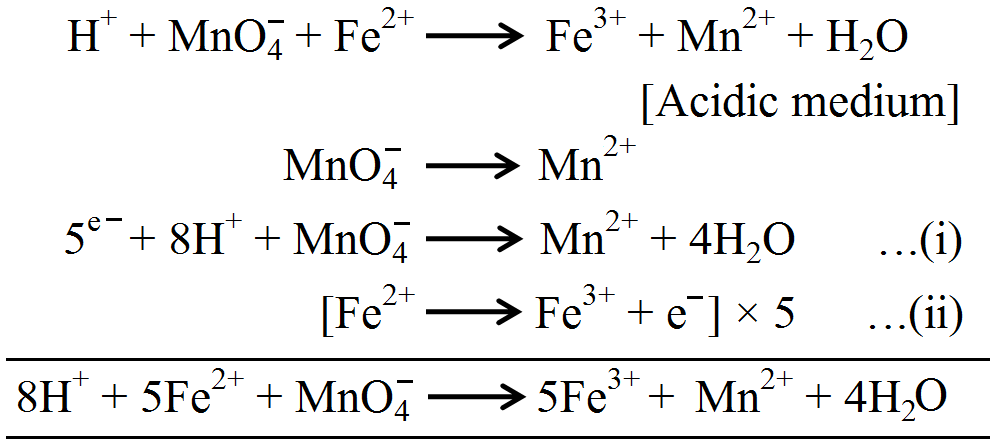
$\text{H}^++\text{MnO}_4^-+\text{Fe}^{2+}\xrightarrow{ \ \ \ \ \\ \ \ }\text{Fe}^{3+}+\text{Mn}^{2+}+\text{H}_2\text{O}\\ \ \ \ \ \ \ \ \ \ \ \ \ \ \ \ \ \ \ \ \ \ \ \ \ \ \ \ \ \ \ \ \ \ \ \ \ \ \ \ \ \ \ \ \ \ \ \ \ \ \ \ \ \ \ \text{(Acidic medium)}$
- Balance the equation.
Answer - Let oxidation number of Fe in Fe3O4 be x
$\therefore3\text{x}-8=0$
$\Rightarrow\text{x}=\frac{8}{3}$
It is the average oxidation number of Fe2+ and 2Fe3+
-
View full question & answer→Question 622 Marks
- Balance $\text{MnO}_4^-+\text{Fe}^{2+}\xrightarrow{ \ \ \ \ \ \ \ \ }\text{Fe}^{3+}+\text{Mn}^{2+}$ in acidic medium by ion electron method.
- Given the standard electrode potentials:
$\frac{\text{K}_+}{\text{K}}=-2.93\text{V},$
$\frac{\text{Ag}^+}{\text{Ag}}=+0.80\text{V},$
$\frac{\text{Mg}^{2+}}{\text{Mg}}=-2.37\text{V}$
Arrange these metals in order of increasing reducing power.
Answer - $\text{MnO}_4^-+\text{Fe}^{2+}\xrightarrow{ \ \ \ \ \ \ }\text{Fe}^{3+}+\text{Mn}^{2+}$ in acidic medium
$[\text{Fe}^{2+}\xrightarrow{ \ \ \ \ \ \ }\text{Fe}^{3+}+\text{e}^-]\times5\ \cdots\text{(i)}$
$5\text{e}^-+8\text{H}^++\text{MnO}_4^-\xrightarrow{ \ \ \ \ \ \ }\text{Mn}^{2+}+4\text{H}_2\text{O} \ \cdots\text{(ii)}$
Adding (i) and (ii), we get
$5\text{Fe}^{2+}+8\text{H}^++\text{MnO}_4^-\xrightarrow{ \ \ \ \ \ \ }\text{Mn}^{2+}+4\text{H}_2\text{O} \ +5\text{Fe}^{3+}$
- Ag < Mg < K is increasing order of reducing power.
View full question & answer→Question 632 Marks
- Identify the oxidant and reductant in the following reactions:
-
$10\text{H}^++4\text{Zn}\text{(S)}+\text{NO}_3^-\text{(aq)}\\ \xrightarrow{ \ \ \ \ \ }4\text{Zn}^{2+}\text{(aq)}+\text{NH}_4^+\text{(aq)}+3\text{H}_2\text{O}$
-
$\text{I}_2\text{(g)}+\text{H}_2\text{(g)}\xrightarrow{ \ \ \ \ \ }2\text{Hl}\text{(g)}+\text{S}\text{(s)}$
-
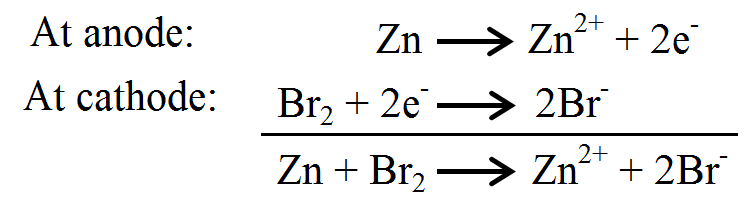
Write the anode, cathode and net cell reaction for the following cell:
$\text{Zn}\text{(s)}|\text{Zn}\text{(aq)}||\text{Br}^-\text{(aq)}|\text{Br}_2\text{(g)},\text{pt}$
- Give two main functions of salt bridge.
Answer -
- Zn is reducing agent because it is losing electrons to form Zn2+ i.e. oxidation state is increasing from 0 to +2. $\text{NO}_3^-$ is oxidising agent because oxidation state of N is decreasing from +5 to -3, i.e. it is gaining electrons.
- I is oxidising agent because it is gaining electrons. Its oxidation state is decreasing from 0 to -1 whereas H2S is reducing agent, the oxidation state of 'S' is increasing from -2 to 0 by losing electrons.
-
-
- It maintains electroneutrality.
- It completes internal circuit.
View full question & answer→Question 642 Marks
- Define the term redox couple. Write the practical application of redox couple.
- Split $2\text{K}\text{(s)}+\text{Cl}_2\text{(g)}\xrightarrow{ \ \ \ \ \ }2\text{KCl}\text{(s)}$ into oxidation and reducton half reaction.
Answer - Redox couple. It is defined as having together the oxidised and reduced forms of a substance taking part in an oxidation or reduction half reaction e.g. $\frac{\text{Zn}^{2+}}{\text{Zn}}$ and $\frac{\text{Cu}^{2+}}{\text{Cu}}$ form a redoxc couple. application. These are used to make electrochemical cell.
- $2\text{K}\xrightarrow{ \ \ \ \ }2\text{K}^++2\text{e}^-$ (oxidation half reaction)
$\text{Cl}_2+2\text{e}^-\xrightarrow{ \ \ \ \ }2\text{Cl}^-$ (reduction half reaction)
View full question & answer→Question 652 Marks
Write formula for the following compound:
Iron(III) sulphate.
AnswerIron(III) sulphate:
Fe2(SO4)3
View full question & answer→Question 662 Marks
Can Fe
3+ oxidise Br
- to Br
2 at 1M concentrations?
E°(Fe3+ | Fe2+)= 0.77V and E°(Br | Br-) = 1.09V
AnswerE°(Fe3+ | Fe2+) is lower than that of E°(Br- | Br-).
Therefore, Fe2+ can reduce Br2 but Br- cannot reduce Fe3+.
Thus, Fe3+ cannot oxidise Br- to Br2.
View full question & answer→Question 672 Marks
Write formula for the following compound:
Tin(IV) oxide.
Question 682 Marks
Write formula for the following compound:
Thallium(I) sulphate.
AnswerThallium(I) sulphate:
Tl2SO4
View full question & answer→Question 692 Marks
How many millimoles of potassium dichromate is required to oxidise 24mL of 0.5M Mohr's salt solution in acidic medium?
AnswerNumber of millimoles of K2 Cr2 O7 present in 24mL of
0.5M solution = 24 × 0.5 = 12
The balanced chemical equation for the redox reaction is
$\text{K}_2\text{Cr}_2\text{O}_7+6(\text{NH}_4)_2\text{SO}_4\cdot\text{6H}_2\text{O}+7\text{H}_2\text{SO}_4\\\xrightarrow{\ \ \ \ \ \ }\text{K}_2\text{SO}_4+6(\text{NH}_4)_2\text{SO}_4\\\ \ \ \ \ \ \ +3\text{Fe}_2(\text{SO}_4)_3+\text{Cr}_2(\text{SO}_4)_3+43\text{H}_2\text{O}$
From the balanced equation, 6 moles Mohr's salt are oxidised by 1 mole of K2Cr2O7.
$\therefore$ 12 millimoles of Mohr's salt will be oxidised by,
$=\frac12\times12=2$ millimoles K2 Cr2 O7
View full question & answer→Question 702 Marks
$\text{MnO}^{2-}_4$ undergoes disproportionation reaction in acidic medium but $\text{MnO}^-_4$ does not. Give reason.
AnswerDisproportionation is a type of redox reaction in which a species is simultaneously reduced and oxidised forming two different products.
In $\text{MnO}^{2-}_4$, the oxidation state of manganese is +6. It can disproportionate to form $\text{MnO}^-_4$ and $\text{MnO}^{2-}_4.$
$3\text{MnO}^{2-}_4+4\text{H}^{+}\xrightarrow{ \ \ \ \ \ \ \ }\text{MnO}_2+2\text{MnO}^{-}_4+2\text{H}_2\text{O}$
However, the oxidation state of Mn in $\text{MnO}^{-}_4$ is +7 which is the maximum possible oxidation state of Mn (atomic number 25, 1s2 2s2 2p6 3s2 3p6 3d5 4s2) and hence it cannot undergo disproportionation reaction.
View full question & answer→Question 712 Marks
Identify the redox reactions out of the following reactions and identify the oxidising and reducing agents in them.
$4\text{NH}_3+3\text{O}_2\text{(g)}\xrightarrow{ \ \ \ \ \ \ \ }2\text{N}_2(\text{g})+6\text{H}_2\text{O(g)}$
Answer$\stackrel{-3+1 \ \ \ \ \ }{\text{4NH}_3\text{(g)}}+\stackrel{0 \ \ \ \ \ \ }{\text{3O}_2\text{(g)}}\xrightarrow{\ \ \ \ \ \ \ \ }\stackrel{0 \ \ \ \ \ \ \ }{\text{2N}_2\text{(g)}}+\stackrel{+1-2 \ \ \ \ \ \ }{\text{6H}_2\text{O}(\text{g})}$
Here. O.N. of N increases from -3 (in NH3) to 0 in (N2) and therefore, NH3 acts as a reducing agent. O.N. of O decreases from 0 (in O2) to -2 (in H,O) and therefore, O2 acts as an oxidizing agent.
Thus, reaction (v) is a redox reaction.
View full question & answer→Question 722 Marks
Explain why $\text{E}^0_\frac{\text{Fe}^{3+}}{\text{Fe}^{2+}}$ and $\text{C}^0_\frac{\text{Cu}^{2+}}{\text{Cu}}$ form a redox of couple?
Answer$\text{E}^0_\text{cell}=\text{E}^0_\frac{\text{Fe}^{3+}}{\text{Fe}^{2+}}-\text{E}^0_\frac{\text{Cu}^{2+}}{\text{Cu}}$
$=+0.77\text{V}-0.34\text{V}$
$=0.43\text{V}$
Since $\text{E}^0_\text{cell}$ is +ve, therefore, it will act as redox couple.
$2\text{Fe}^{3+}+\text{Cu}\xrightarrow{ \ \ \ \ \ \ }\text{Cu}^++2\text{Fe}^{2+}$
View full question & answer→Question 732 Marks
Arrange HNO3, NO, NH4Cl N2 in decreasing order of oxidation state of nitrogen.
Answer $+5\ \ \ \ \ +2 \ \ \ -3 \ \ \ \ \ \ \ \ 0\\\text{HNO}_3,\text{NO}_3,\text{NH}_4\text{Cl},\text{N}_2$ is decreasing order of oxidation state +1 + x - 2 - HNO3
+1 + x - 6 = 0
x = +5
- NO
x - 2 = 0
x = +2
+1 -1
- NH4Cl
x + 4 -1 = 0
x = -3
- N2
N2 has oxidation state
HNO3 > NO > N2 > NH4Cl
View full question & answer→Question 742 Marks
2Cu2S + 3O2 → 2Cu2O+2 SO2
In this reaction which substance is getting oxidised and which substance is getting reduced? Name reducing agent and oxidising agent.
AnswerSince, oxygen is being added to Cu, therefore Cu2S is oxidised to Cu2O and the other reactant i.e. O2 is getting reduced. Hence, Cu2S is a reducing agent and O2 is an oxidising agent.
View full question & answer→Question 752 Marks
On the basis of standard electrode potential values, suggest which of the following reactions would take place? (Consult the book for $\text{E}^\ominus$ value).
- $\text{Cu + Zn}^{2+}\xrightarrow{ \ \ \ \ \ \ \ }\text{Cu}^{2+}+\text{Zn}$
- $\text{Mg + Fe}^{2+}\xrightarrow{ \ \ \ \ \ \ \ \ }\text{Mg}^{2+}+\text{Fe}$
- $\text{Br}_2+\text{2Cl}^-\xrightarrow{ \ \ \ \ \ \ \ \ }\text{Cl}_2+2\text{Br}^-$
- $\text{Fe + Cd}^{2+}\xrightarrow{ \ \ \ \ \ \ \ \ }\text{Cd + Fe}^{2+}$
AnswerOn the basis of standerd reduction potential suggested in the reactivity series (ii) reaction can take place as Mg has more negative value of $\text{E}^\ominus$ cell. Thus, Mg will be oxidized by losing electron and iron will be reduced by gaining electron.
View full question & answer→Question 762 Marks
Find the oxidation state of sulphur in the following compounds:
$\text{H}_2\text{S},$
$\text{H}_2\text{SO}_4,$
$\text{S}_2\text{O}_4^{2-}$
$\text{S}_2\text{O}_8^{2-}$
$\text{HSO}_3^-$
AnswerIn $+1 \text{x} \\ \text{H}_2\text{S}$
$+2+\text{x}=0;$
$\Rightarrow\text{x}=-2$
$+1+\text{x}-2$
In $+1 \ \text{x-2} \\ \text{H}_2\text{SO}_4$
$+2+\text{x}-8=0;$
$\Rightarrow\text{x}=+6$
In $\text{S}_2\text{O}_4^{2-}$
$2\text{x}-8=-2;$
$\Rightarrow2\text{x}=+6$
$\text{x}=+3$
In $\text{S}_2\text{O}_8^{2-}$ There is peroxide linkage, therefore, oxidation state of 'S' is 6 because 'S' has six valence electrons and it can form 6 covalent bonds.
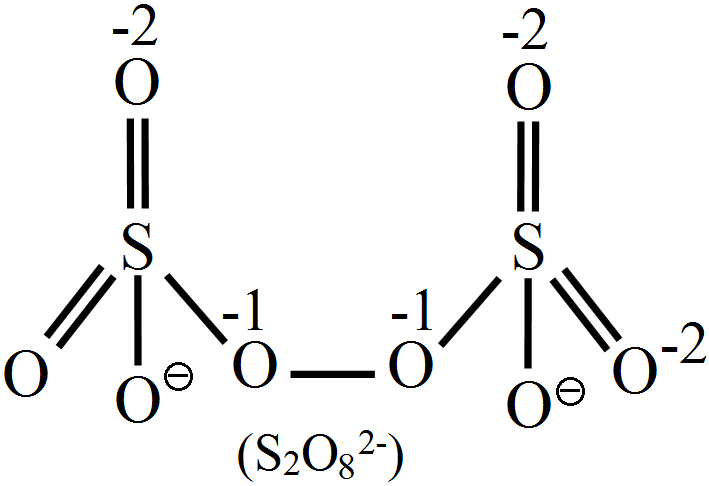
$2\text{x}-2\times6-1-1=-2$
$2\text{x}-14=-2$
$2\text{x}=12$
$\Rightarrow\text{x}=+6$
In $\text{HSO}_3^-$
$+1+\text{x}-6=-1$
$\Rightarrow\text{x}-5=-1$
$\Rightarrow\text{x}=+4$
View full question & answer→Question 772 Marks
Balance the following equations by the oxidation number method.
$\text{I}_2+\text{NO}^-_3\xrightarrow{ \ \ \ \ \ \ \ }\text{NO}_2+\text{IO}^-_3$
Answer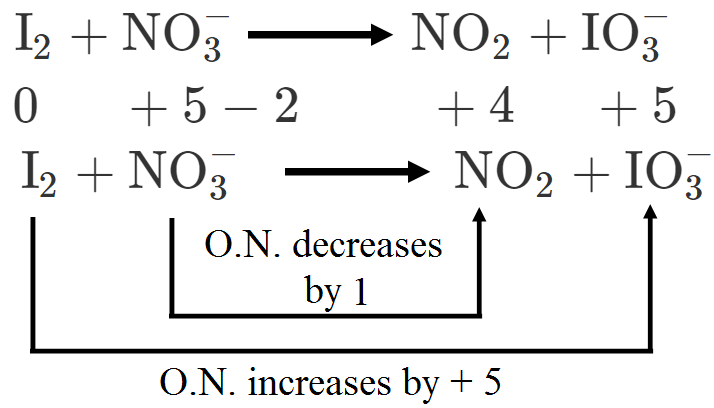
Total increase in O.N. = 5 × 2 = 10
Total decrease in O.N. = 1
To equalize O.N. multiply NO-3, by 10
$\text{I}_2+10\text{NO}^-_3\xrightarrow{ \ \ \ \ \ \ }10\text{NO}_2+\text{IO}^-_3$
Balancing atoms other than O and H
$\text{I}_2+10\text{NO}^-_3\xrightarrow{ \ \ \ \ \ \ \ }10\text{NO}_2+2\text{IO}_3^-$
Balanching O and H
$\text{I}_2+\text{IONO}^-_3+8\text{H}^+\xrightarrow{ \ \ \ \ \ \ \ }10\text{NO}_2+2\text{IO}^-_3+4\text{H}_2\text{O}$
View full question & answer→Question 782 Marks
Identify the redox reactions out of the following reactions and identify the oxidising and reducing agents in them.
$3\text{HCl(aq)}+\text{HNO}_3\text{(aq)}\xrightarrow{ \ \ \ \ \ \ \ \ }\text{Cl}_2\text{(g)}+\text{NOCl}(\text{g})+2\text{H}_2\text{O(l)}$
Answer$\stackrel{+1-1 \ \ \ \ \ \ \ }{\text{3HCl(aq)}}+\stackrel{+1}{\text{H}}\stackrel{+5}{\text{N}}\stackrel{-2}{\text{O}}_3\text{(aq)}\xrightarrow{ \ \ \ \ \ \ \ \ }\stackrel{0 \ \ \ \ \ \ \ \ \ }{\text{Cl}_2\text{(g)}}+\stackrel{+3}{\text{N}}\stackrel{-2}{\text{O}}\stackrel{-1 \ \ \ \ }{\text{Cl(g)}}+\stackrel{+1 \ \ \ \ \ }{\text{2H}_2}\stackrel{-2 \ \ \ }{\text{O(l)}}$
Here, O.N. of Cl increases from -1 (in HCl) to 0 (in Cl2). Therefore, Cl– is oxidized and hence HCl acts as a reducing agent.
The O.N. of N decreases from +5 (in HN03) to +3 (in NOCl) and therefore, HNO3 acts as an oxidizing agent.
Thus, reaction (i) is a redox reaction.
View full question & answer→Question 792 Marks
Identify the oxidant and reductant in the following reaction:
$2\text{K}_4[\text{Fe(CN)}_6]\text{(aq)}+\text{H}_2\text{O}_2\text{(aq)}\\\xrightarrow{ \ \ \ \ \ \ }2\text{K}_3[\text{Fe(CN)}_6]\text{(aq)}+2\text{KOH}\text{(aq)}$
AnswerK4[FeCN)6) is a reducing agent (reductant), i.e. undergoes oxidation, whereas H2O2 is an oxidising agent (oxidant), i.e. undergoes reduction.
View full question & answer→Question 802 Marks
A solution of silver nitrate was stirred with iron rod. Will it cause any change in the concentration of silver and nitrate ions?
AnswerSince, E° of Fe2+/ Fe (- 0.44 V) is lower than that of Ag+/ Ag (+ 0.80 V) electrode, therefore, Ag+ gets reduced and Fe gets oxidised. As a result, concentration of Ag+ ions decreases while that of $\text{NO}^-_3$ ions remain unchanged.
2Ag+ (aq) + Fe(s) → 2Ag(s) + Fe2+(aq)
View full question & answer→Question 812 Marks
Find the oxidation number of carbon in following compounds.
CH3OH, CH2O, HCOOH, C2H2
AnswerIn CH3OH,
x + 4 - 2 = 0
⇒ x = -2 for carbon
In CH2O,
x + 2 - 2 = 0
⇒ x = +2 for carbon
In HCOOH,
+1 + x - 4 + 1 = 0
⇒ x = +2 for carbon
In C2H2,
2x + 2 = 0
⇒ x = -1 for carbon
View full question & answer→Question 822 Marks
The reaction
$\text{Cl}_2\text{(g)}+2\text{OH}^-(\text{aq})\xrightarrow{ \ \ \ \ \ \ \ }\text{ClO}^-(\text{aq})+\text{Cl}^-(\text{aq})+\text{H}_2\text{O}(\text{l})$
represents the process of bleaching. Identify and name the species that bleaches the substances due to its oxidising action.
Answer$\stackrel{0}{\text{Cl}}_2(\text{g})+\stackrel{-2+1}{\text{2OH}^-}(\text{aq})\xrightarrow{ \ \ \ \ \ \ }\stackrel{+1-2}{\text{ClO}^-}(\text{aq})+\stackrel{-1}{\text{Cl}^-}(\text{aq})+\stackrel{ +1-2(\text{oxidation number}) \ \ \ \ \ \ \ \ \ \ \ \ \ \ \ \ \ \ \ \ \ \ \ \ \ \ \ \ \ }{\text{H}_2\text{O(1)} \ \ \ \ \ \ \ \ \ \ \ \ \ \ \ \ \ \ \ \ \ \ \ \ \ \ \ \ \ \ \ \ \ \ \ \ \ \ } $
In this reaction, O.N. of Cl increases from 0 (in Cl2) to +1 (in CIO–) and decreases to -1 (in Cl–). Therefore, Cl2 is both oxidized to CIO– and reduced to Cl–. Since Cl– ion cannot act as an oxidizing agent (because it cannot decrease its O.N. lower than -1), therefore, Cl2 bleaches substances due to oxidizing action of hypochlorite, ClO ion.
View full question & answer→Question 832 Marks
Balance the following equation:
$\text{Br}_2+\text{H}_2\text{O}_2\xrightarrow{ \ \ \ \ \ \ \ \ }\text{BrO}_3^-+\text{H}_2\text{O}$ (in acidic medium)
Answer$\text{H}_2\text{O}_2\xrightarrow{ \ \ \ \ \ \ \ }\text{H}_2\text{O}$ (Reduction half reaction)
$\text{H}_2\text{O}_2\xrightarrow{ \ \ \ \ \ \ }2\text{H}_2\text{O}$ (Balancing oxygen)
$2\text{H}^++\text{H}_2\text{O}_2\xrightarrow{ \ \ \ \ \ \ }2\text{H}_2\text{O}$ (Balancing hydrogen)
$2\text{e}^-+2\text{H}^++\text{H}_2\text{O}_2\xrightarrow{ \ \ \ \ \ \ }2\text{H}_2\text{O}$ (Balancing charge) ...(i)
$\text{Br}_2\xrightarrow{ \ \ \ \ \ \ }\text{BrO}_3^-$ (Oxidation half reaction)
$\text{Br}_2\xrightarrow{ \ \ \ \ \ \ }2\text{BrO}_3^-$ (Balancing bromine)
$6\text{H}_2\text{O}+\text{Br}_2\xrightarrow{ \ \ \ \ \ \ }2\text{BrO}_3^-$ (Balancing oxygen)
$6\text{H}_2\text{O}+\text{Br}_2\xrightarrow{ \ \ \ \ \ \ }2\text{BrO}_3^-+12\text{H}^+$ (Balancing hydrogen)
$6\text{H}_2\text{O}+\text{Br}_2\xrightarrow{ \ \ \ \ \ \ }2\text{BrO}_3^-+12\text{H}^++10\text{e}^-$ (Balancing charge) ...(ii)
Multiply equation (i) by 5 and the resultant to equation (ii).
$5\text{H}_2\text{O}_2+\text{Br}_2\xrightarrow{ \ \ \ \ \ \ \ \ \ }2\text{H}^++4\text{H}_2\text{O}+2\text{Br}\text{O}_3^-$
View full question & answer→Question 842 Marks
Identify the redox reactions out of the following reactions and identify the oxidising and reducing agents in them.
$\text{PCl}_3(\text{l})+3\text{H}_2\text{O}(\text{l})\xrightarrow{ \ \ \ \ \ \ \ \ }3\text{HCl(aq)}+\text{H}_3\text{PO}_3\text{(aq)}$
Answer$\stackrel{+3-1}{\text{PCl}}_3(\text{l})+\stackrel{+1-2 \ \ \ \ \ }{\text{3H}_2\text{O(l)}}\xrightarrow{ \ \ \ \ \ \ \ \ \ }\stackrel{+1-1 \ \ \ \ \ \ \ \ }{\text{3HCl(aq)}}+\stackrel{+1+3-2 \ \ \ \ \ \ \ \ \ \ \ \ }{\text{H}_3\text{PO}_2\text{(aq)}}$
Here O.N. of none of the atoms undergo a change and therefore, it is not a redox reaction.
View full question & answer→Question 852 Marks
Identify the redox reactions out of the following reactions and identify the oxidising and reducing agents in them.
$\text{HgCl}_2\text{(aq)}+2\text{KI(aq)}\xrightarrow{ \ \ \ \ \ \ \ }\text{HgI}_2\text{(s)}+2\text{KCl(aq)}$
Answer$\stackrel{+2-1}{\text{HgCl}}_2\text{(aq)}+\stackrel{+1-1 \ \ \ \ \ \ \ \ \ }{\text{2KI(aq)}}\xrightarrow{ \ \ \ \ \ \ \ \ }\stackrel{+2-1}{\text{HgI}}_2\text{(aq)}+\stackrel{+1-1 \ \ \ \ \ \ \ \ \ \ }{\text{KCl(aq)}}$
Here O.N. of none of the atoms undergo a change and therefore, this is not a redox reaction.
View full question & answer→Question 862 Marks
Two half cells are Al3+ (aq)/ Al and Mg+ (aq)/ Mg. The reduction potentials of these half cells are -1.66V and - 2.36V respectively. Calculate the cell potential. Write the cell reaction also.
AnswerSince, Mg2+ (aq)/ Mg electrode = -2.36V is at lower potential than Al3+ (aq)/ Al electrode = -1.66V, therefore, Mg2+ (aq)/ Mg electrode acts as the anode and Al3+ (aq)/ Al acts as the cathode.
In other words, Mg loses electrons and Al3+ ion accepts electrons.
Thus, the cell reaction is,
3Mg + 2Al3+ → 3Mg2+ + 2Al
and $\text{E}^\circ_\text{cell}=\text{E}^\circ_{\frac{\text{Al}^{3+}}{\text{Al}}}-\text{E}^\circ_{\frac{\text{Mg}^{2+}}{\text{Mg}}}$
$=-1.66-(-2.36)=+0.70\text{V}$
View full question & answer→Question 872 Marks
What is electrochemical series? How can this be used to explain the oxidising and reducing abilities of elements?
AnswerThe series in which elements are arranged in decreasing order of reduction potential is called electrochemical series. F2 is best oxidising agent because it has highest standard reduction potential. Oxidising power goes on decreasing down the series. Reducing power goes on increasing down the series Lithium is best reducing agent because it has lowest standard reduction potential.
View full question & answer→Question 882 Marks
Calculate oxidation state of V in $\text{VO}_3^-$ and Fe in (FeF6)3-
Answer$\stackrel{{\text{x}-2}}{\hbox{VO}_3^-}$ $\text{x}-6=-1$ $\Rightarrow\text{x}=+5$
$[\stackrel{{\text{x}}}{\hbox{ Fe}}\stackrel{{-1}}{\hbox{ F}_6}]^{3-}$ $\text{x}-6=-3$ $\Rightarrow\text{x}=+3$ View full question & answer→Question 892 Marks
Given the standard electrode potentials,
K+/K = –2.93V, Ag+/Ag = 0.80V,
Hg2+/Hg = 0.79V
Mg2+/Mg = –2.37V. Cr3+/Cr = -0.74V
arrange these metals in their increasing order of reducing power.
AnswerLower the electrode potential better is the reducing agent.
Since the electrode potentials increase in the Oder;
K+/K (-2.93 V), Mg2+/Mg (-2.37 V), Cr3+/Cr (-0.74 V), Hg2+/Hg (0.79 V), Ag+/Ag (0.80 V), therefore, reducing power of metals decreases in the same order, i.e., K, Mg, Cr, Hg, Ag.
View full question & answer→Question 902 Marks
Identify the redox reactions out of the following reactions and identify the oxidising and reducing agents in them.
$\text{Fe}_2\text{O}_3\text{(s)}+3\text{CO(g)}\xrightarrow{ \ \ \ \Delta\\\ \ \ \ }2\text{Fe(s)}+3\text{CO}_2\text{(g)}$
Answer$\stackrel{+3-2}{\text{Fe}_2\text{O}_3\text{(s)}}+\stackrel{+2-2 \ \ \ }{\text{3CO(g)}}\xrightarrow{ \ \ \Delta \ \ \ }\stackrel{0 \ \ \ \ \ \ \ \ \ \ }{\text{Fe(s)}}+\stackrel{+4-2}{\text{3CO}_2\text{(g)}}$
Here, O.N. of Fe decreases from +3 (in Fe2O3) to 0 (in Fe) and therefore, Fe2O3 acts as an oxidizing agent.
O.N. of C increases from +2 (in CO) to +4 (in CO2) and therefore, CO acts as a reducing agent. Thus, this is a redox reaction.
View full question & answer→Question 912 Marks
In neutral or faintly alkaline solution '8' moles of peramanganate anions quantitatively oxidise this sulphate anions to produce x' moles of sulphur containing product. What is magnitude of 'X'.
Answer$8\text{MnO}_4^-+3\text{S}_2\text{O}_3^{2-}+\text{H}_2\text{O}\xrightarrow{ \ \ \ \ \ \\ \ \ \ }8\text{MnO}_2+6\text{SO}_4^{2-}+2\text{OH}^-$
6 moles of $\text{SO}_4^{2-}$ will be formed.
View full question & answer→Question 922 Marks
What will be formula used to determine strength of D oxalic acid by titrating with KMnO4 in acidic medium?
Answer5M1V1(KMnO4) = 2M2V2 (oxalic acid) $\text{COO}^-\\ | \ \ \ \ \\ \text{COO}^-$ will lose 2 electrons to form 2CO2, therefore 2M2V2 is used. In KMnO4 Mn7+ is changing to Mn2+ by gaining 5 electrons therefore, 5M1V1 is used.
View full question & answer→Question 932 Marks
The Mn3+ ion is unstable in solution and undergoes disproportionation to give Mn2+, MnO2 and H+ ions. Write a balanced ionic equation for the reaction.
AnswerThe skeletal equation is,
Mn
3+ (aq) → Mn
2+ (aq) + MnO
2 (s) + H
+ (aq)
- +9 charge on the left, +1 charge on the right; add 8 electrons to the left side.
- O charge on the left, +6 charge on the right; add 6 electrons on the right side.
2Mn
3+ (aq) + 2H
2O(l) → Mn
2+ + MnO
2(s) + 4H
+ (aq)
View full question & answer→Question 942 Marks
Write the name of cell in which chemical energy is converted into electrical energy.
Question 952 Marks
Why are positive ions called cations, whereas negative ions are called anions?
AnswerPositive ions are called cations because they are attracted towards cathode whereas negative ions are called anions because they are attracted towards anode.
View full question & answer→Question 962 Marks
Calculate oxidation number of O in KO2 Na in Na2O2
Answer$\stackrel{{2+1}}{\hbox{KO}_2}$
+1 + 2x = 0
2x = -1
$\text{x}=-\frac{1}{2}$
Na2O2
+2 + 2x = 0
2x = -2
x = -1
View full question & answer→Question 972 Marks
At what concenration of Cu2+(aq) will electrode potential become equal to its standard electrode potential?
Question 982 Marks
Out of aluminium and silver vessel, which one will be more suitable to store 1 M HCl solution and why?
$\text{E}^{\circ}_{\text{Al}^{3+}|\text{Al}}=-1.66\text{V, E}^{\circ}_{\text{Ag}^+|\text{Ag}}=+0.80\text{V}$
AnswerSince, reduction potential of silver is more than that of hydrogen $\Big(\text{E}^{\circ}_{\text{H}^+|\text{H}_2},\text{Pt}=0\Big)$ silver vessel will be suitable to store 1M HCl. On the other hand, $\text{E}^\circ_{\text{H}^+|\text{H}_2},$ is less than that of hydrogen $\text{E}^\circ_{\text{H}^+|\text{H}_2}$ so hydrogen will get liberated if stored in aluminium vessel.
View full question & answer→Question 992 Marks
Find the value of n in:
$4\text{MnO}^-_4+8\text{H}^++\text{ne}^-\xrightarrow{\ \ \ \ \ \ }\text{Mn}^{2+}+4\text{H}_2\text{O}$
Answer$\text{MnO}^-_4+8\text{H}^++\text{ne}^-\xrightarrow{\ \ \ \ \ }\text{Mn}^{2+}+4\text{H}_2\text{O}$
-1 + 8 + n = +2
-1 - 2 + 8 + n = 0
n = -5 or 5e-
View full question & answer→Question 1002 Marks
Write the oxidation and reduction reactions separately from the following redox reaction.
$2\text{Fe}+2\text{H}_2\text{O}+\text{O}_2\xrightarrow{ \ \ \ \\ \ \ }2\text{Fe(OH)}_2$
Answer$\text{Fe}\xrightarrow{ \ \ \ \ \ \ }\text{Fe}^{2+}+2\text{e}^-\text{(Oxidation)}$
$\frac{1}{2}\text{O}_2+\text{H}_2\text{O}+2\text{e}^-\xrightarrow{ \ \ \ \ \ }2\text{OH}^-\text{(Reduction)}$
View full question & answer→Question 1012 Marks
Consider the elements:
Cs, Ne, I and F
Identify the element that exhibits only negative oxidation state.
AnswerF. Fluorine being the most electronegative element shows only a -ve oxidation state of -1.
View full question & answer→Question 1022 Marks
What is the oxidation number of S in Na2S4O6 and Na2SO3?
Answer$\text{Na}_2\text{S}_4\text{O}_6;$
$+2+4=12=0$
$4\text{x}=10$
$\text{x}=+2.5$
$\ \ \ \ \ \ \ \ \ \ \ \ \ \ \ \ \ {\text{O}\ \ \ \ \ \ \ \ \ \ \ \text{O}}\\\ \ \ \ \ \ \ \ \ \ \ \ \ \ \ \ \ \ \|\ \ \ \ \ \ \ \ \ \ \ \ \| \\\text{Na}-\text{O}-\text{S}-\text{S}-\text{S}-\text{S}-\text{ONa}\\ \ \ \ \ \ \ \ \ \ \ \ \ \ \ \ \ \ \ \|\ \ \ \ \ \ \ \ \ \ \ \| \\\ \ \ \ \ \ \ \ \ \ \ \ \ \ \ \ \ \text{O}\ \ \ \ \ \ \ \ \ \ \text{O}$
$\text{Na}_2\text{SO}_3$
$+2+\text{x}-6=0$
$\text{x}=+4$
The middle 'S' atoms have zero oxidation number and other two 'S' atoms have +5 each.
Average oxidation number is $\frac{5+5}{4}=2.5$
View full question & answer→Question 1032 Marks
A freshly cut apple is almost white but turns brown after some time, why?
AnswerApple contains Fe2+ which get oxidised to Fe3+ which is brown in colours. Apple turns brown due to oxidation of Fe2+ to Fe3+
View full question & answer→Question 1042 Marks
How to find strength of KMnO4 by titrating it with Mohr's salt in acidic medium?
Answer5M1V1 = M2V2 is used because in KMnO4, Mn7+ changes (KMnO4) (Mohr's salt) to Mn2+ by gaining 5 electrons, therefore we have 5M1V1 but in Mohr's salt (FeSO4(NH4).6H2O, Fe2+ loses one electrons to form Fe2+ therefore M2V2 is used.
View full question & answer→Question 1052 Marks
Out of Zn and Cu vessel which one will be more suitable to store 1M HCl?
$\text{E}^\circ_\frac{\text{Zn}^{2+}}{\text{Zn}}=-0.76\text{V}$
$\text{E}^\circ_\frac{\text{Cu}^{2+}}{\text{Cu}}=+0.34\text{V}$
Answer'Cu' vessel is more suitable because Cu is less reactive than hydrogen due to higher value of reduction potential where 'Zn' is more reactive than hydrogen, will displace H2 from IM HCl.
View full question & answer→Question 1062 Marks
What are spectator ions? Give one example.
AnswerSpectator ions are ions that stay unaffected during a chemical reaction. They appear both as reactant and as product in an ionic equation, e.g. in the following ionic equation, the sodium and nitrate ions are spectator ions.
$\text{Ag}^+\text{(aq)}+\text{NO}^-_3\text{(aq)}+\text{Na}^+\text{(aq)}+\text{Cl}^-\text{(aq)}\\\xrightarrow{\ \ \ \ \ \ \ \ }\text{AgCl(s)}+\text{Na}^+\text{(aq)}+\text{NO}^-_3\text{(aq)}$
View full question & answer→Question 1072 Marks
What is oxidation state of Cr in [Cr(H2O)6]Cl3
AnswerLet oxidation state of Cr be ‘x', H is +1, O is -2,
Cl = -1
x + 12 - 12 - 3 = 0
x = 3
View full question & answer→Question 1082 Marks
What is the relationship between direction of current and flow of electrons by convention?
AnswerThe current flows from cathode to anode, whereas electrons flow from anode to cathode.
View full question & answer→Question 1092 Marks
What happens when Cu2+ is added KI solution? Indicator used in this titration?
Answer$2\text{Cu}^{2+}+4\text{I}^-\text{(aq)}\xrightarrow{ \ \ \ \ \ }\text{Cu}_2\text{I}_2\text{(s)}+\text{I}_2\text{(aq)}$
Starch is used as indicator which gives blue colour with I2.
View full question & answer→Question 1102 Marks
Fe + Cd2+ → Cd + Fe2+ will this reaction take place or not?
$\text{E}^0_\frac{\text{Fe}^{2+}}{\text{Fe}}=-0.44\text{V}$
$\text{E}^0_\frac{\text{Cd}^{2+}}{\text{Cd}}=-0.40\text{V}$
Answer$\text{E}^0_\text{cell}=\text{E}^0_\frac{\text{Cd}^{2+}}{\text{Cd}}-\text{E}^0_\frac{\text{Fe}^{2+}}{\text{Fe}}$
$=-0.40\text{V}-(-0.44\text{V})$
$=+0.04\text{V}$
View full question & answer→Question 1112 Marks
Give an example of disproportionation reaction.
AnswerChlorine is getting oxidised as well as reduced.
$\therefore$ It is disproportionation reaction.
$\text{Cl}_2+2\text{NaOH}\xrightarrow{ \ \ \ \ \ \ \ }\text{NaCl}+\text{NaClO}+\text{H}_2\text{O}\\ \ 0 \ \ \ \ \ \ \ \ \ \ \ \ \ \ \ \ \ \ \ \ \ \ \ \ \ \ \ \ \ \ \ {-1}\ \ \ \ \ \ \ \ \ \ \ {+1}$
View full question & answer→Question 1122 Marks
Represent a galvanic cell in electrode and ions contain Cu electrode dipped in molar solution of copper sulphate and silver electrode dipped in molar solution of silver nitrate.Given
$\text{E}^\circ_\frac{\text{Cu}^{2+}}{\text{Cu}\text{(s)}}=0.34\text{V}$
$\text{E}^\circ_\frac{\text{Ag}^+}{\text{Ag}\text{(s)}}=0.80\text{V}$
Answer$\text{Cu}\text{(s)}|\text{Cu}^{2+}(1\text{M})||\text{Ag}^+(1\text{M})|\text{Ag}\text{(s)}$
View full question & answer→Question 1132 Marks
Consider the elements: Cs, Ne, I and F
Identify the element that exhibits only postive oxidation state.
AnswerCs. Alkali metals because of the presence of a single electron in the valence shell, exhibit an oxidation state of +1.
View full question & answer→Question 1142 Marks
$2\text{Cu}_2\text{S}+3\text{O}_2\xrightarrow{ \ \ \ \ \ \ \ \ }2\text{Cu}_2\text{O}+2\text{SO}_2$ In this reaction which substance is getting oxidised and which substance is getting reduced. Name reducing agent and oxidising agent.
AnswerCu2S is getting oxidised, whereas O2, is getting reduced. Cu2S is reducing agent, whereas O2 is oxidising agent.
View full question & answer→Question 1152 Marks
Is it safe to stir IM AgNO3 solution with copper spoon?
$\text{E}^\circ_\frac{\text{Ag}^+}{\text{Ag}}=+0.80\text{V}$
$\text{E}^\circ_\frac{\text{Cu}^{2+}}{\text{Cu}}=+0.34\text{V}$
AnswerNo, because Cu is more reactive than Ag, it will disptace Ag from AgNO3 solution. Secndly
$\text{E}^\circ_\text{Cell}=\text{E}^\circ_\frac{\text{Ag}^+}{\text{Ag}}-\text{E}^\circ_\frac{\text{Cu}^{2+}}{\text{Cu}}$
$=0.80\text{V}-0.34\text{V}$
$=0.46\text{V}$
Since $\text{E}^\circ_\text{Cell}$ is +ve, $\Delta\text{G}^\circ$ will be negative, reaction will take place.
View full question & answer→Question 1162 Marks
Define the term redox titration.
AnswerThe titration in which we can determine the strength of reductant or oxidant using a redox sensitive indicator.
View full question & answer→Question 1172 Marks
Calculate the oxidation number of Cr in $\text{K}_2\text{Cr}_2\text{O}_7$ and S in $\text{S}_2\text{O}_3^{2-}$
Answer$\text{K}_2\text{Cr}_2\text{O}_7$
$+2+2\text{x}-14=0$
$\text{x}=+6$
$\text{S}_2\text{O}_3^{2-} $
$2\text{x}-6=-2$
$2\text{x}=4$
$\text{x}=+2$
View full question & answer→Question 1182 Marks
What would happen if no salt bridge were used in the electrochemical cell (e.g. Zn -Cu cell)?
AnswerIf no salt bridge is used, the positive ions (i.e. Zn2+) formed by loss of electrons will accumulate around the zinc electrode and negative ions $\big(\text{i.e.}\text{ SO}^{2-}_4\big)$ left after reduction of Cu2+ ions will accumulate around the copper electrode. Thus, the solution will develop charges. Further, since the inner circuit is not complete, the current stops flowing.
View full question & answer→Question 1192 Marks
Zn rod is immersed in CuSO4 solution. What will you observe after an hour? Explain your observation in terms of redox reaction.
Answer$\text{Zn}\text{(s)}+\text{CuSO}_4\text{(aq)}\xrightarrow{ \ \ \ \ \ \ }\text{ZnSO}_4\text{(aq)}+\text{Cu(s)}$
The blue colour will get discharged and reddish brown copper metal will get deposited.
View full question & answer→Question 1202 Marks
AnswerSalt bridge is a U-shaped tube which contains Agar-Agar (gum like substance) and an inert electrolyte like KCI or KNO3.
View full question & answer→Question 1212 Marks
Write the oxidation and reduction half reactions from the following redox reaction.
2Fe + 2H2O + O2 → 2Fe(OH)2
Answer$\text{Fe}\xrightarrow{\ \ \ }\text{Fe}^{2+}+2\text{e}^-$ (Oxidation)
$\frac12\text{O}_2+\text{H}_2\text{O}+2\text{e}^-\xrightarrow{\ \ \ \ \ \ }\text{2OH}^-$ (Oxidation)
View full question & answer→Question 1222 Marks
$\text{E}^\circ_\frac{\text{Zn}^{2+}}{\text{Zn}}=-0.76\text{V}$
$\text{E}^\circ_\frac{\text{Cr}^{2+}}{\text{Cr}}=-0.74$
$\text{E}^\circ_\frac{\text{H}^+}{\text{H}_2}=0$
$\text{E}^\circ_\frac{\text{Fe}^{3+}}{\text{Fe}^{3+}}=0.77\text{V}$
Which is the strongest oxidising agent out of them?
AnswerFe3+ is strongest oxidising agent because it has highest standard reduction potential.
View full question & answer→Question 1232 Marks
Define oxidation and reduction according to electronic concept.
AnswerOxidation is a process in which loss of electrons takes place. Reduction is a process in which gains of electrons takes place.
View full question & answer→Question 1242 Marks
What happens when I2 is titrated with sodium thio sulphate (hypo) solution? Write chemical equation.
AnswerSodium tetrathionate and sodium iodide is formed, both are colourless.
$\text{I}_2+2\text{Na}_2\text{SO}_3\xrightarrow{ \ \ \ \ \ \ }2\text{NaI}+\text{Na}_2\text{S}_4\text{O}_6$
View full question & answer→Question 1252 Marks
Nitric acid is an oxidising agent and reacts with PbO but it does not react with PbO2 . Explain why?
AnswerNitric acid is an oxidising agent that means it oxidises an element from the loweroxidation state to higher oxidation state. In PbO, lead is in lower oxidation state +2. Nitricacid oxidises lead from Pb2+ to Pb4+. Whereas in PbO2, lead is in +4 oxidation state,which can not be oxidised further.
$\text{PbO}+2\text{HNO}_3\xrightarrow{ \ \ \ \ \ \ \ \ }\text{Pb(NO}_3)_2+\text{H}_2\text{O}$
View full question & answer→Question 1262 Marks
Why is potassium a highly reactive metal, whereas gold is a noble metal?
Answer'K' has low ionisation enthalpy and has low reduction potential, therefore, it is highly reactive metal whereas 'Au' has high reduction potential, therefore, it is a noble metal.
View full question & answer→Question 1272 Marks
IF SHE (Standard Hydrogen Electrode) acts as anode and given metal acts as cathode, what is the sign of the reduction potential of metal?
AnswerIt will have +ve reduction potential.
View full question & answer→Question 1282 Marks
Calculate the oxidation number of P in $\text{P}^{3-}_4$ $\text{HPO}^{2-}_3$
Answer$\text{P}^{3-}_4;$
$\text{x}-8=-3$
$\text{x}=+5$
$\text{HPO}^{2-}_3$
$+1+\text{x}-6 $
$\text{x}=+3$
View full question & answer→Question 1292 Marks
Define oxidation and reduction in terms of oxidation number.
AnswerOxidation involves increase in oxidation number. Reduction involves decrease in oxidation number.
View full question & answer→Question 1302 Marks
What is the most essential conditions that must be satisfied in a redox reaction?
AnswerIn a redox reaction, the total number of electrons lost by the reducing agent must be equal to the number of electrons gained by the oxidising agent.
View full question & answer→Question 1312 Marks
Represent a galvanic cell in electrode and ions containing Cu electrode dipped in molar solution of copper sulphate and silver electrode dipped in molar solution of silver nitrate.
$\Big[\text{Given E}^\circ_{\frac{\text{Cu}^{2+}}{\text{Cu(s)}}}=0.34\text{V, E}^\circ_{\frac{\text{Ag}^+}{\text{Ag(s)}}}=0.80\text{V}\Big]$
AnswerSince, the reduction potential of copper is less than that of Ag, so Cu electrode behaves as anode and Ag electrode as cathode,
Cu | Cu2+ (aq) || Ag+ (aq) | Ag.
View full question & answer→Question 1322 Marks
What is oxidation state of Cr in K2Cr2O7?
Answer+2 + 2x - 14 = 0
2x = 12
x = +6
View full question & answer→Question 1332 Marks
What is the oxidation number of Mn in KMnO4?
AnswerLet oxidation number of Mn be x.
$\therefore$ +1 + x - 8 = 0
⇒ x = +7.
View full question & answer→Question 1342 Marks
An electrochemical cell consist of two electrodes i.e. anode and cathode. What is direction of flow of electrons in the cell?
AnswerElectrons flow from anode to cathode because electron density is more at anode due to loss of electron and less at cathode due to gain of electrons.
View full question & answer→Question 1352 Marks
Can we use KCl as electrolyte in the salt bridge of the cell, Cu(s) | Cu2+ (aq) || Ag+ (aq) | Ag(s)?
AnswerKCl cannot be used as electrolyte in the salt bridge because Cl- ions will combine with Ag+ ions to form white precipitates of AgCl.
View full question & answer→Question 1362 Marks
Does the oxidation number of an element in any molecule or any polyatomic ion represent the actual charge on it?
AnswerNo, The oxidation number of an element in any species is an apparent charge on the atom which it appears to have acquired when all other atoms in the species are removed as ions.
View full question & answer→Question 1372 Marks
Name the indicator used in redox titration involving K2Cr2O7 as an oxidising agent.
AnswerDiphenyl amine is used as indicator which gives dark blue colour at end point.
View full question & answer→Question 1382 Marks
Why is anode called oxidation electrode, whereas cathode is called reduction electrode?
AnswerAt anode, loss of electrons takes place, i.e. oxidation takes place, whereas at cathode, gain of electrons takes place, i.e. reduction takes place. Therefore, cathode is called reduction electrode and anode is called oxidation electrode.
View full question & answer→Question 1392 Marks
Which indicator is used in redox tiration of oxalic acid versus KMnO4 in acidic medium?
Question 1402 Marks
Which method can be used to find out strength of reductant/ oxidant in a solution?
AnswerTitration method is used to find strength of oxidant and reductant.
View full question & answer→Question 1412 Marks
What happens when Cl2 gas is passed through aqueous solution of KBr? What type of redox reaction is it?
Answer$\text{Cl}_2\text{g}+2\text{KBr}\text{(aq)}\xrightarrow{ \ \ \ \ \ \ \ \ }2\text{KCl}\text{(aq)}+\text{Br}_2\text{(l)}$ It is non-metal displacement reaction.
View full question & answer→Question 1422 Marks
Refer to the periodic table given in your book and now answer the following questions:
Select the possible non metals that can show disproportionation reaction.
AnswerIn disproportionation reactions, one of the reacting substances always contains an element that can exist in at least three oxidation states.
P, Cl, and S can show disproportionation reactions as these elements can exist in three or more oxidation states.
View full question & answer→Question 1432 Marks
Identify oxidant and reductant in the reaction:
$\text{I}_2\text{(aq)}+2\text{S}_2\text{O}_3^{2-}\xrightarrow{ \ \ \ \ \ }2\text{I}^-+\text{S}_4\text{O}_6^{2-}$
AnswerI, is oxidant, $\text{S}_2\text{O}_3^{2-}$ is reductant.
View full question & answer→Question 1442 Marks
How would you know whether a redox reaction is taking place in an acidic, alkaline or neutral medium?
AnswerIf H+ or any acid appears on either side of the chemical equation, the reaction takes place in the acidic solution.
If OH-, or any base, appears on either side of the chemical equation, the solution is basic. If neither H+, OH- nor any acid or base is present in the chemical equation, the solution is neutral.
View full question & answer→Question 1452 Marks
View full question & answer→