Question
Balance the following equations by the oxidation number method.
$\text{I}_2+\text{NO}^-_3\xrightarrow{ \ \ \ \ \ \ \ }\text{NO}_2+\text{IO}^-_3$
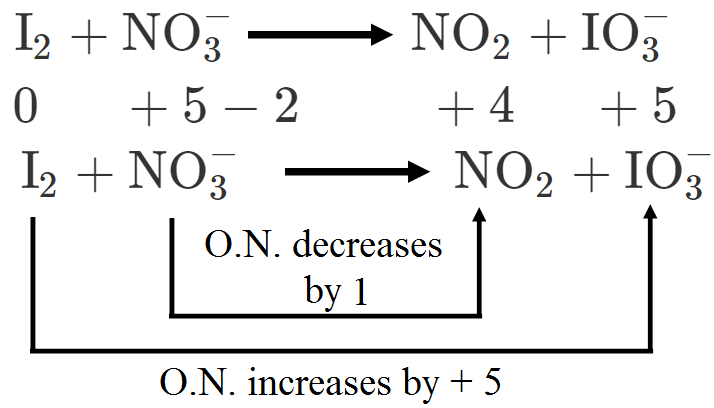
Answer


Total increase in O.N. = 5 × 2 = 10
Total decrease in O.N. = 1
To equalize O.N. multiply $\text{NO}^-_3$, by 10
$\text{I}_2+10\text{NO}^-_3\xrightarrow{ \ \ \ \ \ \ }10\text{NO}_2+\text{IO}^-_3$
Balancing atoms other than O and H
$\text{I}_2+10\text{NO}^-_3\xrightarrow{ \ \ \ \ \ \ \ }10\text{NO}_2+2\text{IO}_3^-$
Balanching O and H
$\text{I}_2+\text{IONO}^-_3+8\text{H}^+\xrightarrow{ \ \ \ \ \ \ \ }10\text{NO}_2+2\text{IO}^-_3+4\text{H}_2\text{O}$

Need a full question paper?

Generate a complete, print-ready paper with questions like this in minutes — across 16+ boards, with answer keys.

Start Generating Free

Similar questions

Give the possible alkyne isomers of molecular formula of $C _5 H _8$.
Do the following conversion in three steps.
Image
Can the following reaction,
$\text{Cr}_{2}\text{O}^{2-}_7 + \text{H}_{2}\text{O}\rightleftharpoons 2\text{CrO}^{2-}_{4} + 2\text{H}^{+}$
be regarded as a redox reaction?
Arrange the following type of radiations in increasing order of frequency:
  1. Radiation from microwave oven.
  2. Amber light from traffic signal.
  3. Radiation from $FM$ radio.
  4. Cosmic rays from outer space and $(e) X-$rays.
Represent a galvanic cell in electrode and ions contain Cu electrode dipped in molar solution of copper sulphate and silver electrode dipped in molar solution of silver nitrate.Given
$\text{E}^\circ_\frac{\text{Cu}^{2+}}{\text{Cu}\text{(s)}}=0.34\text{V}$
$\text{E}^\circ_\frac{\text{Ag}^+}{\text{Ag}\text{(s)}}=0.80\text{V}$
Predict the major products of the following:
1. $CH _3- C \equiv C - Ph \xrightarrow[ H _2 O ]{ Hg ^{2+}, H ^{+}}$
2. $PhCH = CH 2 \xrightarrow{ HBr }$
How many significant figures should be present in the answer of the following calculations?
0.0125 + 0.7864 + 0.0215
Justify that the following reactions are redox reactions:$2K(s) + F_2(g) → 2K^+F^-(s)$
What will be the pH of a mixture of $\frac{ N }{10} HCl$
$
(100 ml)+\frac{N}{2} 20 HNO_3(200 ml)+\frac{M}{60} H_2 SO_4(300 ml) ?
$
The first $(\Delta_{1}\text{H}_{1})$ and the second $(\Delta_{1}\text{H}_{1})$ ionization enthalpies (in $\mathrm{kJ} \mathrm{~mol}^{-1}$ ) and the $(\Delta_{1}\text{H}_{1})$ electron gain enthalpy (in $\mathrm{kJ} \mathrm{~mol}^{-1}$ ) of a few elements are given below:
Elements $\Delta\text{H}_{1}$ $\Delta{\text{H}}_{2}$ $\Delta_{\text{eg}}\text{H}$
I 520 7300 -60
II 419 3051 -48
III 1681 3374 -328
IV 1008 1846 -295
V 2372 5251 +48
VI 738 1451 -40
Which of the above elements is likely to be:
The most reactive metal.